

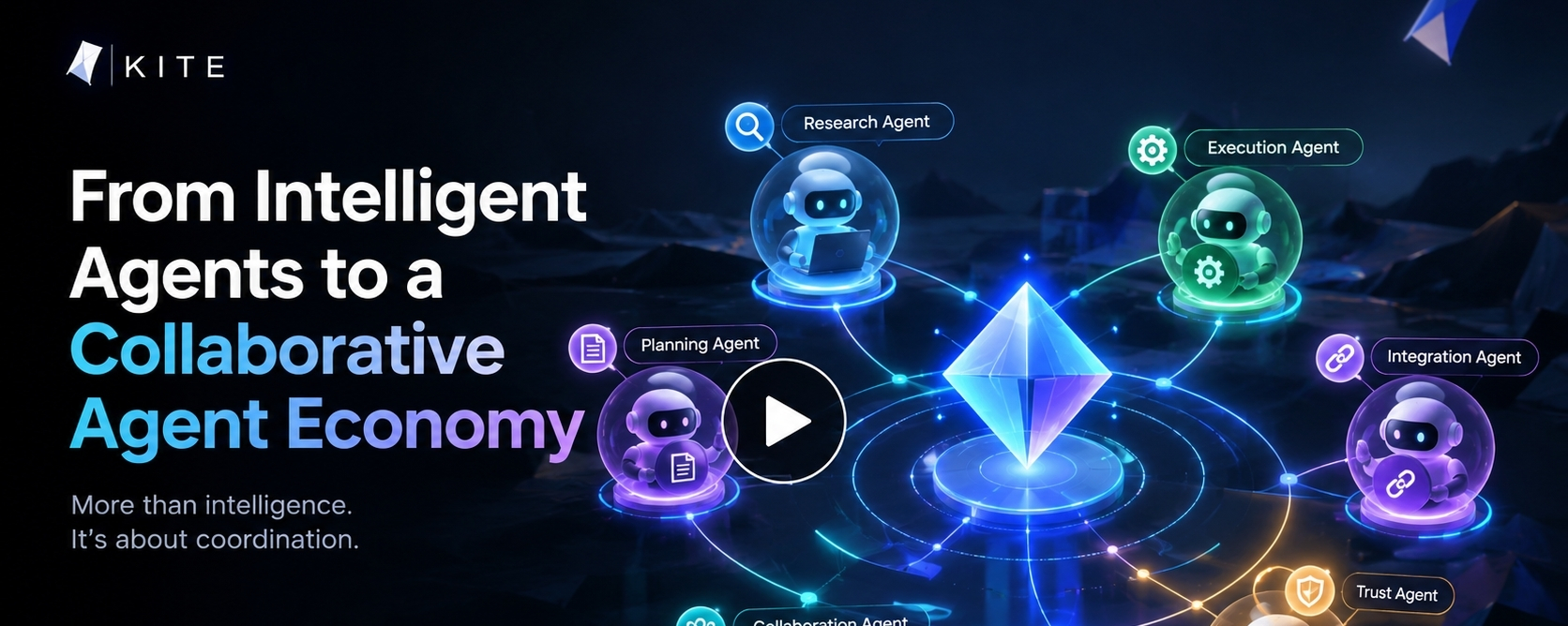

We are entering a phase where AI agents can do more than answer questions. They can potentially research, plan, use tools, and execute multi-step tasks. But a bigger question remains:
How will independent agents discover, coordinate with, and create value alongside one another?
An intelligent agent working in isolation has limits. A connected agent economy raises a different set of challenges: interoperability, reliable execution, coordination, and accountability.
That’s the problem space that makes Kite worth exploring.
Instead of looking at AI agents as standalone assistants, we should ask how infrastructure can help turn individual capabilities into collaborative systems. What happens when agents can participate in workflows that involve multiple tools, services, and other agents?
Of course, making that vision work requires more than a compelling narrative. Real progress must be measured by practical utility, reliability, developer adoption, and how well the system handles failures and trust.
For me, the most interesting question isn't simply how smart an AI agent can become.
It’s how much useful work can agents accomplish together — reliably and transparently?
That is a question worth exploring as the agent economy develops.
What do you think will be the biggest bottleneck for AI agents working together: coordination, trust, interoperability, or real-world utility? 👇