
Bitcoin is entering October with a familiar macro question:
Can falling Treasury yields give risk assets enough breathing room for the next leg higher?
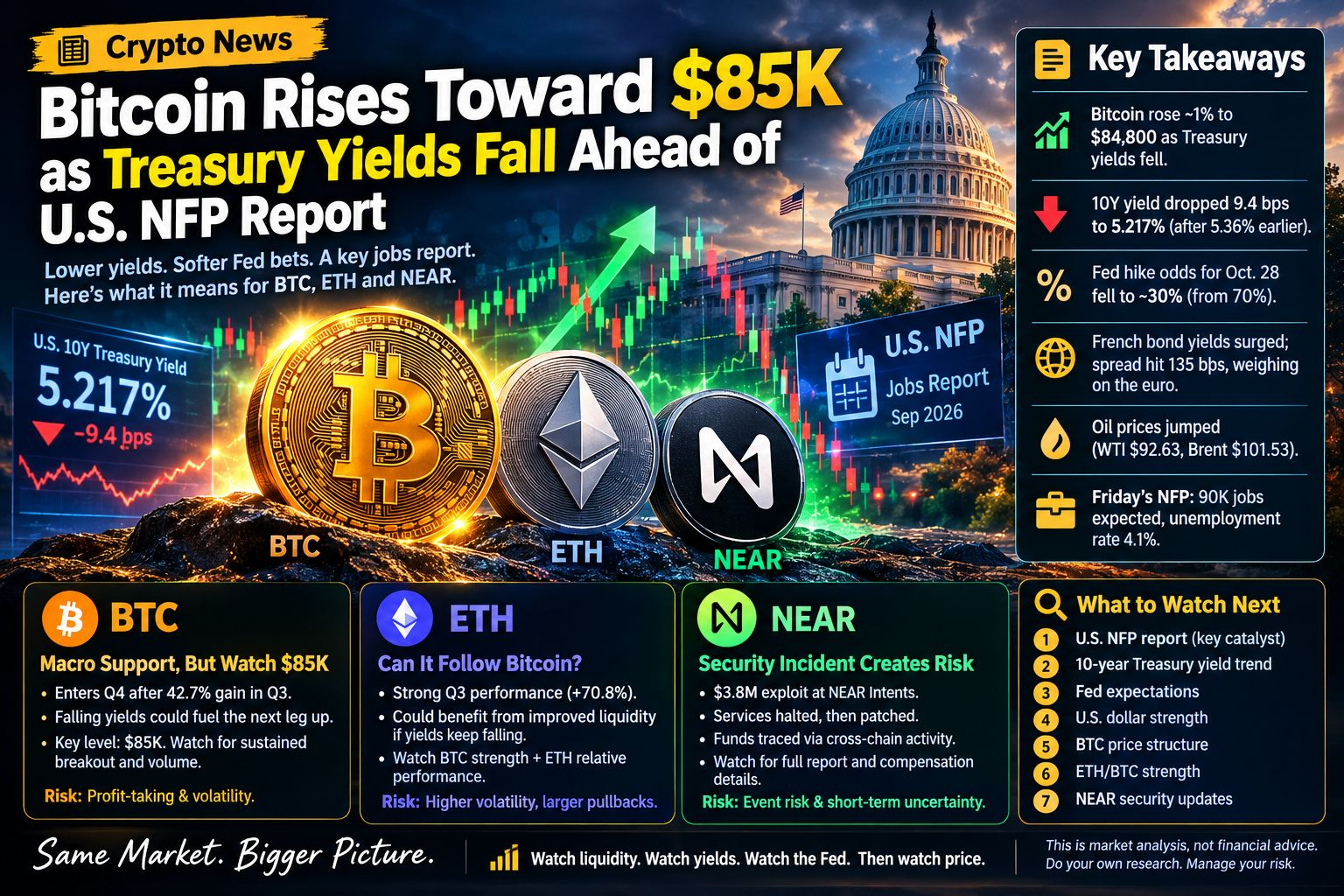
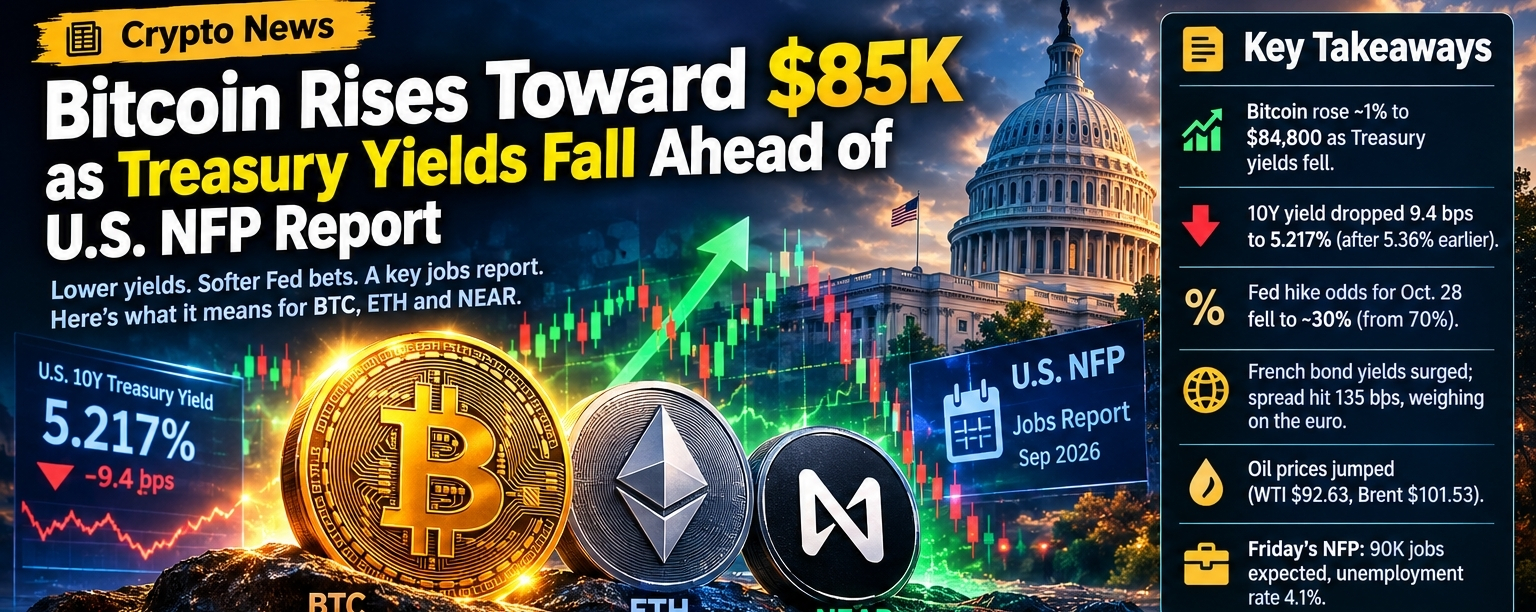
BTC climbed roughly 1% toward the $84,800–$85,000 area as U.S. Treasury yields pulled back sharply from multi-year highs. The move came just before the September U.S. Nonfarm Payrolls report, making Friday’s jobs data one of the most important short-term catalysts for crypto markets.
The bigger story is not simply Bitcoin’s daily move.
It is the changing relationship between Treasury yields, Federal Reserve expectations, the U.S. labor market and global liquidity.
Recent market data shows the 10-year Treasury yield briefly reached around 5.34%, its highest level since 2002, before retreating. At the same time, expectations for an October Fed rate hike dropped dramatically during the week. �
The Wall Street Journal +1
That combination is giving Bitcoin some room to breathe.
📈 Bitcoin’s $85K Area Is Becoming a Macro Battleground
Bitcoin has shown notable resilience despite the enormous rise in bond yields.
After the September Treasury selloff, the 10-year yield pushed above 5.3%, creating pressure across traditional risk assets. Yet $BTC remained in the mid-$80K region.
Now the situation has temporarily shifted.
As Treasury yields moved lower, Bitcoin recovered toward $85K, suggesting that traders are responding not only to crypto-specific developments but also to changes in global financial conditions.
This is important because Bitcoin increasingly trades as a macro-sensitive asset.
When yields rise rapidly, investors can earn more from relatively low-risk government debt, potentially reducing appetite for volatile assets.
When yields fall, that pressure can ease.
So the question for BTC is no longer simply “Are buyers coming back?”
It is:
Can the Treasury-yield reversal continue?
If yields continue falling, the environment could become more supportive for Bitcoin and other risk assets.
If yields reverse higher again, the pressure could return quickly.
🏦 Fed Expectations Have Changed Fast
One of the biggest developments this week has been the rapid repricing of Federal Reserve expectations.
Markets had previously priced a much higher probability of another rate increase at the October 28 meeting. That probability has now fallen sharply, with recent market pricing putting the October hike probability around the mid-to-high 20% range. �
The Wall Street Journal +1
Federal Reserve Vice Chair Philip Jefferson also emphasized the need for policymakers to take additional time to evaluate the changing economic environment.
That matters for crypto because monetary policy expectations can influence:
Fed expectations → Treasury yields → dollar liquidity → risk appetite → Bitcoin/altcoins
This chain reaction can sometimes be more important than a single crypto headline.
But there is a major complication.
Inflation pressures have not completely disappeared.
⚠️ Strong Manufacturing + Higher Prices Create a Complicated Fed Picture
U.S. manufacturing activity remained in expansion territory, while the Prices Paid component jumped sharply.
That creates a difficult situation for the Federal Reserve.
If economic activity remains relatively strong while input prices continue rising, policymakers have less room to aggressively loosen financial conditions.
Therefore, investors should not automatically interpret falling yields as the beginning of a long-term rate-cut cycle.
One market move is not yet a trend.
The next few economic reports will matter.
🇺🇸 Friday’s NFP Report Could Decide the Short-Term Direction
This is where the September Nonfarm Payrolls report becomes extremely important.
Economists have been looking for roughly 90,000 new jobs and an unemployment rate around 4.1%, although forecasts vary considerably. Reuters noted a wide forecast range of roughly 35,000–180,000 jobs, highlighting how large the potential surprise could be. �
Reuters
If jobs come in weaker than expected:
Markets could interpret it as evidence that the labor market is losing momentum.
That could:
Lower Fed-hike expectations → push Treasury yields lower → weaken rate pressure → support BTC and risk assets.
If jobs come in much stronger:
The opposite reaction becomes possible.
A strong labor market could revive expectations that the Fed needs to maintain restrictive policy for longer.
That could push:
Yields higher → dollar stronger → liquidity tighter → pressure on BTC and altcoins.
There is also a middle scenario.
A moderate jobs number could potentially be the most interesting outcome for markets because it would show continued economic activity without dramatically increasing pressure for additional tightening.
🪙 BTC: The Macro Trade Remains Alive
For Bitcoin, the current setup is about more than the $85K level.
BTC is entering Q4 after an exceptionally strong Q3, according to the figures in the supplied market data, with Bitcoin gaining around 42.7% during the quarter.
That creates two opposing forces.
Bullish factor:
Falling Treasury yields and reduced expectations for another immediate Fed hike could improve the macro environment.
Risk factor:
Bitcoin has already experienced a powerful quarterly advance, meaning traders may become more sensitive to profit-taking, leverage and negative macro surprises.
Therefore, chasing a breakout simply because BTC approaches $85K may not be the most important consideration.
The reaction after the breakout matters more than the breakout itself.
A sustained move above resistance with strong spot demand would tell a different story from a temporary spike followed by heavy selling.
💎 ETH: Can Ethereum Follow Bitcoin’s Macro Recovery?
Ethereum enters Q4 with even stronger recent momentum.
The supplied data shows $ETH gained approximately 70.8% in Q3, its strongest quarterly advance since Q1 2021.
That makes ETH particularly interesting if liquidity conditions improve.
If Treasury yields continue declining and Bitcoin maintains its structure, capital can potentially rotate further into higher-beta crypto assets.
But there is another side.
ETH’s stronger previous performance also means expectations are higher. If macro conditions suddenly deteriorate, higher-beta assets can experience larger pullbacks than Bitcoin.
For ETH, I would therefore watch three things closely:
BTC stability + Treasury yields + ETH relative strength
If Bitcoin holds while yields decline and ETH begins outperforming BTC again, that would indicate stronger risk appetite across the crypto market.
🚨 $NEAR : A Completely Different Risk Story
While BTC and ETH are being driven primarily by macro conditions, NEAR is dealing with a crypto-specific security issue.
NEAR Intents suffered a reported $3.8 million exploit, forcing the platform to halt services while the vulnerability was patched. The team said affected users would be compensated in full. �
Cointelegraph +1
This is an important distinction for investors.
A macro-driven BTC pullback and a protocol-specific security event are not the same type of risk.
The NEAR situation highlights why investors should examine the infrastructure behind a token rather than looking only at price charts.
For NEAR, the important questions now are:
How exactly did the vulnerability occur?
Has the vulnerability been completely fixed?
Are all affected services operating normally?
How will compensation be handled?
What does the full post-incident report reveal?
Does the incident affect confidence in NEAR Intents adoption?
Until more technical details are published, NEAR should be treated as a higher event-risk trade compared with simply following the broader BTC macro trend.
Recent reporting also says the stolen funds were traced through cross-chain activity toward Bitcoin, while the investigation remains ongoing. �
PrimeXBT +1
🌍 Europe and Oil Add Another Layer of Risk
Crypto traders also cannot ignore the broader global environment.
French government bond yields have risen relative to German Bunds, widening the French-German spread to levels not seen in years. At the same time, geopolitical tensions and higher oil prices are keeping inflation risks elevated.
This creates an unusual combination:
Higher oil + higher bond yields + fiscal concerns = potentially tighter global financial conditions.
That is important because Bitcoin may benefit from easier liquidity, but could struggle if global yields continue climbing.
Recent Reuters coverage described the Treasury market reaching a 24-year yield high while European bond-market concerns and dollar strength remained important factors for investors. �
Reuters
🔍 What I’m Watching Now
For the next few sessions, I would focus less on individual headlines and more on the interaction between these indicators:
1️⃣ U.S. NFP
The immediate catalyst.
2️⃣ 10-Year Treasury Yield
A sustained move lower could improve the environment for risk assets.
3️⃣ Federal Reserve Expectations
Watch whether markets continue reducing expectations for additional tightening.
4️⃣ U.S. Dollar
A stronger dollar can create additional pressure on global risk assets.
5️⃣ BTC Price Structure
Watch whether Bitcoin can build acceptance above the mid-$80K area rather than simply wick above it.
6️⃣ ETH/BTC Strength
This can help reveal whether capital is beginning to rotate deeper into crypto.
7️⃣ NEAR Security Updates
For NEAR specifically, technical remediation and transparency are more important than short-term hype.
🧠 The Bigger Investment Picture
The most interesting part of this market is that crypto is increasingly becoming a reflection of the global liquidity cycle.
Bitcoin can rally when yields fall.
Ethereum can accelerate when risk appetite expands.
Altcoins can outperform when liquidity moves further down the risk curve.
But the opposite is also true.
If Treasury yields return toward recent highs, the dollar strengthens and the Fed becomes more hawkish, crypto could face another wave of volatility.
That is why investors should avoid treating one green candle as confirmation of a new bull leg.
Watch liquidity. Watch yields. Watch the Fed. Then watch price.
🚀 Final Takeaway
Bitcoin approaching $85K is important, but the real catalyst is sitting outside the crypto market.
Friday’s NFP report could influence Treasury yields, Fed expectations and the dollar — and those factors could ultimately determine whether BTC can extend its recovery.
For BTC, the key question is whether falling yields become a sustained trend.
For ETH, the question is whether improving liquidity can support continued relative strength after its powerful Q3 performance.
For NEAR, the focus is different: security, remediation and confidence after the $3.8M NEAR Intents exploit.
The crypto market may be entering Q4 with strong momentum, but the next move will likely be decided by the battle between economic growth, inflation, interest rates and liquidity.
No FOMO. No blind leverage. Let the data confirm the trend.