


167 traders already voted on whether this is a risk-off signal. Here's how to actually read it.
🚀 While most crypto traders were watching charts, the bond market quietly hit a level it hasn't touched in over two decades.
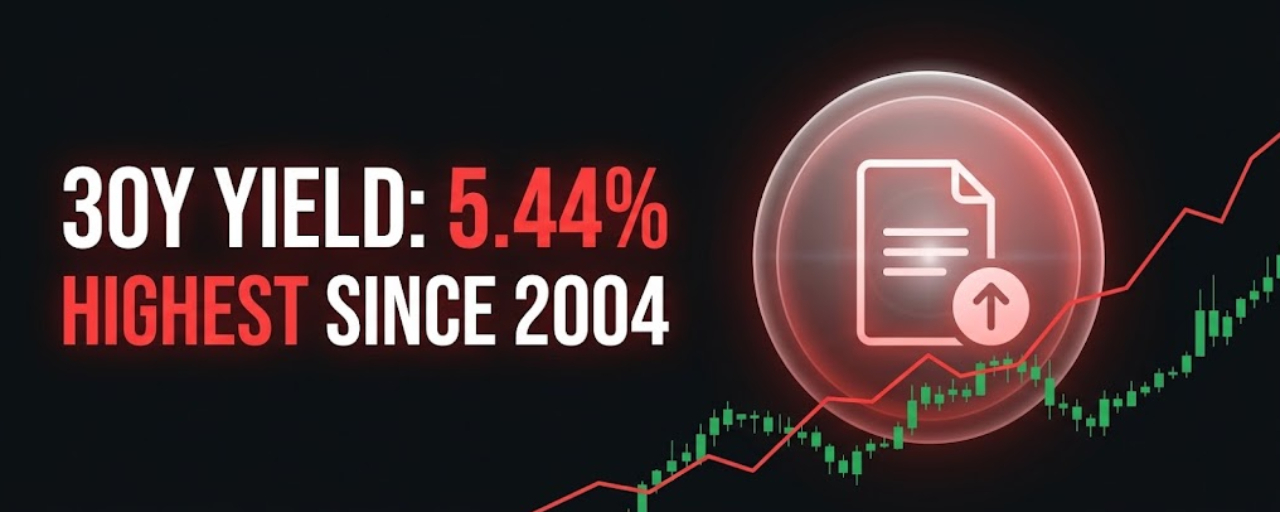
The 30-year US Treasury yield climbed as much as four basis points on Thursday to 5.44%, the highest since 2004. It's not an isolated spike either, yields across nearly every maturity are sitting near their highest levels since 2007. One portfolio manager summed up the mood bluntly: people are running out of superlatives for how high the 30-year yield has gotten.
🗳️ Binance Square's own community is already split on what it means.
A live poll attached to the story has pulled in 167 votes, asking whether this counts as a crypto risk-off signal. The options range from "yes, I'm hedging now" to "I see a buying chance," and the spread of answers tells you something important on its own, there's no consensus, even among people actively trading through it.
🧠 Why is this happening, and why does it matter beyond one headline number?
Rising long-term yields usually mean investors are demanding more compensation to lock up their money for decades, and that demand is being driven by a mix of persistent inflation, elevated energy prices (Brent crude jumped right before this latest leg up), and heavier government borrowing. The Treasury Department has tried to ease the pressure, Secretary Scott Bessent expanded the bond buyback program back in August specifically to bring long-term borrowing costs down, but it's had little sustained impact. This isn't a one-day story. It's a slow, months-long repricing of what long-term debt actually costs, and it's happening while the market tries to figure out whether crypto still moves with traditional rate-sensitive assets or has started trading on its own logic.
🔐 So does a rising 30-year yield actually predict what Bitcoin or altcoins do next?
Historically, the relationship is real but inconsistent. Higher yields can pull capital toward safer, income-generating assets and away from speculative ones, that's the textbook risk-off mechanism. But crypto has decoupled from that pattern during stretches before, particularly when a strong enough narrative (an ETF, a regulatory shift, a specific catalyst) was pulling capital in regardless of what bonds were doing. The honest answer is that yields matter, but they're one input among several, not a standalone crystal ball.
✅ What this means for you
If you're holding crypto, this is a moment to watch correlation, not predict it. Track whether your positions actually move with bond market stress over the next couple weeks, that tells you more about the current relationship than any single data point or poll result.
If you're on the sidelines, resist the urge to treat a 30-year yield headline as a trading signal on its own. It's context, useful for understanding the broader mood, but crypto-specific catalysts (ETF flows, on-chain whale activity, protocol news) have repeatedly mattered more for near-term price action than macro-headlines alone.
If you're building a habit of reading markets holistically, this is a good moment to practice it, watch whether the assets that are supposed to be most rate-sensitive (large caps, majors) behave differently than the ones running on pure narrative (privacy coins, new listings). That divergence, if it shows up, tells you a lot about where we actually are in this cycle.
🟢 Bullish scenario
Crypto continues showing resilience or even outperformance despite the yield spike, strengthening the case that digital assets are becoming less tethered to traditional rate cycles, and the "buying chance" voters end up looking early rather than wrong.
🔴 Risk scenario
The yield selloff deepens further, broader risk appetite tightens across every asset class, and crypto eventually follows equities and other risk assets lower, validating the "hedge now" side of the poll.
👀 Three things to watch
1️⃣ Whether the 30-year yield keeps climbing
Does 5.44% mark a near-term ceiling, or does the selloff extend further as inflation and borrowing concerns persist?
2️⃣ How crypto actually trades over the next 1-2 weeks
Does price action track bond market stress closely, or does it move independently on its own catalysts?
3️⃣ Whether the Treasury's buyback program gains traction
Does expanded buying start to meaningfully slow the yield climb, or does it remain a limited tool against a bigger structural trend?
💡 The key takeaway
A 20-year high in long-term yields is a real, structural story, not noise. But the community's own 167-vote split shows that even active traders don't agree on what it means for crypto specifically, and that disagreement is honestly the more useful signal than the yield number itself.
The real question isn't whether 5.44% is high, it clearly is. It's whether crypto has genuinely started writing its own rules, or whether this is simply a lag before the broader risk-off mood catches up.
That is the part worth watching.
This post is for informational and educational purposes only and is not financial advice. Crypto markets are volatile. Always conduct your own research before making financial decisions.
#BinanceSquare #Macro #Bitcoin #Crypto #Bonds
