
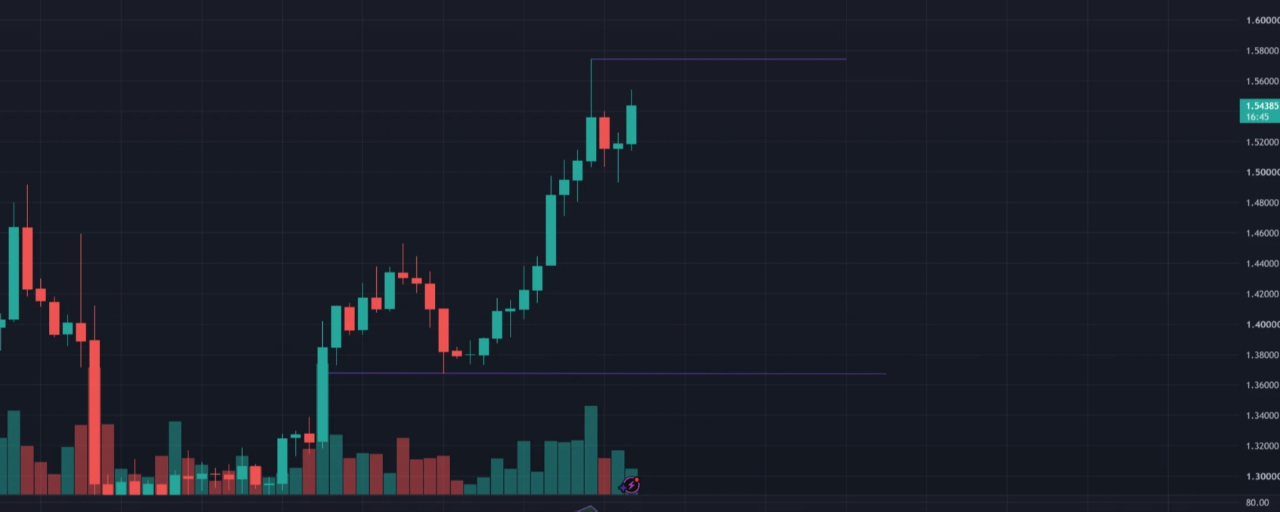

What caught my attention with XRP is not just the recovery from $1.39.
It is the fact that buyers are now fighting the same level that stopped the first attempt.
XRP recovered through $1.40 and pushed toward $1.55 before sellers stepped in. The pullback only reached around $1.52 before buyers recovered most of the move.
That creates an interesting short term structure.
XRP has formed a higher low around the recent reaction area and is now testing $1.55 again.
But there is another detail I would not ignore.
XRP reserves on Binance have climbed toward roughly 2.68B compared with around 2.55B during the summer decline.
At first glance rising exchange reserves can look bearish because more tokens are immediately available for trading.
But the flow data gives a more complicated picture.
Daily XRP deposits have been running far above the quarterly baseline during active sessions. At the same time withdrawals have been strong enough to offset much of that inflow.
Net flows have also recently turned negative.
So I would not interpret the reserve increase as automatic selling pressure.
It looks more like a market with heavy two way positioning.
That distinction matters because XRP is now sitting directly below a technical resistance level.
For me the clean signal is $1.55.
A decisive daily close above it would show that buyers have finally absorbed the supply that rejected the previous attempt.
Then I would watch whether $1.55 can become support instead of immediately turning back into resistance.
If XRP fails again then $1.52 becomes the first short term level I would watch.
Below that the original recovery zone around $1.40 becomes much more important.
The interesting part is that exchange reserves are rising while net flows are not showing clear accumulation or distribution.
So the market is active.
But the direction still needs confirmation.
XRP does not need another huge move right now.
It needs to prove that $1.55 can be broken and held.
That is the level I would watch more closely than the size of the rebound itself.