
#southafricaproposescryptoexchangecontrols
🇿🇦 A Borderless Asset Meets a 1961 Rulebook
Crypto was built to move across borders without asking permission. South Africa's regulators are now trying to bring it firmly back inside a permission-based system.
What's happening:
The South African Reserve Bank's Financial Surveillance division, together with National Treasury, has proposed a major overhaul of the country's decades-old exchange control regime — including the first formal attempt to bring crypto assets and stablecoins into that framework.
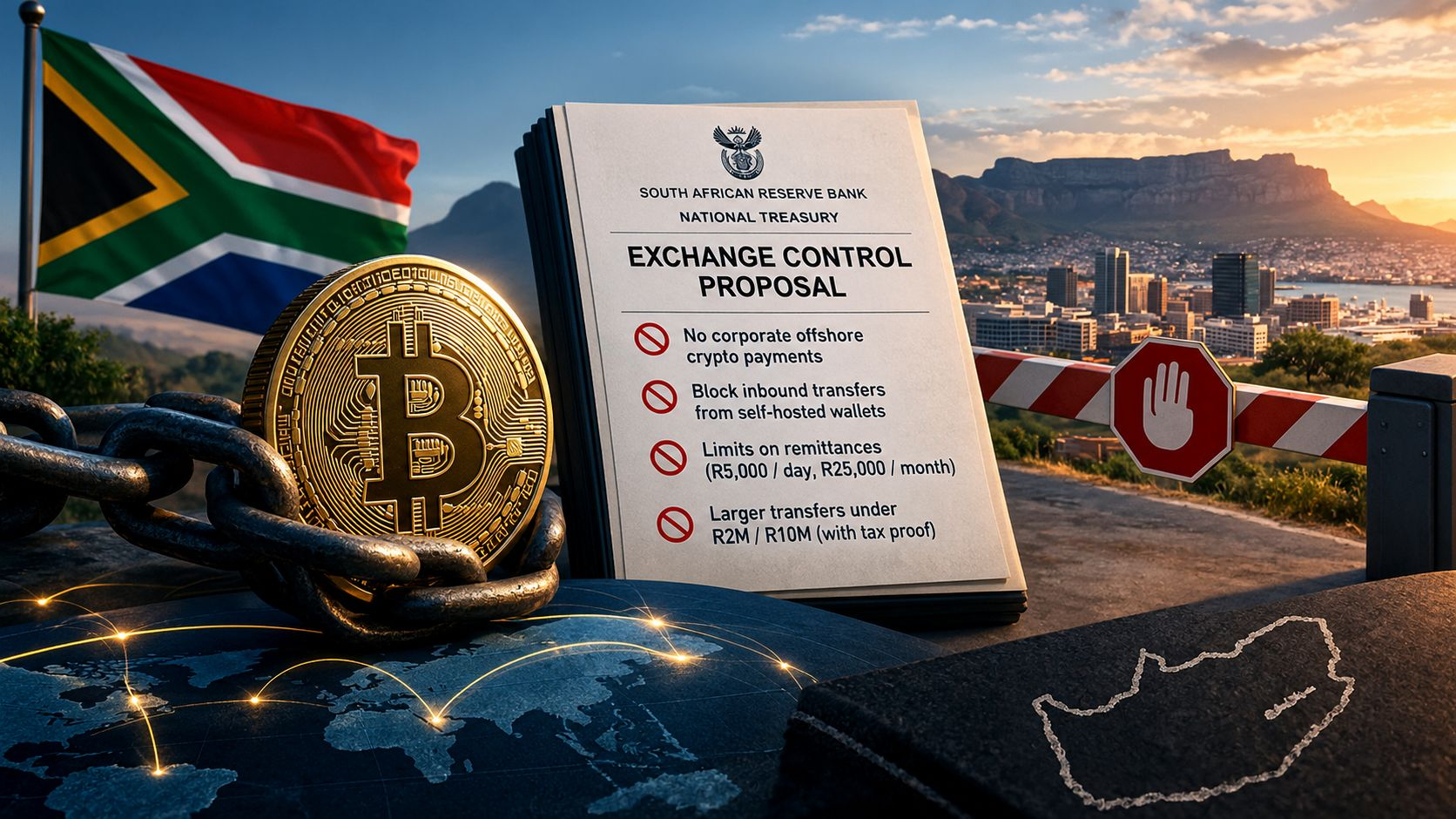
Under the draft rules, companies would be prohibited from using crypto or stablecoins for offshore receipts or payments, while inbound transfers from self-hosted wallets would be blocked outright.
Individuals could still send crypto to self-hosted wallets abroad, but those transfers would automatically be treated as offshore capital movements and become subject to existing exchange-control limits, even when the funds are ultimately intended for domestic use.
Smaller remittance-style transactions through licensed local crypto platforms would be capped at R5,000 ($308) per day and R25,000 ($1,540) per month.
Larger transfers could fall under a R2 million annual discretionary allowance, rising to R10 million with proof of tax compliance.
The proposal follows a South African court ruling last year that crypto assets do not currently qualify as "currency" under existing exchange-control law, leaving a regulatory gap the new rules are designed to close.
Public comment is open until the end of September.
Why it matters:
South Africa has relatively high crypto adoption, with digital assets used for trading, remittances and cross-border value transfers outside traditional banking channels.
That is also why the proposal has triggered pushback.
A coalition of major local exchanges and industry figures has warned that restricting corporate cross-border crypto transfers could push activity toward unregulated channels rather than eliminate it. Industry representatives have also said billions of rand in potential investment are waiting for greater regulatory clarity.
Some banking figures, meanwhile, have welcomed the proposal as a long-overdue attempt to establish clearer rules, describing it as an initial framework that could still be adjusted.
The bigger issue goes beyond South Africa.
Regulators are increasingly trying to apply traditional capital-control systems to assets that were designed to move globally with far fewer intermediaries.
Something to sit with:
Does South Africa ultimately find a workable balance between oversight and innovation, or does industry pressure lead to significant changes before the rules are finalized?
The final version could offer an interesting signal for how other emerging markets approach the same problem.