
#vietnamplansfirstcryptolicensesin2026
Vietnam Crypto Exchange Licenses: The Race for the First Approval
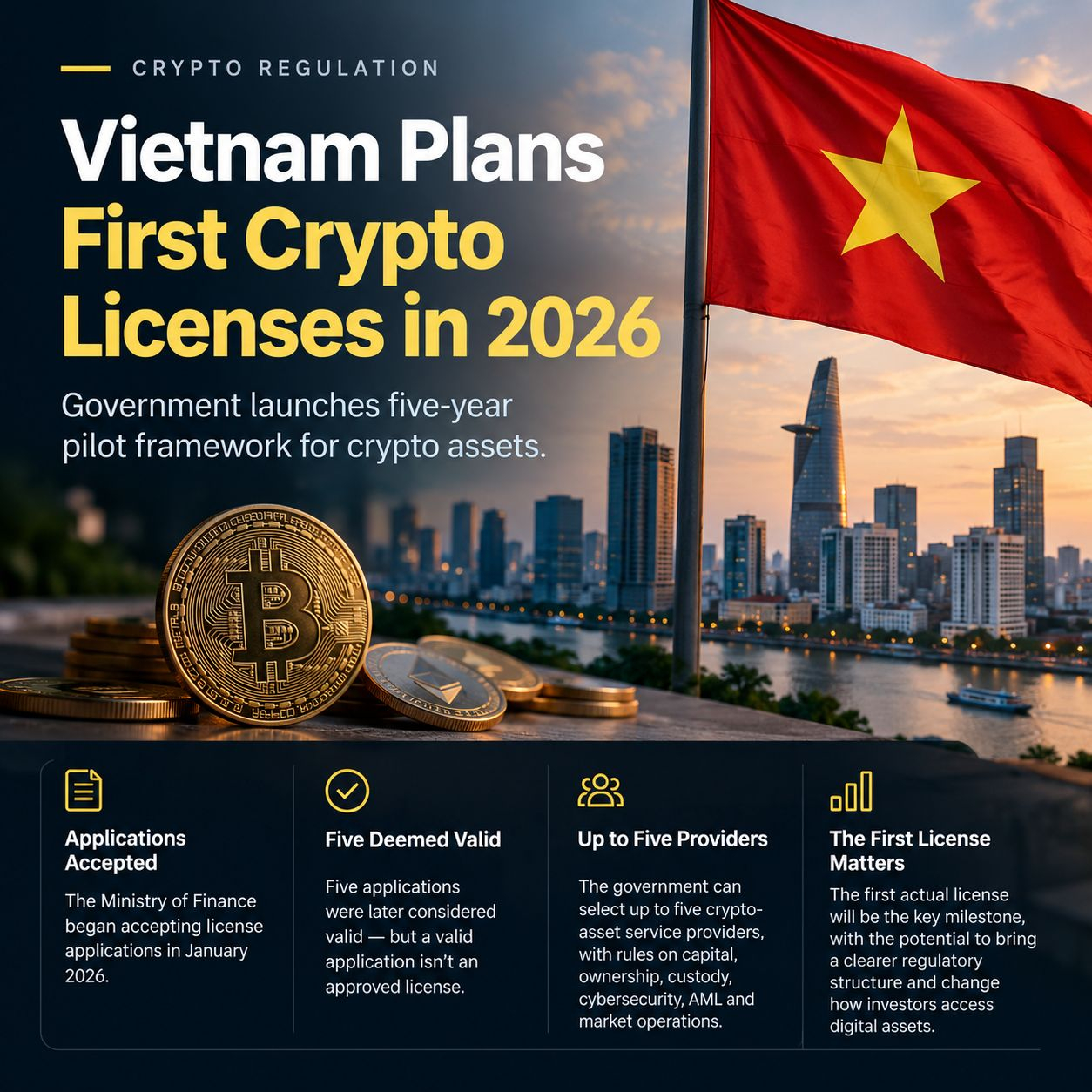
Vietnam is moving into a new phase of crypto regulation as the country works toward establishing its first locally licensed crypto-asset service providers.
The shift follows the government's decision to create a five-year pilot framework for Vietnam's crypto-asset market under Resolution 05/2025/NQ-CP, which took effect in September 2025. The framework establishes a formal regulatory structure for crypto-asset trading and related services rather than leaving the market primarily dependent on overseas platforms.
But there is an important detail that can easily get lost in the headlines:
Vietnam has applicants. It does not yet have a licensed crypto exchange.
Five applications passed the initial review
The Ministry of Finance has been processing applications from companies seeking permission to provide crypto-asset market services.
By March 2026, five applications had passed an initial qualification or validity review. Reuters reported that the applicants included companies connected to Techcombank, VPBank, LPBank, VIX Securities and Sun Group.
Other reporting has identified five applications assessed as valid during the Ministry of Finance's review.
However, passing an initial review is not the same as receiving a final operating license.
The distinction matters because the pilot framework gives the government the ability to select a limited number of crypto-asset service providers, while applicants still have to satisfy the relevant regulatory requirements.
What the licensing framework requires
Vietnam's pilot framework is designed around a more controlled market structure.
Applicants face requirements covering areas such as capital, ownership structure, custody, cybersecurity, anti-money-laundering controls and market operations.
That means the licensing process isn't simply about creating a local exchange website and opening deposits.
The government is effectively building a regulated market infrastructure around crypto trading, with licensed service providers expected to operate within defined requirements.
This could also change the relationship between Vietnamese crypto users and international exchanges.
Why the first license matters
Vietnam already has an active crypto market, with many users historically relying on international exchanges.
Reuters reported in March that Vietnamese traders had conducted more than $200 billion in crypto transactions during the year leading to June, highlighting the size of the market the government is attempting to bring under a more formal framework.
The regulatory direction has since become even clearer.
Decree 284, which took effect on September 1, introduced administrative penalties related to crypto-asset trading. Vietnamese reporting says domestic investors trading through platforms that aren't licensed under the new framework can face penalties, while no local crypto exchange had yet received a license at the time of the latest reports.
That creates an unusual situation: the rules are moving ahead while the local licensing process is still being completed.
For the market, the first final license therefore carries more significance than simply adding another exchange.
It would demonstrate that Vietnam's new regulatory framework has moved from legislation and applications into actual regulated market operations.
International exchanges are also watching
The transition could have consequences for global exchanges that currently serve Vietnamese users.
VietnamNet reported that Binance had taken steps related to its Vietnam operations, including advertising for a country general manager position, while OKX announced a strategic investment in a Vietnamese digital-asset exchange project.
These developments don't establish how every international exchange will respond to Vietnam's new rules, but they show that major industry players are paying attention to the country's regulatory transition.
The bigger question is how the market will look once the licensing process is complete.
Will local exchanges attract significant trading activity? How will liquidity compare with established global platforms? And how quickly will the regulatory framework evolve after the pilot begins operating in practice?
Those questions remain open.
What crypto traders should watch
For traders, the most important milestone isn't simply the number of applications.
It's the first actual license issuance.
That event would provide a clearer signal that Vietnam's pilot market is operational and would give market participants more information about which companies have successfully met the government's requirements.
After that, attention is likely to shift toward practical issues such as exchange liquidity, custody standards, compliance, access for local users and how international platforms adapt to the new environment.
Vietnam's crypto market is therefore moving beyond the discussion stage.
The licensing process is underway. The first final approval is the milestone that remains to be reached.