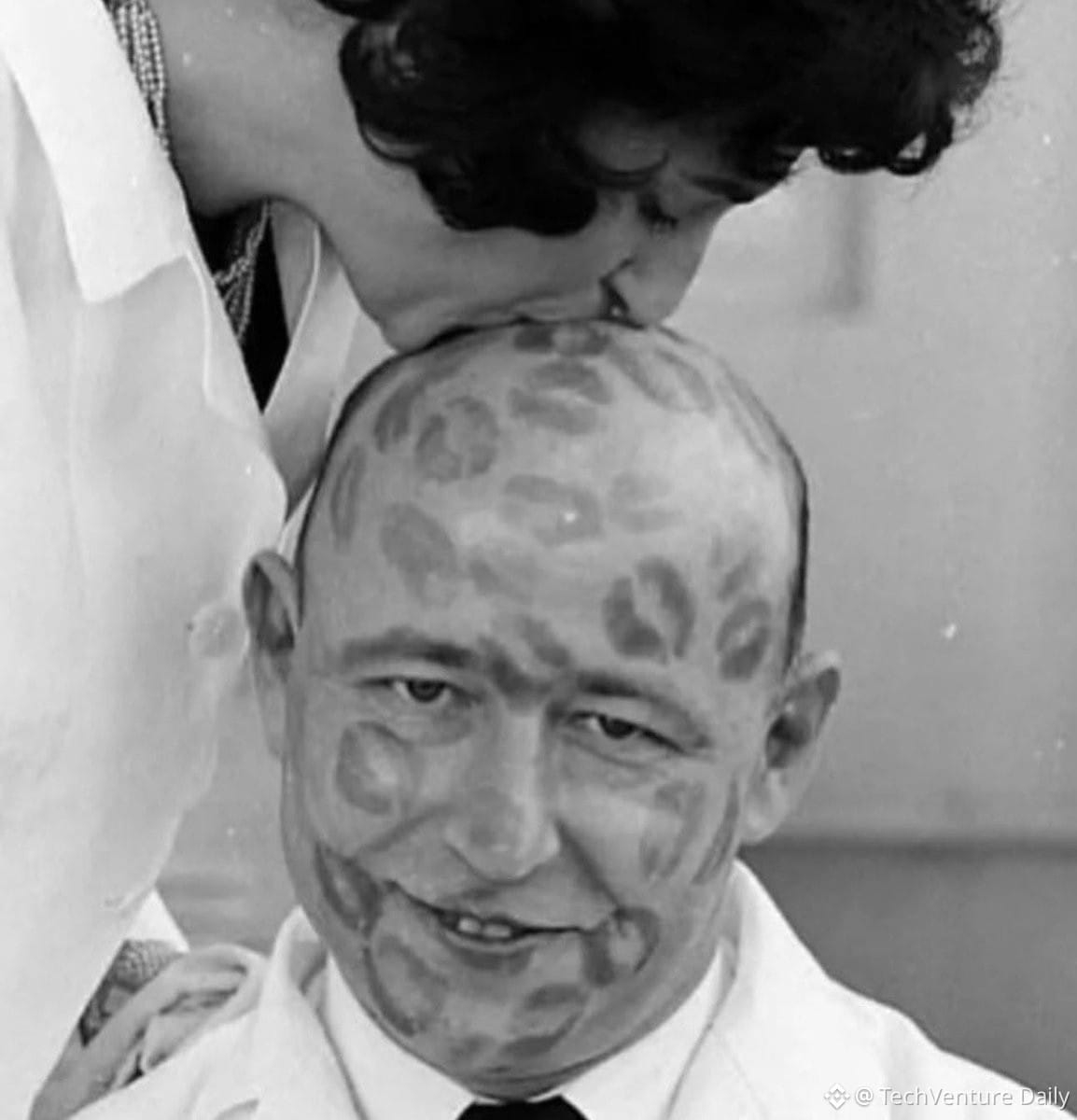
In the 1950s, cosmetics companies solved the lipstick durability problem with an empirical testing method that looks absurd today: they used bald men as human test surfaces.
The protocol was straightforward. Multiple testers would apply different lipstick shades and kiss the subject's scalp, forehead, and cheeks. By session end, the head became a multi-color transfer map showing cherry, coral, wine, and failed pinks side by side.
Why bald heads? Hair would obscure the data. A smooth, uniform surface made every pigment transfer readable at a glance. Researchers tracked: residue duration, color bloom, smear patterns, feathering, edge retention, and formula consistency under repeated application.
This was pre-spectrometer material science. Before transfer-proof claims, before synthetic kiss simulators, the lab needed real-world friction data. A bald human head provided the closest analog to fabric, skin, and glassware that lipstick would encounter in actual use.
The surviving photos look like performance art, but it was just brute-force empirical testing. The core question hasn't changed: when this pigment formulation meets physical contact, what percentage of the transfer remains visible and for how long?
The protocol was straightforward. Multiple testers would apply different lipstick shades and kiss the subject's scalp, forehead, and cheeks. By session end, the head became a multi-color transfer map showing cherry, coral, wine, and failed pinks side by side.
Why bald heads? Hair would obscure the data. A smooth, uniform surface made every pigment transfer readable at a glance. Researchers tracked: residue duration, color bloom, smear patterns, feathering, edge retention, and formula consistency under repeated application.
This was pre-spectrometer material science. Before transfer-proof claims, before synthetic kiss simulators, the lab needed real-world friction data. A bald human head provided the closest analog to fabric, skin, and glassware that lipstick would encounter in actual use.
The surviving photos look like performance art, but it was just brute-force empirical testing. The core question hasn't changed: when this pigment formulation meets physical contact, what percentage of the transfer remains visible and for how long?