

Saudi Arabia is learning a lesson that money and American weapons could never erase: you cannot buy your way out of geography.
For years, Riyadh behaved as though its oil wealth and its alliance with Washington made it immune to the consequences of its regional policies.
It accumulated weapons, hosted foreign forces and poured billions into military adventures while treating Iran as an enemy to be contained.
Now the bill has arrived.
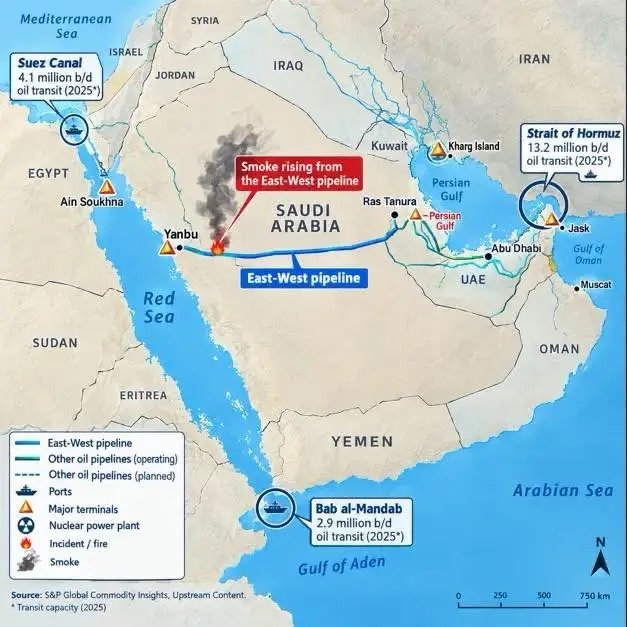
With the Strait of Hormuz effectively strangled and the kingdom’s vital East-West oil pipeline to the Red Sea disrupted, Saudi Arabia’s ability to move its most valuable commodity has been severely compromised.
The kingdom can possess some of the world’s largest oil reserves, but reserves sitting underground do not pay the bills.
Oil has to reach the market.
And suddenly, the country that imagined itself the dominant power of the Gulf may have to knock on Tehran’s door.
That is the bitter irony.
Iran, the state Saudi Arabia spent years trying to isolate and contain, now possesses enormous leverage over the regional environment in which Saudi Arabia must operate.
If Riyadh wants relief, it may have to negotiate with Tehran,and Tehran will not be doing favors out of charity.
Iran will demand a price.
It will demand political concessions. Security guarantees.
Changes in Saudi regional policy.
An end to support for hostile operations.
Whatever the final bargain looks like, one thing should be obvious: Saudi Arabia will be negotiating from weakness, not strength.
And what of the United States?
The American military presence has not prevented this strategic nightmare. Billions spent on weapons and decades of dependence on Washington have not abolished the vulnerability created by geography.
American bases cannot make the Strait of Hormuz disappear.
They cannot permanently protect every pipeline.
They cannot manufacture a stable regional order through military force.
So perhaps it is time for Riyadh to ask the question it has avoided for generations:
Why should Saudi Arabia continue hosting US military forces when those forces have failed to provide the strategic security they promised?
The answer should be a complete rethink.
Get rid of the permanent American military footprint.
Stop treating the Gulf as an arena for American-Iranian confrontation.
Stop imagining that endless weapons purchases constitute a foreign policy. And start negotiating directly with the countries that Saudi Arabia actually has to live beside.
Because Iran is not going away.
Iraq is not going away.
Yemen is not going away.
The Gulf is not going away.
Washington can send aircraft carriers.
It can deploy troops.
It can sell another hundred billion dollars of weapons.
But it cannot change the map.
Saudi Arabia's real security will ultimately have to come from diplomacy, regional arrangements and mutually understood limits,not from renting an American shield while antagonizing its neighbors.
The age of assuming that Washington will solve every Saudi security problem is over.
If Riyadh now has to negotiate with Tehran, it should negotiate seriously.
And if that means paying a steep price for years of strategic miscalculation, perhaps that is precisely the point.
Sometimes the price of avoiding diplomacy is eventually having to negotiate from your knees.