


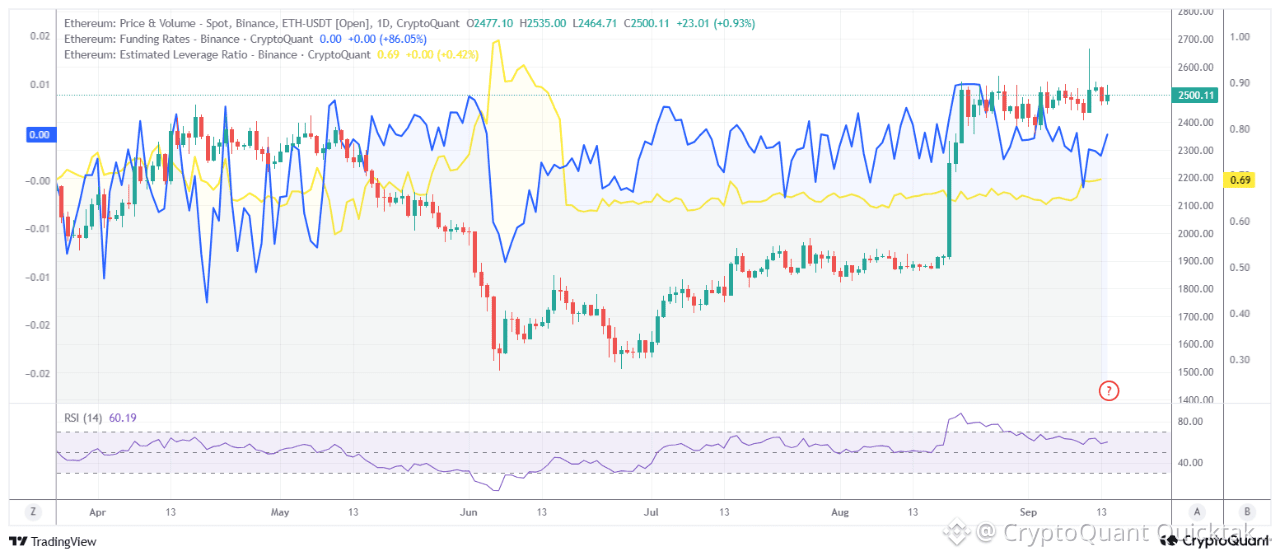
Ethereum’s latest close is around $2,500, while the intraday range is 2,464-$2,535. Following the strong breakout at the end of August, price has been consolidating sideways within the $2,400–$2,550 range. At this stage, there is a sideways outlook after a sharp rise.
The funding rate is very close to zero. This is important because the long side is not overly crowded in the futures market; therefore, the risk of sudden downward pressure caused by long liquidations while the price rises is quite low. With positive funding, longs pay shorts; funding remaining close to zero indicates that the rise has not been excessively inflated by leverage.
The estimated leverage ratio is at 0.69 and has been rising slightly in recent weeks, but it remains far from the approximately 1.00 peak seen in June. In other words, appetite for leverage is increasing, but it has not yet reached the historical extreme zone shown on the chart. This leaves room for an upward move, while also increasing liquidation risk in a reversal if leverage continues to rise.
The RSI is at 60.19, indicating neither overbought conditions nor weak momentum. Its pullback from above 80 the overbought level reached at the end of August is positive; as the price remains sideways and RSI cools off, technical room is created for a new upward attempt.
In the main scenario, buyers retain the advantage as long as daily closes remain above the $2,400-$2,450 range. In this case, the $2,535-$2,550 resistance zone may be targeted first, followed by the $2,650-$2,700 range, where the previous sharp wick is located. If funding remains low and the price strengthens above $2,550, the breakout would be healthier because the move would be spot driven.
However, due to expectations of an interest rate hike on the US side this week, I see a higher probability of the FVG structure extending down to $1,900 being filled.
Written by PelinayPA