


The Case for XVS at $200
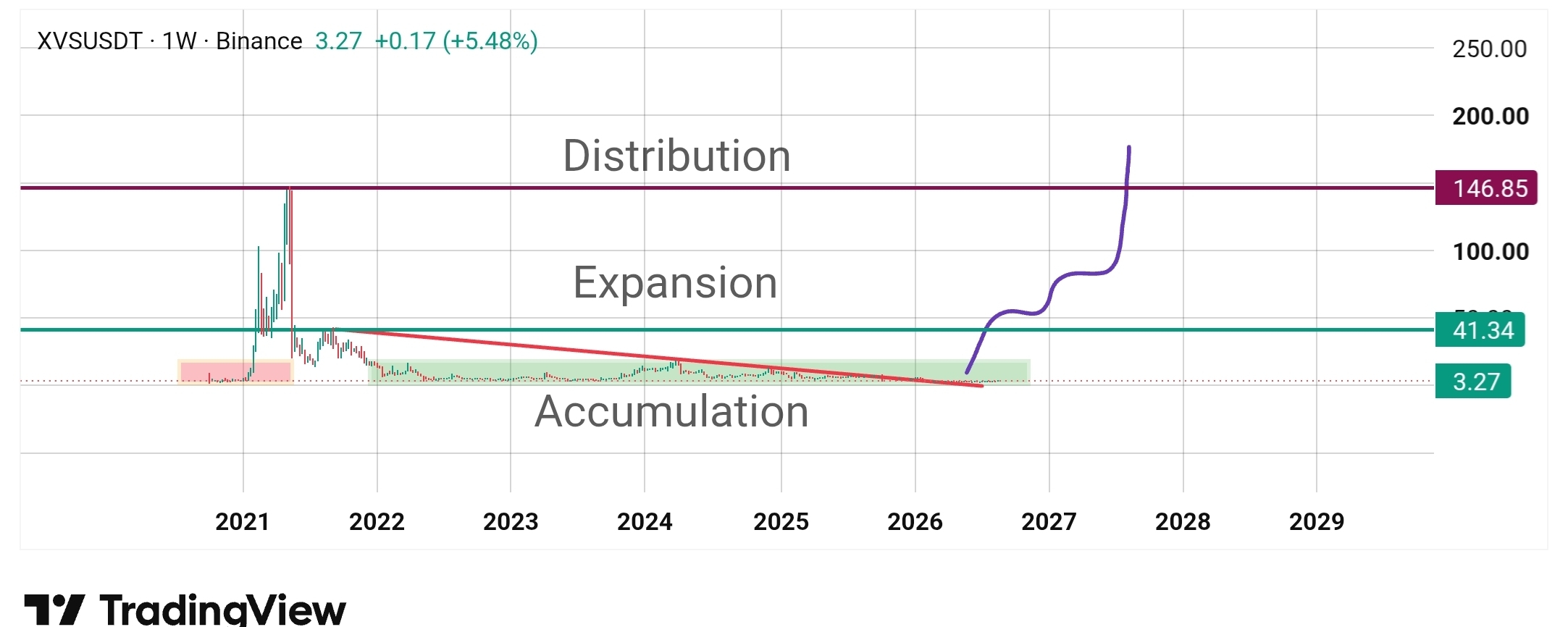
XVS is about $3.16. Market cap is about $52 million. There are roughly 16.4 million coins circulating, and 30 million at full supply. The old high was $147 in May 2021.
$200 is not a small bounce. It is about a 63x from here. Circulating market cap at $200 would be about $3.3 billion. Fully diluted, about $6 billion.
That sounds insane until you look at what the protocol already holds.
In July 2026, Venus’s BNB Chain core pool had about $1.41 billion supplied and $380 million borrowed. BTC and BNB collateral alone were hundreds of millions. USDT on Venus is still a major borrow market, with utilization recently near 67%. The token that governs this machine is worth fifty million dollars. That is the mismatch.
Markets do not stay this wrong forever in a risk-on cycle. They either kill the protocol or they re-rate the token. Venus is not dead. So the open question is only how far the re-rate can go.
1. The business is already big enough
A lending protocol with more than a billion in deposits is not a meme. It is infrastructure.
People are not depositing that much for a screenshot. They deposit BTCB, BNB, liquid BTC wrappers, ETH, and stables because Venus is still the default money market on BNB Chain. That chain is where a huge share of retail crypto actually lives. If BNB Chain activity comes back in a bull market, Venus is the on-ramp for leverage and yield. The token does not need a new invention. It needs the market to notice the old one.
Compare the multiple. Aave runs a much bigger book and still carries a multi billion token. Venus does not need to catch Aave. It needs the market to stop valuing a billion dollar lender at a 0.04 market-cap-to-TVL ratio. Even a move toward a more normal DeFi multiple puts XVS in a different universe than $3.
2. The coin already proved it can go vertical
In 2021, with fewer coins out, less product, and no institutional vaults, XVS went to $147.
Today there is more supply, so the same price needs a bigger market cap. That is the honest objection. The honest reply is that crypto does not price tokens on last cycle’s float. It prices them on narrative plus scarcity plus attention. When that hits a small liquid cap, price does the violent work.
$200 is not “return to the old high.” It is a new high. That is the stretch. It is also how crypto cycle tops work. They overshoot the last memory. If Venus is still the BNB Chain lender when that tape arrives, $147 is the floor of the dream, not the ceiling.
3. Half the float is already sitting still
This is the part most people skip.
About 7.4 million XVS is in the staking vault. That is roughly 45% of circulating supply. Binance’s main reserve wallet holds another 3.29 million and has not been dumping it. Prime V2 now scores stakers by size and time. The top 500 each month get fee-funded boosts. Old deposits keep a higher multiplier. That is designed to make people stay.
Vault yield is only about 2%. That is not why you stake. You stake for votes, for Prime, and because selling a locked bag is friction. In a quiet market that looks boring. In a squeeze it matters. Thin daily volume often around $1 million cannot absorb a real bid if the vault and Binance inventory stay put.
Buybacks already recycle protocol fees into XVS for the vault. Q2 2026 bought back about 48,600 XVS from BNB Chain fees. The amounts are small today. They scale if loans and liquidations scale. That is the flywheel: more usage → more fees → more buybacks and Prime → more reason to hold the token.
4. The product is no longer just “Compound on BSC”
2021 Venus was a farm. 2026 Venus is trying to be credit plumbing.
Isolated pools for risk
Prime V2 for committed stakers
Flux with Fluid for tighter liquidity
Fixed-term institutional vaults
RWA collateral: tokenized cash funds, gold, equities
Custody rails with names like Ceffu and partners like Asseto and United Stables
In August they launched a $U fixed-term vault so CASH+ holders can borrow without selling the RWA. Other vaults with Asseto and Solv were in fundraising. That is a different buyer than a yield farmer who dumps emissions on Friday. Institutions do not have to love XVS. They only have to use Venus. If they do, fees rise, and the token that captures those fees gets a story the last cycle never had.
5. No VC overhang
Venus was a fair launch. Binance Launchpool. Liquidity mining. Community treasury. No giant unlock calendar of funds that have to sell into every green candle.
That matters at the top. Tokens with heavy venture supply get offered all the way up. XVS supply is capped at 30 million. A large slice is already in the protocol, the vault, or Binance storage. The free float that can actually hit the book is smaller than the headline cap. Small float plus a new narrative is how mid-caps go stupid.
6. Why it is cheap and why that can flip
XVS is cheap because the market remembers incidents, thin volume, and years of the token lagging the protocol. That memory is real. It is also how discounts get built.
The flip is simple:
Crypto risk appetite returns.
BNB Chain volume and collateral prices rise.
Venus deposits and borrows expand from the $1.4B / $380M base.
Prime and vault keep coins locked.
Attention rotates to “forgotten DeFi with real TVL.”
A $50 million token with $1 million of daily volume does not need much money to reprice.
From $3 to $20 is already a different market. From $20 to $80 is a cycle high-beta move. From $80 to $200 is the blow off the same kind of tape that printed $147 last time. You do not need all of that on Monday. You need the first two steps to start, and the float to stay tight.
The path in one line
A billion dollar lender, on the busiest retail chain in crypto, with half its token staked, a capped supply, fee buybacks, and a new institutional/RWA surface, is trading at a $52 million cap. If this cycle prices functioning DeFi again, that cap does not stay $52 million. And if the cap goes to a few billion, the price is $200.
That is the case. Not a promise. A valuation argument. The protocol is already large. The token is still small. Cycles close that gap violently.