
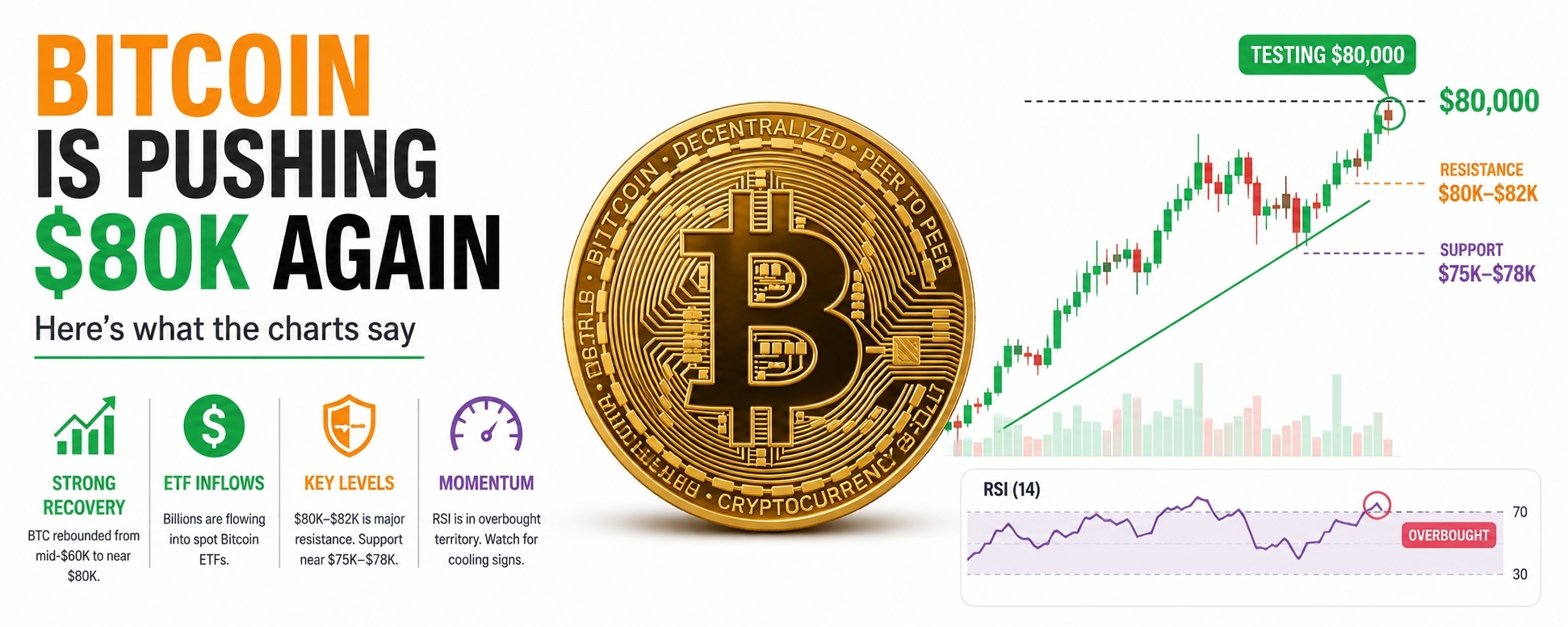


Bitcoin has a way of making the same price level feel completely different each time it reaches it. Right now, I’m watching Bitcoin push toward $80,000 again, and I keep wondering what the market is actually trying to tell us beneath all the noise. The number looks familiar, almost ordinary after everything Bitcoin has done over the years, but the reaction around it is never ordinary. Traders watch every candle, analysts redraw their levels, and suddenly a few thousand dollars can change the entire mood.
I’ve been watching these moments for years, and one thing that still stands out is how quickly the story changes. When Bitcoin was sitting much lower earlier in August, the conversation was full of doubt. People were questioning whether the market had lost its strength and whether another deeper correction was coming. Now Bitcoin is back around $80,000, and the conversation has shifted toward what comes next.
That change in mood is interesting to me because Bitcoin itself hasn't suddenly become a different asset. The network is still running as it was. Blocks are still being produced. Transactions are still moving. What has changed is the price, and with it, people's perception of what is possible.
That is usually where things get complicated.
Bitcoin moving back above $80,000 is one thing. Staying there is another. I’ve always found the second part more interesting. A quick move through a resistance level can attract plenty of attention, but the real test often comes afterward, when the excitement starts to disappear and the market has to deal with sellers who have been waiting for higher prices.
There are people who bought Bitcoin much lower and may be perfectly happy taking some profit around these levels. There are traders who have been waiting for confirmation before entering. There are others who missed the move completely and are now wondering whether they should chase it. All of those decisions are happening at roughly the same time.
That creates the strange tension we often see around major Bitcoin levels.
Everyone is looking at the same chart, but not everyone is seeing the same thing.
For one person, $80,000 could be a breakout. For another, it could be an exit. Someone else might simply see a temporary stop on the way toward higher prices. Another trader may be watching for the first sign that the rally is running out of energy.
The chart cannot tell us who is right yet.
Bitcoin has already made a fairly serious recovery from the mid-$60,000 area earlier this month. That is a large move, and moves like that naturally make me cautious. Not because a strong rally automatically means a reversal is coming, but because fast advances tend to change people's behavior. Confidence grows quickly when the candles are green. Risk that looked obvious a few weeks earlier suddenly seems less important.
This is where I think crypto can become dangerous.
The market has a talent for turning a reasonable observation into an extreme belief. Bitcoin rises, and suddenly people are no longer discussing whether the move can continue. They are discussing how high it might go. One target becomes another, and before long the original price level barely matters.
I don't think $80,000 guarantees $90,000, just as a rejection from $80,000 wouldn't automatically mean the whole rally is finished.
What matters is how Bitcoin reacts when it encounters real selling.
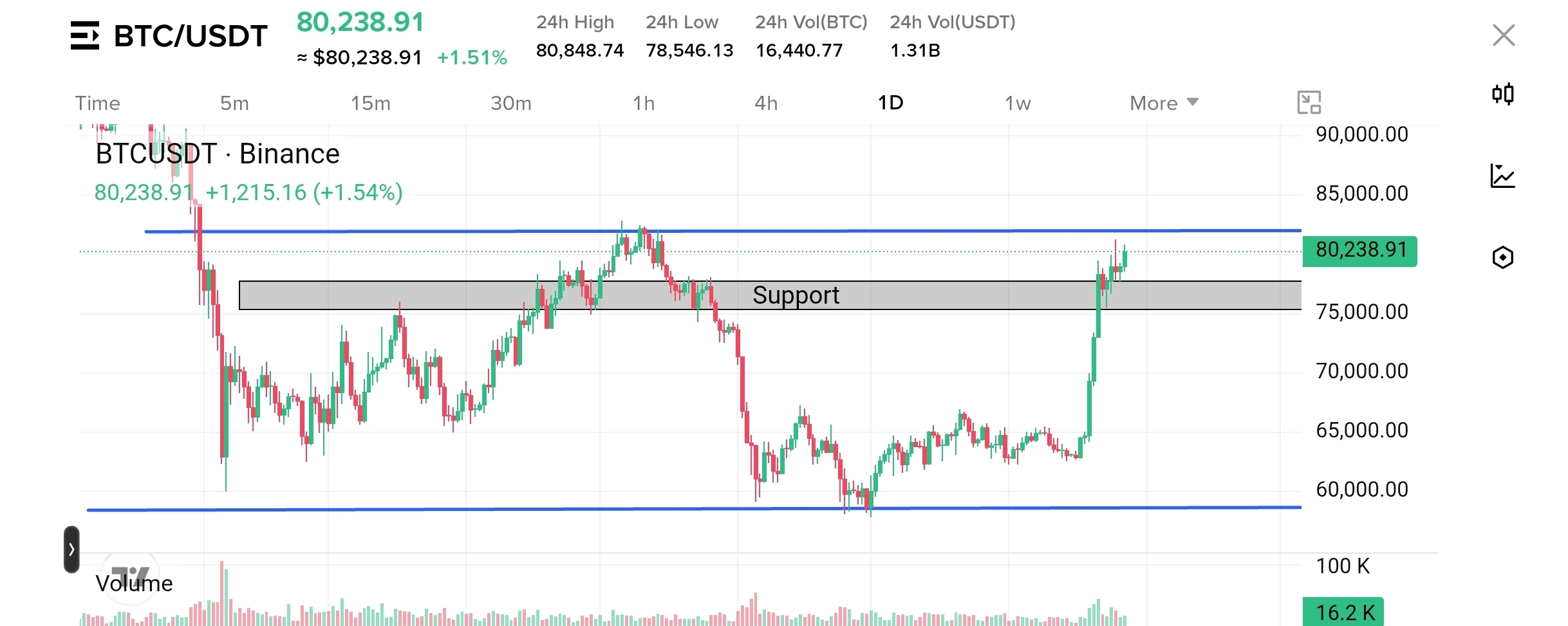
Recent technical analysis has placed the $80,000–$82,000 area among the important resistance zones, with lower areas around $75,000–$78,000 potentially becoming relevant if the market pulls back. Those levels are useful to watch, but I don't see them as predictions carved into stone. They are simply areas where traders have previously shown that they care.
And that distinction matters.
Support only remains support while buyers are willing to defend it. Resistance only remains resistance while sellers are willing to step in. Once enough real money changes its mind, the chart changes with it.
The momentum indicators are also giving a slightly uncomfortable message. Bitcoin's weekly RSI has moved into a level that many traders would describe as overbought. That sounds alarming until you remember how Bitcoin behaves during strong trends. An overbought market can remain overbought for a surprisingly long time. Strong demand can keep pushing price higher even while traditional indicators are telling traders to be careful.
So I don't see the RSI as a signal to run for the door.
I see it more as a reminder that the easy part of the move may already have happened.
There is also something different about this rally compared with some of the purely speculative moves we've seen in crypto. Spot Bitcoin ETFs have been receiving meaningful inflows, with recent reports showing billions of dollars moving into these products over a relatively short period.
That doesn't guarantee that Bitcoin will continue rising. Money can leave as quickly as it arrives. But it does tell us that there is real demand from investors who are accessing Bitcoin through traditional financial structures rather than simply chasing a leveraged position on a crypto exchange.
That part is worth paying attention to.
At the same time, Bitcoin's growing connection to traditional markets creates another layer of uncertainty. The dollar matters. Bond yields matter. Liquidity matters. Central-bank expectations matter. When investors become worried about currencies losing purchasing power or government debt becoming more difficult to manage, Bitcoin can benefit from that narrative.
Gold has benefited from similar thinking.
There is something slightly ironic about this. Bitcoin was created as an alternative to the traditional financial system, yet the market price of Bitcoin now reacts heavily to the same macroeconomic forces that move stocks, bonds and currencies.
The blockchain doesn't care about the Federal Reserve.
Bitcoin's market price certainly does.
That doesn't make the original idea behind Bitcoin less interesting. It just shows how different the underlying network is from the financial asset trading on global markets. One can operate independently while the other remains deeply connected to investor sentiment and global liquidity.
And then there is leverage.
This is one of the things I watch most carefully when Bitcoin starts moving quickly. Leverage can make a healthy trend look stronger than it really is. Traders borrow confidence from the market, and everything looks fine while price moves in their favor. But when price turns suddenly, those positions can become forced sellers.
One liquidation can create another.
That can turn an ordinary pullback into something much more violent.
If Bitcoin can continue moving higher without a huge build-up in leverage, I would find that more encouraging than a rally powered by traders taking increasingly large risks. A slower market with real buyers is usually more interesting to me than a market moving vertically because everyone is afraid of missing out.
Still, I don't think one indicator can explain what Bitcoin is doing.
There are too many different participants now. Long-term holders, miners, ETF investors, institutions, market makers, short-term traders and leveraged speculators all have different reasons for being here. One group can be selling while another is buying heavily.
That disagreement is what creates the price.
It is also why I think the next reaction around $80,000 could tell us more than the initial breakout itself.
If Bitcoin moves above the area and keeps finding buyers whenever it dips, the market may slowly turn that old resistance into something more comfortable. If it repeatedly pushes higher and gets rejected, that would suggest sellers are still waiting there. Neither outcome needs to happen immediately.
Bitcoin doesn't have to choose a direction simply because traders want one.
A pullback into the mid-$70,000s would not necessarily destroy the current structure either. After such a strong move, the market may simply need time to cool down. Sometimes price has to move sideways before it can decide what comes next.
What would make me more cautious is not a small pullback itself, but a deeper decline combined with weakening demand. That would tell us something different. It would suggest that the buyers supporting the recent move may not be as committed as the price action initially made them appear.
For now, though, I think Bitcoin is sitting in an interesting middle ground.
The buyers have brought it back toward $80,000. The sellers have shown that they are still willing to appear around the upper levels. ETF demand has improved, the broader macro environment has been supportive, and momentum has become strong enough to make the market feel confident again.
But confidence is not confirmation.
That is something I have learned to separate over time.
Crypto is full of moments when everyone suddenly seems certain about what comes next. Those are usually the moments when I slow down rather than speed up. The market doesn't become easier to predict just because more people are talking about it.
So I'm watching Bitcoin here without trying to force a conclusion.
If it holds above $80,000 and gradually builds a base, that would be interesting. If it breaks higher and attracts genuine demand rather than just late speculation, that would be even more interesting. And if it falls back, I would want to see how buyers respond rather than immediately calling the move a failure.
Because the real story is rarely the first move.
It is what happens afterward.
Bitcoin has reached this area again, and now the market has to decide what that price actually means. Is $80,000 becoming a level buyers are comfortable defending, or is it simply another place where people who bought lower are willing to sell?
I don't think we know yet.
And honestly, that uncertainty is what makes the chart worth watching.
