


In the current news cycle, viral hashtags and sensational headlines tend to impact investment choices particularly on X. Political noise, celebrity drama and meme tokens can move short run sentiment. Meanwhile, the bond market silently shows what really matters the growth, inflation as well as liquidity. This paper justifies why bond markets should be given more serious consideration than social-media trends in relation to crypto and provides data-driven information on the associations between Treasury yields and Bitcoin prices.
Bond market is the economic barometer of the world.
With a global total of approximately 140 trillion in the bond market and the U.S. market reaching 56.4 trillion, it is estimated that it would be 140 trillion at the end of 2023. To put it into perspective, the market cap of Bitcoin in the early 2025 will be approximately 1.9 trillion, and thus thirteen nations have bond markets bigger than Bitcoin.
– in 2024 the size of the fixed-income securities in the world reached 145.1 trillion. By Q3 2025, the crypto market is estimated to be approximately 4.2 trillion dollars or 13 per cent of the U.S. Treasury debt and 7 per cent of the capitalization of the S&P 500.
– Due to size and liquidity, bond market determines the benchmark rate of risk-free that is used to price mortgage, corporate debt etc. A well-developed bond market will decrease the cost of borrowings; a poorly developed market will increase this cost.
There is also bond yield which gives a real-time picture of the economic expectations.
– Yield curve shape- a normal upward sloping curve indicates healthy growth whereas an inverted curve is an indicator of recession panic.
– 10 -year Treasury rate - It is the world standard; this is tracked by the investors as the inflation indicator and Federal Reserve policy.
– The international demand of Treasuries -high demand drives the yield down and indicates that the world is convinced of the fiscal health of the U.S.
In contrast to social media, billions of dollars are being transferred in the bond market based on actual expectations regarding inflation, growth, and fiscal stability. This is the reason why bond market is said by professional investors to be smarter than stock market.
The price vs popularity: the impact of bonds on crypto.
Since late 2023 to mid 2025 U.S. bond yields have risen due to continuous inflation and concerns about the record government borrowing. Safe assets became more appealing due to high yield and were involved in regular crypto sell-offs.
But yield is not necessarily a bearish thing. They can destroy confidence in fiat money, by causing a spurt in yields because of fears of unsustainable deficits or an unsuccessful Treasury auction. on May 2025 a weak bond sale made the 10-year yield rise beyond 5.1 per cent., yet Bitcoin soared above $111,000 as buyers searched for other options.
The long-term relation between Bitcoin and interest rates is low based on historical studies. According to Charles Schwab, the strength of the dollar may impose short-term effects on Bitcoin, although in the long term, it has demonstrated a low level of correlation with the 10-year Treasury yield.
Information: Bitcoin and 10-year Treasury yields (2024-2025)
I tabulated monthly closing prices of both Bitcoin and Bitcoin and 10-year Treasury yields of 2024-2025 to observe their relationship. The following table summarises the data (yields are expressed in percentage):
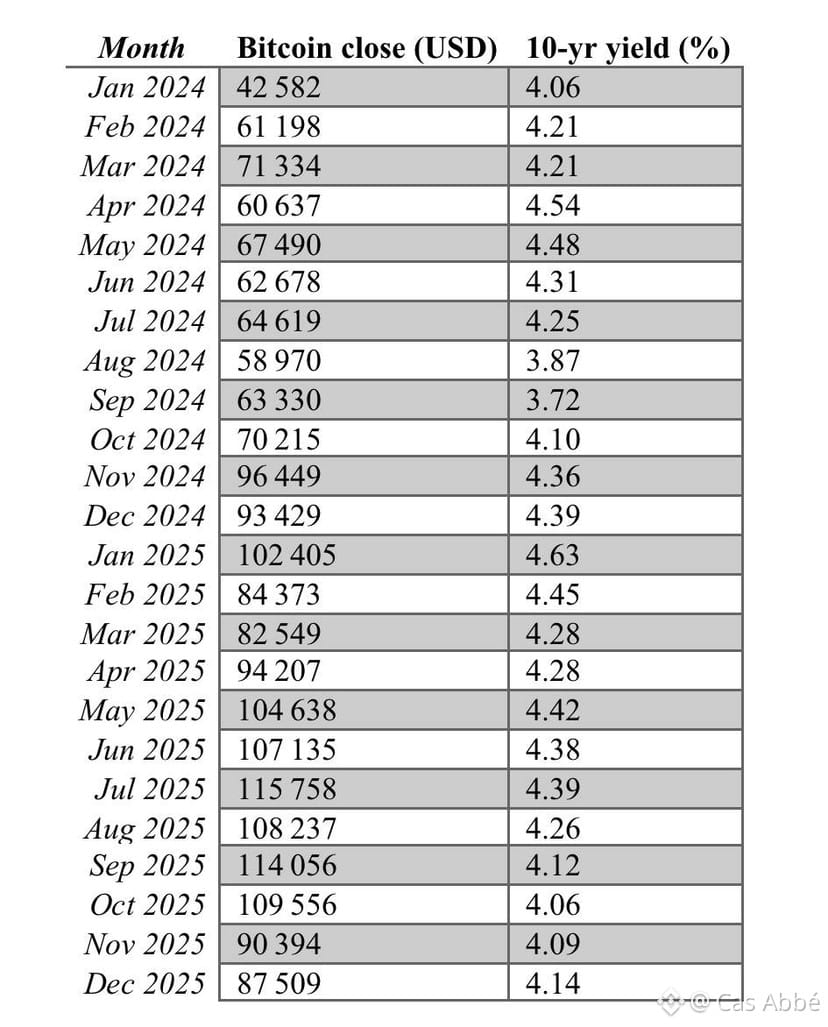
In plotting these series some few patterns are obtained:
– Bitcoin price increased around 18 months between 42k and over 115k, and dropped to form below 90k by the end of the year 2025. At the same time, 10-year yields were ranging between 3.7 per cent and 4.6 per cent.
– The series was weakly positively correlated (~0.31). Both were early rising, though price rallies were usually accompanied by declining yields (e.g., November 2024), and some yield rises were accompanied by price rallies (e.g., May 2025).
The following two images are making this relationship more tangible. The former chart crossplots the monthly close of Bitcoin and the 10-year yield (scaled to fit onto the same scale). The second scatter plot is a combination of the yield of each of the months with the close of Bitcoin.
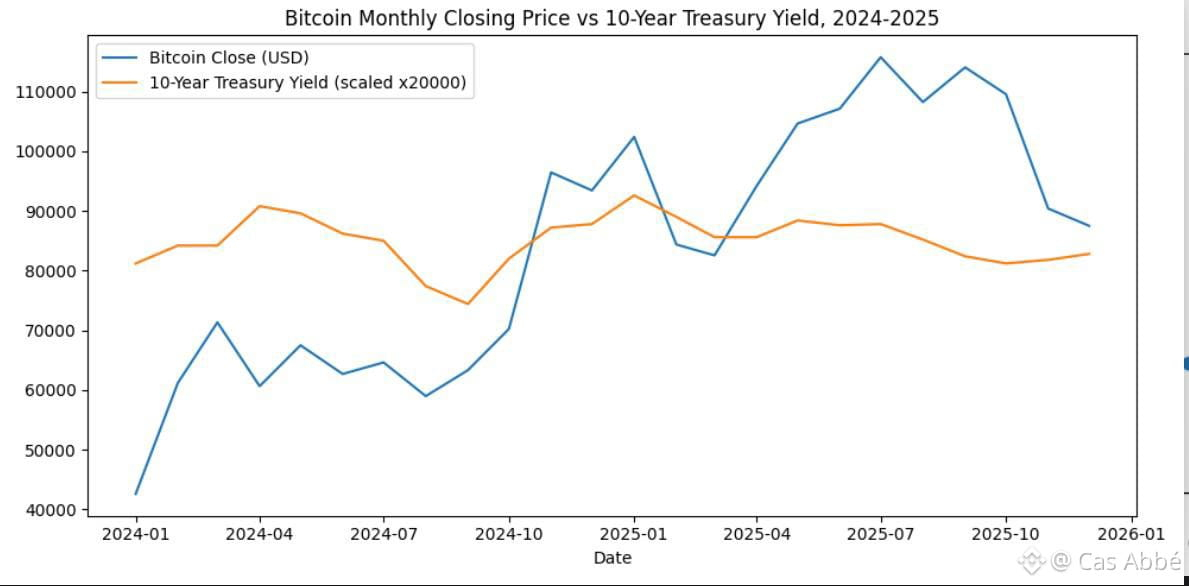
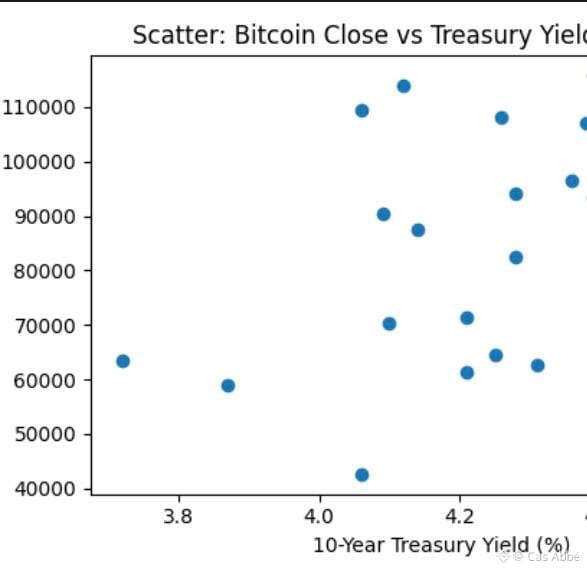
In the line chart, both series began to increase at the beginning of 2024, but the direction they take later is different. The fact that the scatter plot is widely dispersed proves that yields are not the only factors that affect Bitcoin.
Social media vs bond markets, a case to case check.
Social networks go viral - politics, influencers, and Fed pivot rumours. However, the bond market gives the best indications of crypto. Here’s why:
1- Scale and depth. Bonds market deal with trillions of dollars on daily basis. Twitter has the power to generate gossip, but it does not determine the cost of borrowing or finance governments.
2- Macro fundamentals. Yields are driven by real factors of growth, inflation, fiscal policy, and hashtags are sentiment driven and prone to misinformation. A negative yield curve or unsuccessful bond auction damages the liquidity and asset prices.
3- Liquidity and leverage. Increased yields reduce the situation and diminish the leverage of crypto traders. When the cost of financing increases, rallies driven by social media decline.
4- Signal vs noise. This is because viral posts confound opinion and speculation whereas bond prices reflect the view of the collective opinion of sophisticated investors. Schwab observed that the relationship between Bitcoin and interest rates is not very strong, i.e. the trending hashtags do not tend to indicate moves made by a macro.
To see this point of view, consider the Bond Market as a skyscraper in the middle of which the hashtags whirl. It is resolute since it is supported by the actual cash flows and government support, whereas social media trends are here and there.
1- Bond yields are a compass. They reflect how the market perceives the growth, inflation and risk. Nothing would provide a better understanding of how liquidity is going to be in the future than watching the yield curve and the big Treasury auctions.
2- Crypto isn't immune to macro. The increase in yields puts pressure on Bitcoin by enhancing the U.S. dollar and increasing risk-free assets. However, when the yields shoot up due to fiscal panic, Bitcoin is a beneficiary.
3- Correlation is fluid. Bitcoin was modestly positively correlated to the 10-year yield (0.31) over 20242025 and had previously been fluctuating. Do not think about macro relationship as rigid- circumstance is paramount.
4- Size and liquidity matter. The bond market is huge with trillions outstanding, which is much larger than crypto is. It influences pricing of all assets including digital assets. The mood may be determined by the social media whilst the cost of capital is determined by the bond market.
Final thoughts
I like a good meme even more than anyone, but with investing, and crypto, in particular, I have been looking at Treasury auctions and yield curve more than I listen to trending topics. Short term movements can be initiated in social media, but the bond market is the bloodline of the financial system. Knowledge of yield drivers, such as growth anticipations, inflation, fiscal well-being, will make it easier to maneuver through crypto markets with less headache and noise. Next time there is a hashtag, look at the 10-year yield, and then you FOMO.
