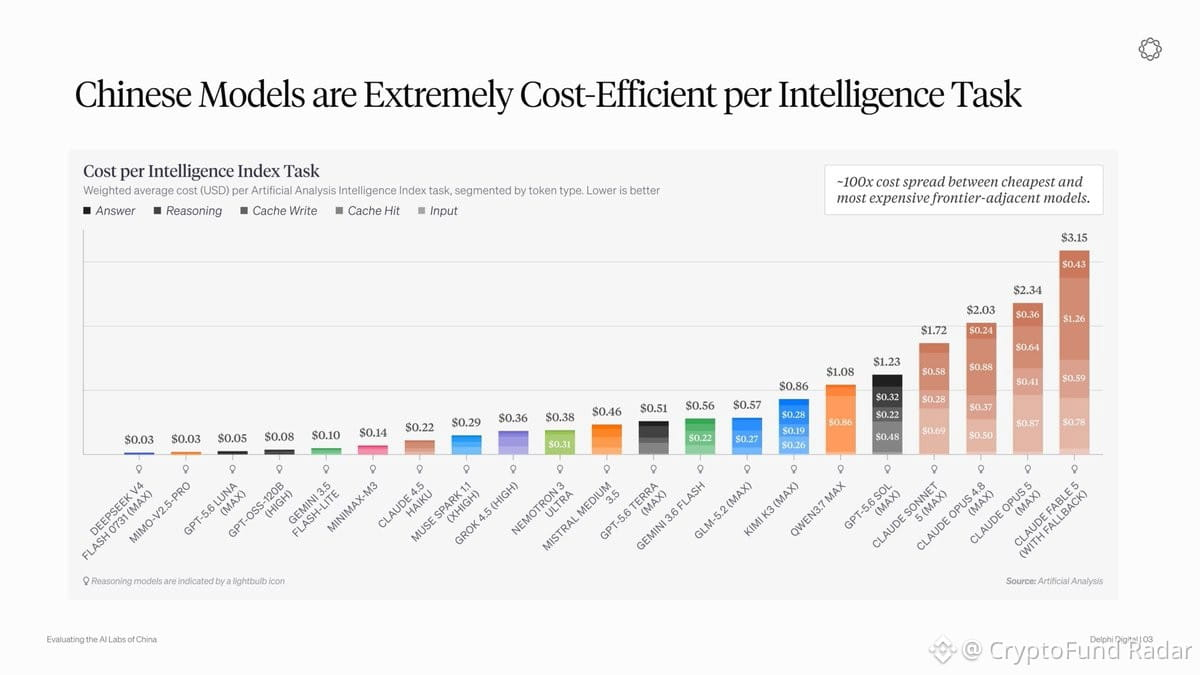
China's chip ban forced their AI labs to stop brute-forcing scale and start optimizing efficiency—and it's becoming a moat.
While US labs throw more $NVDA H100s at the problem, Chinese teams spent years squeezing performance out of restricted hardware. Result? Models trained cheaper, served faster, and built for lower compute overhead.
This isn't just distillation. It's architectural innovation—post-training methods, memory optimization, and inference efficiency baked into the stack. Cost per token is dropping hard.
Here's the shift: most real-world use cases don't need frontier-level reasoning. They need good enough at 10x lower cost. Chinese models are already there—competitive performance, fraction of the price.
Inference on domestic chips is closer than training from scratch. Frontier training still needs cutting-edge silicon China can't fully replace yet. But the gap is narrowing fast through software and architecture, not hardware.
Next gen Chinese models will show how far you can go when constraints force real innovation. Efficiency might beat raw scale in the market that actually pays.
While US labs throw more $NVDA H100s at the problem, Chinese teams spent years squeezing performance out of restricted hardware. Result? Models trained cheaper, served faster, and built for lower compute overhead.
This isn't just distillation. It's architectural innovation—post-training methods, memory optimization, and inference efficiency baked into the stack. Cost per token is dropping hard.
Here's the shift: most real-world use cases don't need frontier-level reasoning. They need good enough at 10x lower cost. Chinese models are already there—competitive performance, fraction of the price.
Inference on domestic chips is closer than training from scratch. Frontier training still needs cutting-edge silicon China can't fully replace yet. But the gap is narrowing fast through software and architecture, not hardware.
Next gen Chinese models will show how far you can go when constraints force real innovation. Efficiency might beat raw scale in the market that actually pays.