


I have watched Bitcoin make enough strange moves over the years to know that the first reaction at an important level rarely tells the whole story.
Sometimes a rejection is the beginning of a much deeper sell-off. Sometimes it is nothing more than the market taking a breath before trying again.
Right now, Bitcoin is sitting in that uncomfortable middle ground.
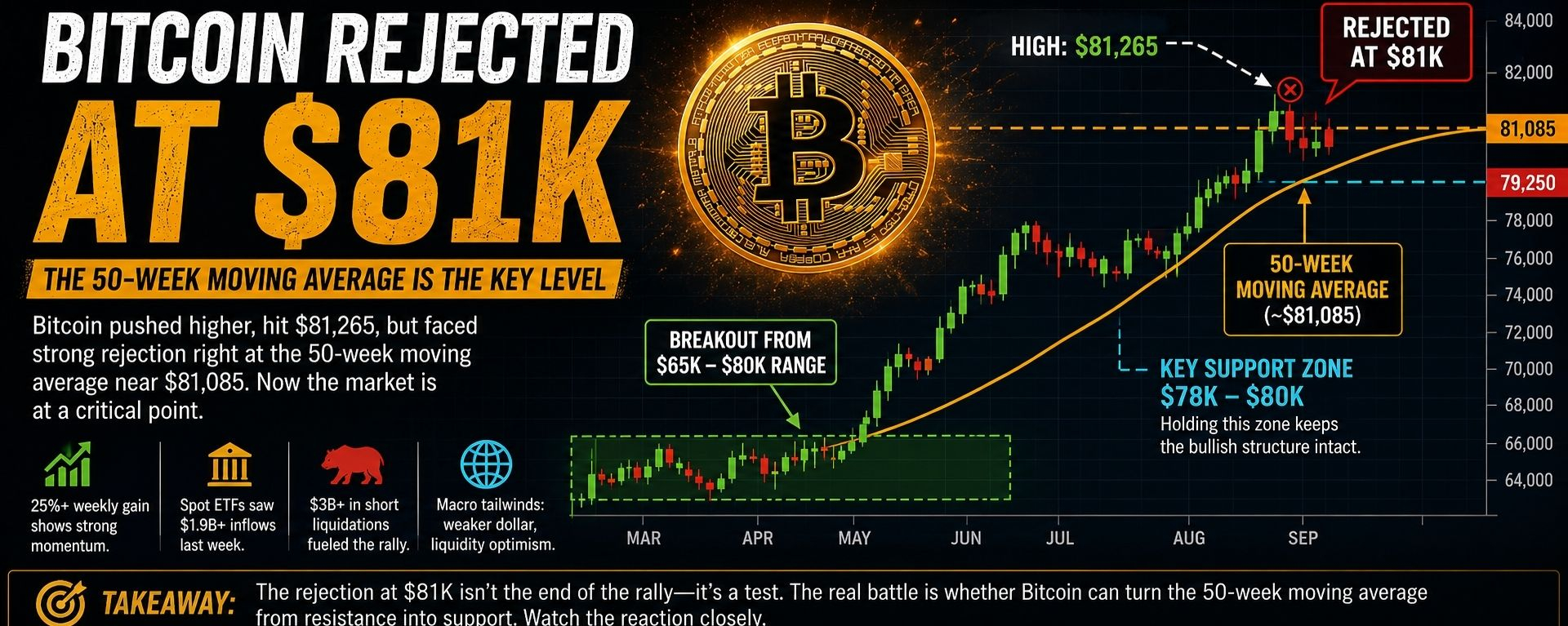
The price pushed above $80,000 and reached roughly $81,265 before running into the 50-week moving average, which was sitting close to $81,000. That is not just another line on a chart. It is one of those levels that longer-term traders tend to notice, especially after Bitcoin has spent a meaningful amount of time trading below it.
And the reaction was immediate.
Bitcoin could not hold above the area.
For the moment, sellers are still there.
But I don't think the right conclusion is simply, "Bitcoin got rejected, so the rally is over."
That is too easy.
What interests me much more is how Bitcoin got there in the first place.
The market did not slowly grind from one level to another. It moved aggressively. Bitcoin gained roughly 25% over a seven-day period, reclaiming levels that had looked difficult to reach only a short time earlier.
That kind of move changes everything.
People who were comfortable being bearish suddenly have to reconsider. Traders who were waiting for confirmation start entering late. Short sellers begin closing positions. Momentum traders start chasing the move. Long-term holders begin wondering whether this is finally the beginning of another major recovery.
And somewhere in the middle of all that excitement, somebody is selling.
That's normal.
Markets don't move higher because everyone agrees. They move higher because buyers are willing to absorb the supply being offered.
That is why I am less interested in the fact that Bitcoin touched $81K and more interested in what happens after the rejection.
If the price simply pulls back, finds support and tries again, the story is very different from a situation where Bitcoin starts losing every level it just reclaimed.
There is another reason I am taking this move seriously.
The spot Bitcoin ETF flows have improved at almost exactly the right time.
Recent data showed strong inflows into U.S. spot Bitcoin ETFs, with more than $1.9 billion entering during one recent week. Additional inflows followed on August 24. That tells me there is real demand behind at least part of this move rather than the entire rally being driven by derivatives.
But I would still be careful about turning ETF inflows into a guaranteed bullish signal.
Money can enter ETFs while Bitcoin consolidates.
Money can enter ETFs while older holders sell.
Money can enter ETFs while leverage gets washed out.
The important thing is what the combination of those flows and price action eventually produces.
And that is still developing.
The short squeeze also played a major role.
Billions of dollars in short positions were reportedly liquidated as Bitcoin moved sharply higher. When shorts are forced to close, they have to buy. Those forced purchases can create a feedback loop: price rises, more shorts get liquidated, those shorts buy back, price rises again.
It can look incredibly powerful on a chart.
But there is a catch.
Forced buying eventually runs out.
Once the shorts have covered, Bitcoin needs normal buyers to keep the move alive.
That is where I think the current market becomes much more interesting.
The easy part of the rally may already be behind us.
Now Bitcoin has to deal with people who are not forced to buy.
The 50-week moving average is important for precisely this reason.
A 50-week moving average is slow. It does not react to every little move. It represents a much broader view of Bitcoin's trend, which is why a sustained move above it would mean more than a few minutes spent trading over $81K.
Bitcoin touching the average is one thing.
Closing above it is another.
Holding above it is something else entirely.
That sequence matters.
I would much rather see Bitcoin spend several days fighting around $81K, eventually break through, pull back and successfully defend the same area than watch it shoot straight toward $90K in a few hours.
That might sound less exciting.
But it would be healthier.
A breakout becomes much more convincing when the market gets an opportunity to reject it and fails to do so.
This is where I think many traders get impatient.
They want the breakout candle.
They want the next target.
They want to know whether $100K is coming.
But the market doesn't work according to our preferred timetable.
Sometimes Bitcoin needs to move sideways before it can move higher.
And after a roughly 25% weekly rally, I would actually expect some cooling-off to be normal.
There is nothing unhealthy about Bitcoin taking a pause after a move like that.
In fact, a pause could be constructive.
If Bitcoin can consolidate somewhere around the high-$70,000s while ETF demand remains positive, leverage cools down and sellers fail to push it substantially lower, that would tell me much more than another huge green candle.
It would show that buyers are comfortable holding their positions.
That is different from chasing.
The macro picture is also playing a role.
Bitcoin's recent strength came at a time when the dollar was weakening and investors were paying more attention to concerns surrounding currency debasement and government debt.
The U.S. Treasury has also announced plans to increase the size of certain buyback operations involving longer-dated Treasury securities. Markets have interpreted the broader environment as potentially supportive for liquidity and risk assets.
But I don't think it is accurate to reduce that story to "Treasury buybacks mean easy money, therefore Bitcoin goes up."
Financial markets are more complicated than that.
Treasury buybacks are not the same thing as Federal Reserve quantitative easing.
And the Federal Reserve itself still has an inflation problem to think about.
Recent meeting minutes showed that several policymakers had become more concerned about inflation. If inflation stays stubborn and interest-rate expectations become more restrictive, that could create a very different environment for Bitcoin and other risk assets.
So there are two competing forces here.
On one side, there is the weaker-dollar and liquidity argument.
On the other, there is the possibility that inflation keeps monetary policy tighter than investors would like.
Bitcoin is sitting between those two stories.
That is one reason I don't want to make a dramatic prediction from one rejection.
There is also something else worth remembering.
Bitcoin's current move has not happened because of one single piece of news.
There is ETF demand.
There is short covering.
There is renewed confidence around the regulatory environment.
There is the dollar.
There are Treasury-market developments.
There is the possibility that Bitcoin already formed a meaningful low.
All of these things are contributing to the same price action.
But they don't all have the same lifespan.
A short squeeze can disappear within days.
ETF demand can continue for months.
A regulatory headline can change overnight.
The dollar can reverse.
And technical levels can remain important until the market proves otherwise.
That is why the $81K area is so useful.
It gives us something objective to watch.
We don't have to guess what Bitcoin "should" do.
We can simply watch what it actually does.
If Bitcoin keeps getting rejected around $81K–$82K and starts producing lower highs, sellers are clearly defending the area.
If Bitcoin pulls back toward $78K–$80K and buyers step in, that could be healthy consolidation.
And if Bitcoin eventually breaks above $81K–$82K, closes above the 50-week moving average and then comes back to test the same area without losing it, that would be a much stronger signal that the market structure is changing.
That last part is the one I would pay the most attention to.
The retest.
Anyone can break resistance once.
The market has to prove it can hold the breakout.
That's where the difference between a rally and a trend often becomes visible.
There is also a psychological side to this.
Imagine someone bought Bitcoin much lower.
At $81K, they have a reason to take some profit.
Now imagine someone who missed the entire move and is only thinking about buying because Bitcoin just crossed $80K.
They are entering into resistance.
Those two traders are looking at exactly the same chart but making completely different decisions.
This is why markets can become extremely volatile around obvious levels.
One group is selling into strength.
Another group is chasing strength.
And the price becomes the battlefield between them.
The same thing happened during many previous Bitcoin cycles.
The market rarely moves cleanly from "bearish" to "bullish."
There are usually false starts, failed breakouts, sharp pullbacks and periods where nobody is quite sure what comes next.
That uncertainty is not necessarily a problem.
It is often part of the transition.
One thing I would not ignore is the possibility that Bitcoin simply needs more time.
The market has moved so quickly that expecting an immediate continuation higher may actually be the wrong way to think about it.
A few days of sideways trading around $78K–$81K could do more for the market than another sudden 8% rally.
It could flush out excessive leverage.
It could allow late buyers to settle.
It could give ETF demand time to build.
It could allow the market to test whether sellers still have enough supply to keep Bitcoin below the 50-week average.
And if Bitcoin eventually breaks out after that process, the breakout could be much more meaningful.
This is also why I am not particularly interested in making a prediction about $90K or $100K right now.
Those numbers make for good headlines.
But they do not help much with understanding the current market.
The immediate question is much simpler:
Can Bitcoin turn $81K from resistance into support?
If the answer eventually becomes yes, the market will have given us something tangible.
If the answer remains no and Bitcoin begins losing the support underneath the recent rally, then the recovery deserves a much more cautious interpretation.
There is another scenario that I think deserves attention.
Bitcoin could reject $81K, fall toward the upper-$70,000s, and then spend a considerable amount of time building a base.
That would not necessarily mean the bullish thesis has failed.
Markets sometimes need to consolidate before making their next important move.
The problem would begin if every bounce becomes weaker and the market starts making lower lows.
That would tell us that sellers are gaining control.
For now, I don't think we have enough evidence to say that.
The rejection is real.
The resistance is real.
But the broader recovery is also real.
ETF demand has improved.
Bitcoin has reclaimed important price levels.
The dollar has been weaker.
The market's perception of the regulatory environment has improved.
And the speed of the recovery tells us that there is clearly a large amount of demand willing to step in when conditions change.
The question is whether that demand is strong enough to absorb the sellers waiting around the 50-week moving average.
That is the real battle.
Not bulls versus bears on social media.
Not one analyst against another.
Actual supply versus actual demand.
And Bitcoin has a very simple way of settling that argument.
Price.
If buyers eventually absorb the supply around $81K–$82K, the market will show it.
If sellers remain dominant, the market will show that too.
I think this is where experience matters.
After watching enough Bitcoin cycles, you stop trying to predict every candle.
You start watching behavior.
A strong market usually tells you when it is strong.
It holds levels.
It recovers quickly after pullbacks.
It refuses to give back important gains.
Weak markets do the opposite.
They break support, bounce weakly, get rejected again and gradually lose the confidence that brought buyers in.
Bitcoin is not showing that kind of weakness yet.
But it has not proven the opposite either.
That is why the 50-week moving average matters so much right now.
It is sitting directly where the market's confidence is being tested.
Bitcoin has recovered enough to reach it.
Now it needs to show that it can live above it.
The August 25 rejection at roughly $81K was therefore not the end of the story.
It was the first serious question.
Can buyers come back?
Can they absorb the sellers?
Can Bitcoin reclaim the 50-week average?
And, most importantly, can it hold that level when the excitement disappears?
That last question is the one I would keep in mind.
Because a market does not become healthy simply by moving higher.
It becomes healthy when higher prices stop feeling temporary.
Right now, Bitcoin is somewhere between those two states.
The recovery has become too strong to ignore.
The rejection has become too important to dismiss.
And the 50-week moving average has become the line where those two realities meet.
Bitcoin has already shown that it can reach $81K.
Now the market has to show whether it belongs there.
That is the part I am watching.