Dusk Is Bringing More Of The Regulated Asset Lifecycle Onchain, Not Just The Asset Itself
Tokenization usually gets the attention because it is the easiest part to show. Put a bond or fund onchain and suddenly there is something visible to point at.
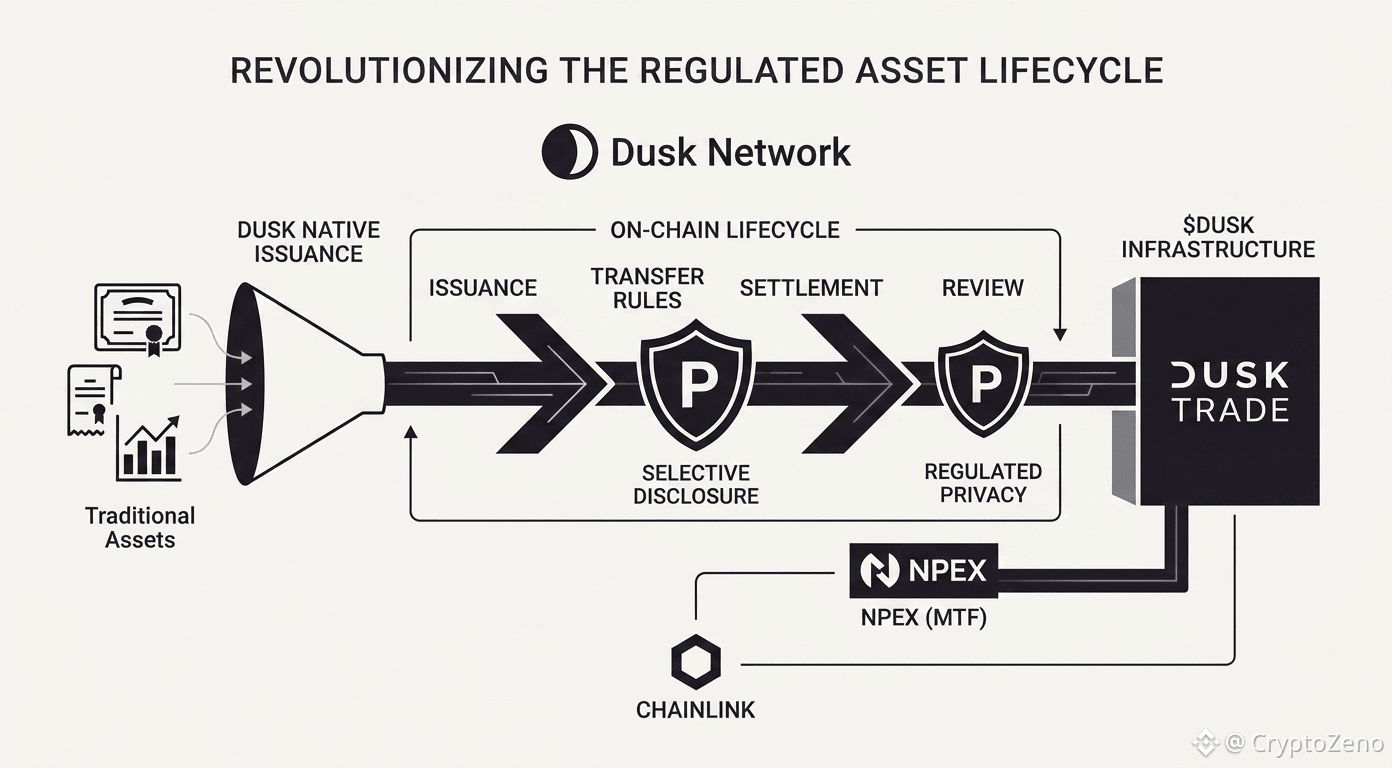
Dusk native issuance model goes further by targeting parts of the lifecycle that normally remain outside the token itself: issuance, transfer rules, settlement, review and servicing. That makes the blockchain responsible for more than representing an existing security. @Dusk is trying to make the asset’s operating rules part of the infrastructure.
The same idea shows up in Dusk Trade. Its workflow covers onboarding, wallet connection, asset discovery, buying and selling, payment coordination and settlement, with MMFs, ETFs and bonds among the intended products. Underneath that, the $DUSK stack is also designed for regulated privacy, where sensitive information can stay protected while selective disclosure gives authorized parties a way to review it.
There is already a concrete institutional angle behind this architecture. NPEX is an AFM-regulated exchange licensed as an MTF, Broker and ECSP, and its partnership with Dusk targets more than €300M in assets being brought onchain. Chainlink is also part of the infrastructure picture, strengthening the connection between Dusk and external data and interoperability.
What I’d like to see from the Dusk team next is how far this model can go as more regulated assets come onchain. With native issuance, Dusk Trade, selective disclosure and deterministic settlement developing together, the next step could be supporting more complex asset lifecycles without adding extra layers around the investor. That would make the work Dusk is already doing even more relevant to regulated markets.
@Dusk #DUSK
Tokenization usually gets the attention because it is the easiest part to show. Put a bond or fund onchain and suddenly there is something visible to point at.
Dusk native issuance model goes further by targeting parts of the lifecycle that normally remain outside the token itself: issuance, transfer rules, settlement, review and servicing. That makes the blockchain responsible for more than representing an existing security. @Dusk is trying to make the asset’s operating rules part of the infrastructure.
The same idea shows up in Dusk Trade. Its workflow covers onboarding, wallet connection, asset discovery, buying and selling, payment coordination and settlement, with MMFs, ETFs and bonds among the intended products. Underneath that, the $DUSK stack is also designed for regulated privacy, where sensitive information can stay protected while selective disclosure gives authorized parties a way to review it.
There is already a concrete institutional angle behind this architecture. NPEX is an AFM-regulated exchange licensed as an MTF, Broker and ECSP, and its partnership with Dusk targets more than €300M in assets being brought onchain. Chainlink is also part of the infrastructure picture, strengthening the connection between Dusk and external data and interoperability.
What I’d like to see from the Dusk team next is how far this model can go as more regulated assets come onchain. With native issuance, Dusk Trade, selective disclosure and deterministic settlement developing together, the next step could be supporting more complex asset lifecycles without adding extra layers around the investor. That would make the work Dusk is already doing even more relevant to regulated markets.
@Dusk #DUSK