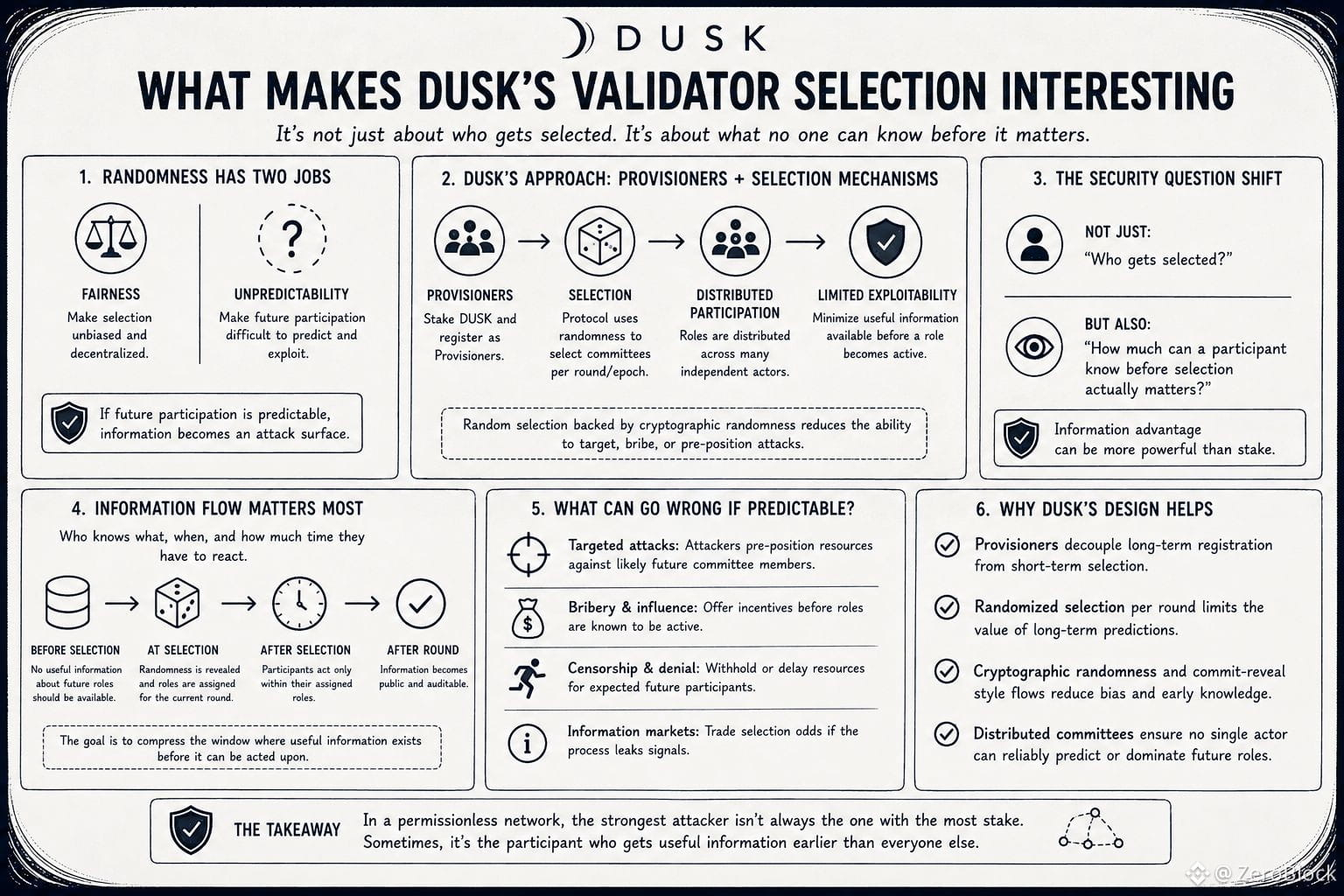
I was looking at how @Dusk handles validator selection and one detail kept bothering me.
It is easy to think of random selection as simply a way to make the committee fair.
But randomness has another job.
It has to make future participation difficult to predict.
That matters because the moment a participant can estimate where they are likely to appear later in the process the system starts creating information that can be acted on.
What I found interesting about Dusk is that the selection process is not treated as a simple lottery.
The protocol uses the concept of Provisioners and selection mechanisms to keep participation distributed while limiting how much useful information any participant can exploit ahead of time.
That changes the security question for me.
It is not only
Who gets selected...
It is also
How much can a participant know before selection actually matters...
That distinction is easy to miss.
A perfectly fair selection mechanism can still create problems if participants receive enough predictable information to adjust their behavior before their role becomes active.
So I think the more interesting way to look at Dusk is through information flow.
Who knows what.
At what point.
And how much time they have to react.
Because in a permissionless network the strongest attacker is not necessarily the one with the most stake.
Sometimes it is simply the participant who gets useful information earlier than everyone else.
That is the part of Dusk selection I want to understand better.
#dusk $DUSK @Dusk
It is easy to think of random selection as simply a way to make the committee fair.
But randomness has another job.
It has to make future participation difficult to predict.
That matters because the moment a participant can estimate where they are likely to appear later in the process the system starts creating information that can be acted on.
What I found interesting about Dusk is that the selection process is not treated as a simple lottery.
The protocol uses the concept of Provisioners and selection mechanisms to keep participation distributed while limiting how much useful information any participant can exploit ahead of time.
That changes the security question for me.
It is not only
Who gets selected...
It is also
How much can a participant know before selection actually matters...
That distinction is easy to miss.
A perfectly fair selection mechanism can still create problems if participants receive enough predictable information to adjust their behavior before their role becomes active.
So I think the more interesting way to look at Dusk is through information flow.
Who knows what.
At what point.
And how much time they have to react.
Because in a permissionless network the strongest attacker is not necessarily the one with the most stake.
Sometimes it is simply the participant who gets useful information earlier than everyone else.
That is the part of Dusk selection I want to understand better.
#dusk $DUSK @Dusk