
Been digging into Dusk again and I think I was paying attention to the wrong thing before.
The privacy narrative is obvious. What’s more interesting to me is how much the network itself has changed underneath it.
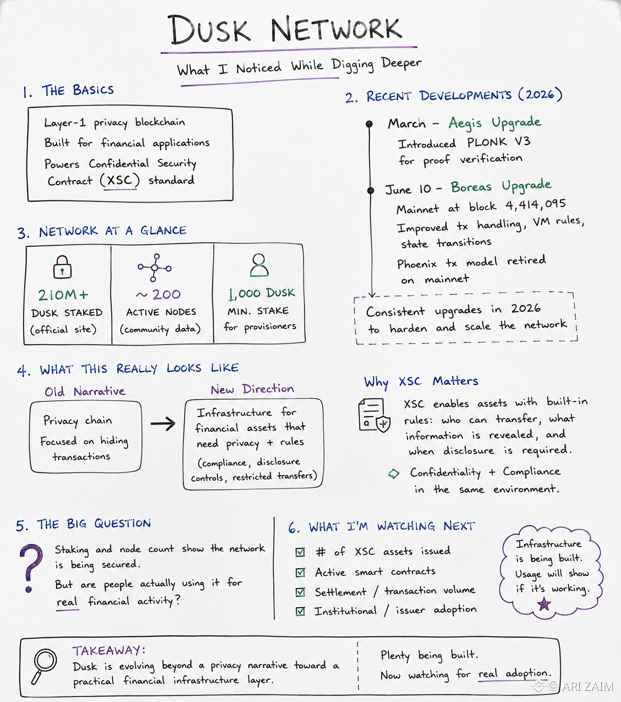
Aegis went live in March, bringing PLONK V3 verification. Then Boreas hit mainnet in June at block 4,414,095. At the same time, 210M+ $DUSK is staked, while community data has recently shown roughly 200 active nodes.
None of that is groundbreaking on its own.
Plenty of chains have validators, staking and regular upgrades.
But put the pieces together and @Dusk looks less like it’s trying to be “a privacy chain” and more like it’s slowly building infrastructure for assets that need both privacy and rules.
That’s where XSC caught my attention.
The interesting part isn’t simply hiding transaction data. It’s the idea that an asset can have restrictions around transfers and disclosure without making everything happening onchain public.
Makes sense on paper. Whether anyone actually needs it is the harder question.
And staking numbers won’t answer that.
I’d rather know how many XSC assets are actually being issued, how many contracts are being used repeatedly, and how much real settlement activity is happening.
That’s what I’m watching now.
If anyone has been digging through #dusk data too, curious what you’ve found.
The privacy narrative is obvious. What’s more interesting to me is how much the network itself has changed underneath it.
Aegis went live in March, bringing PLONK V3 verification. Then Boreas hit mainnet in June at block 4,414,095. At the same time, 210M+ $DUSK is staked, while community data has recently shown roughly 200 active nodes.
None of that is groundbreaking on its own.
Plenty of chains have validators, staking and regular upgrades.
But put the pieces together and @Dusk looks less like it’s trying to be “a privacy chain” and more like it’s slowly building infrastructure for assets that need both privacy and rules.
That’s where XSC caught my attention.
The interesting part isn’t simply hiding transaction data. It’s the idea that an asset can have restrictions around transfers and disclosure without making everything happening onchain public.
Makes sense on paper. Whether anyone actually needs it is the harder question.
And staking numbers won’t answer that.
I’d rather know how many XSC assets are actually being issued, how many contracts are being used repeatedly, and how much real settlement activity is happening.
That’s what I’m watching now.
If anyone has been digging through #dusk data too, curious what you’ve found.