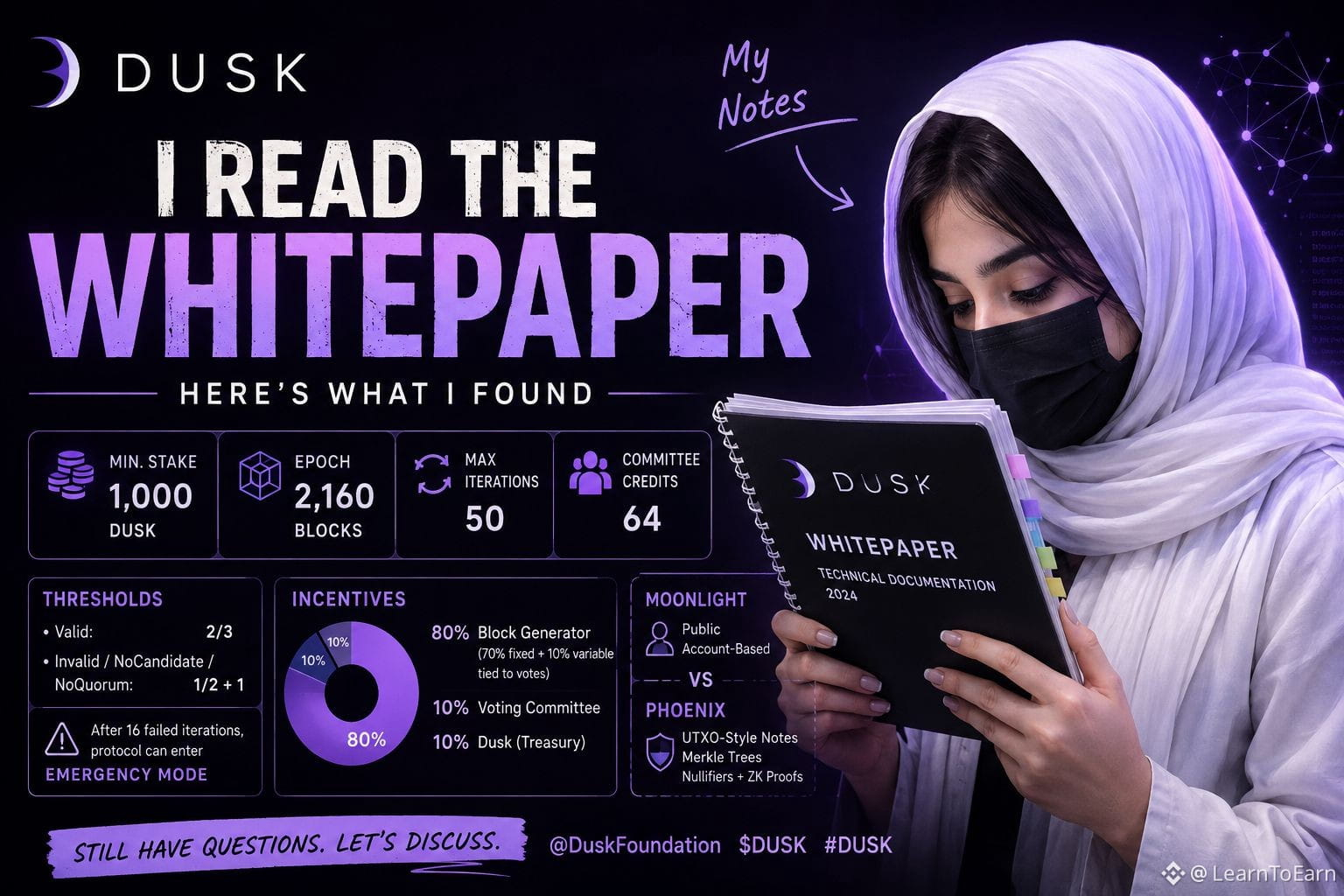

I went back through the Dusk whitepaper last night, and the consensus section made me slow down. Dusk uses Succinct Attestation with permissionless, committee-based Proof of Stake. A minimum stake of 1,000 DUSK is required, while the current epoch is 2,160 blocks. Each round can run up to 50 iterations, and committees have 64 credits, so voting power is weighted rather than one person, one vote.
What I found interesting is the threshold structure: Valid needs 2/3, while Invalid, NoCandidate, or NoQuorum can reach a majority of 1/2 + 1. After 16 failed iterations, the protocol can enter emergency mode, which raises a question about liveness versus fork risk.
The incentive design also caught my attention: 80% goes to the block generator, 10% to the voting committee, and 10% to Dusk. The generator’s 80% is 70% fixed plus a 10% variable portion tied to included votes. Major faults such as double voting can trigger hard slashing.
Then Moonlight and Phoenix made the architecture clearer to me: public account-based transactions versus UTXO-style notes, Merkle trees, nullifiers, and ZK proofs.
I’m still wondering: does stake-weighted credit allocation create concentration risks? And how robust is emergency mode under validator failure?
#dusk $DUSK @Dusk
What I found interesting is the threshold structure: Valid needs 2/3, while Invalid, NoCandidate, or NoQuorum can reach a majority of 1/2 + 1. After 16 failed iterations, the protocol can enter emergency mode, which raises a question about liveness versus fork risk.
The incentive design also caught my attention: 80% goes to the block generator, 10% to the voting committee, and 10% to Dusk. The generator’s 80% is 70% fixed plus a 10% variable portion tied to included votes. Major faults such as double voting can trigger hard slashing.
Then Moonlight and Phoenix made the architecture clearer to me: public account-based transactions versus UTXO-style notes, Merkle trees, nullifiers, and ZK proofs.
I’m still wondering: does stake-weighted credit allocation create concentration risks? And how robust is emergency mode under validator failure?
#dusk $DUSK @Dusk