I used to think blockchain privacy was pretty straightforward: hide the transaction details, and that’s it. But the more I looked into Dusk, the more I realized there’s a lot more going on underneath.
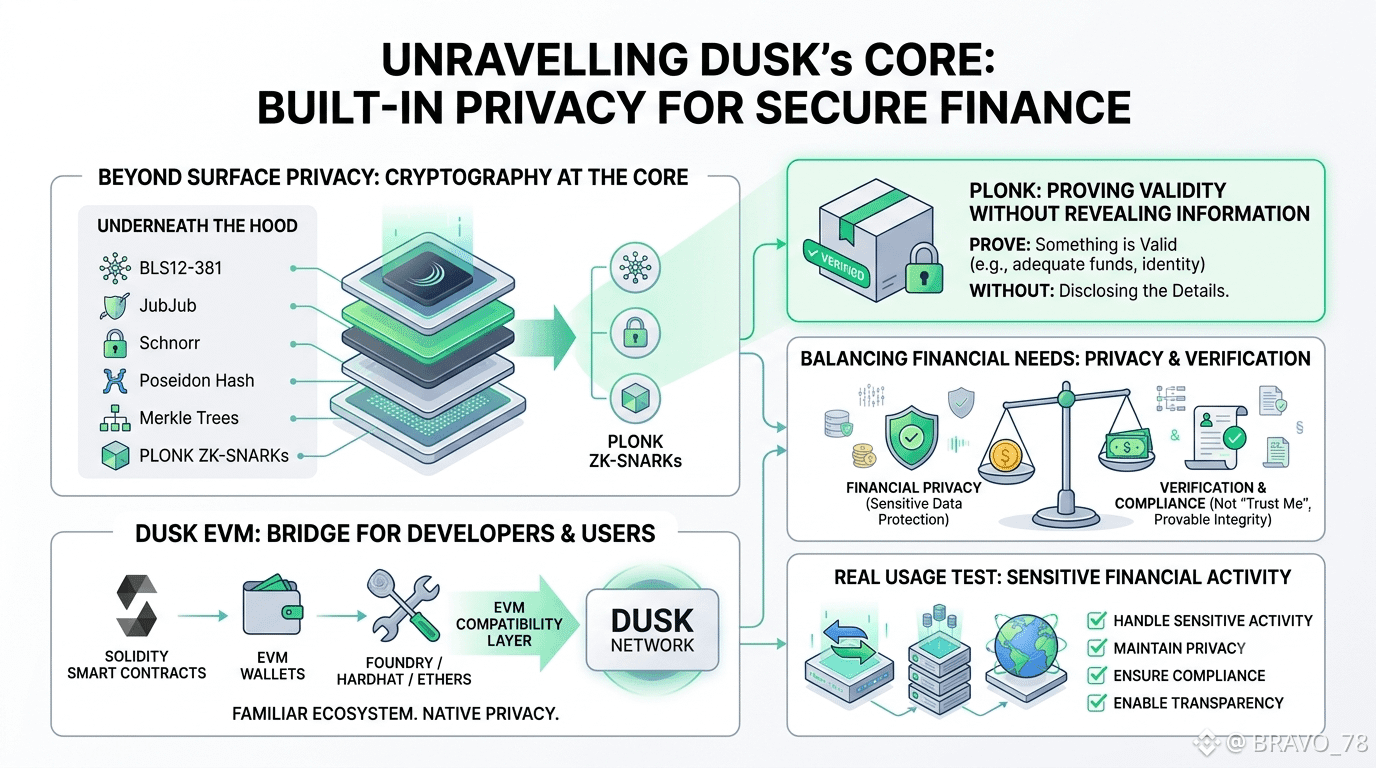
What really caught my attention is the cryptography. Dusk isn’t simply putting a privacy layer on top of everything. It’s building privacy into the core of the system using things like BLS12-381, JubJub, Schnorr, Poseidon, Merkle trees, and PLONK.
PLONK is especially interesting to me because it allows someone to prove that something is valid without having to reveal all the information behind it. That feels much more relevant when you start thinking about actual financial use cases.
Because honestly, financial markets can’t just expose everything publicly. At the same time, they can’t work on “trust me” either. There has to be a balance between privacy and verification.
That’s where DuskEVM makes sense to me. Developers can still work with Solidity, EVM wallets, Foundry, Hardhat, and ethers instead of learning an entirely unfamiliar environment.
I’m still watching to see whether the technology can translate into real usage. For me, the real test isn’t how impressive the architecture sounds. It’s whether Dusk can actually handle sensitive financial activity while keeping privacy, compliance, and transparency working together.
@Dusk #dusk $DUSK
$RAY
What really caught my attention is the cryptography. Dusk isn’t simply putting a privacy layer on top of everything. It’s building privacy into the core of the system using things like BLS12-381, JubJub, Schnorr, Poseidon, Merkle trees, and PLONK.
PLONK is especially interesting to me because it allows someone to prove that something is valid without having to reveal all the information behind it. That feels much more relevant when you start thinking about actual financial use cases.
Because honestly, financial markets can’t just expose everything publicly. At the same time, they can’t work on “trust me” either. There has to be a balance between privacy and verification.
That’s where DuskEVM makes sense to me. Developers can still work with Solidity, EVM wallets, Foundry, Hardhat, and ethers instead of learning an entirely unfamiliar environment.
I’m still watching to see whether the technology can translate into real usage. For me, the real test isn’t how impressive the architecture sounds. It’s whether Dusk can actually handle sensitive financial activity while keeping privacy, compliance, and transparency working together.
@Dusk #dusk $DUSK
$RAY