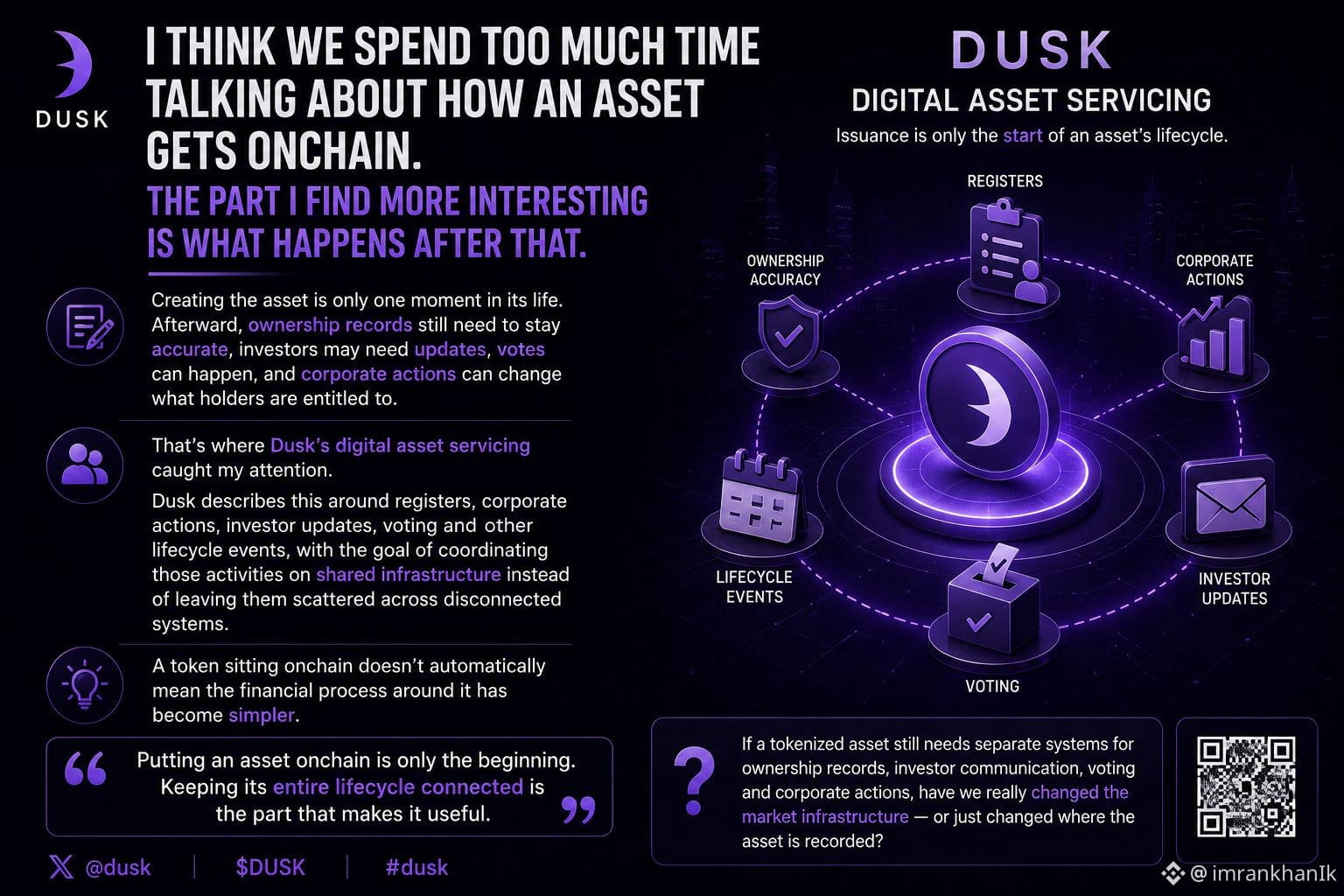

I think we spend too much time talking about how an asset gets onchain.
The part I find more interesting is what happens after that.
Creating the asset is only one moment in its life. Afterward, ownership records still need to stay accurate, investors may need updates, votes can happen, and corporate actions can change what holders are entitled to.
That’s where Dusk’s digital asset servicing caught my attention.
Dusk describes this around registers, corporate actions, investor updates, voting and other lifecycle events, with the goal of coordinating those activities on shared infrastructure instead of leaving them scattered across disconnected systems.
And honestly, that made me look at tokenization a little differently.
A token sitting onchain doesn't automatically mean the financial process around it has become simpler.
Putting an asset onchain is only the beginning. Keeping its entire lifecycle connected is the part that makes it useful.
Maybe I'm looking at it too simply, but that's where I think the real infrastructure question starts.
If a tokenized asset still needs separate systems for ownership records, investor communication, voting and corporate actions, have we really changed the market infrastructure — or just changed where the asset is recorded?
#dusk $DUSK @Dusk
The part I find more interesting is what happens after that.
Creating the asset is only one moment in its life. Afterward, ownership records still need to stay accurate, investors may need updates, votes can happen, and corporate actions can change what holders are entitled to.
That’s where Dusk’s digital asset servicing caught my attention.
Dusk describes this around registers, corporate actions, investor updates, voting and other lifecycle events, with the goal of coordinating those activities on shared infrastructure instead of leaving them scattered across disconnected systems.
And honestly, that made me look at tokenization a little differently.
A token sitting onchain doesn't automatically mean the financial process around it has become simpler.
Putting an asset onchain is only the beginning. Keeping its entire lifecycle connected is the part that makes it useful.
Maybe I'm looking at it too simply, but that's where I think the real infrastructure question starts.
If a tokenized asset still needs separate systems for ownership records, investor communication, voting and corporate actions, have we really changed the market infrastructure — or just changed where the asset is recorded?
#dusk $DUSK @Dusk