
Been digging into @Dusk again, and I think I was looking at it a little too simply before.
The obvious story is privacy for financial apps. But after going through what they’ve actually been shipping, I’m more interested in how they’re splitting up the stack.
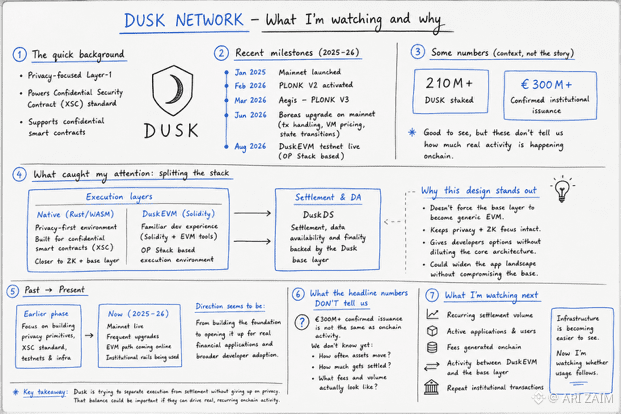
Mainnet only went live in January 2025. Since then we’ve seen PLONK V2 in February 2026, Aegis/PLONK V3 in March and Boreas in June. Dusk also says 210M+ $DUSK is staked, alongside €300M+ in confirmed institutional issuance.
Useful context, but none of that tells me much on its own.
What I keep coming back to is DuskEVM.
Rather than turning the whole network into another EVM environment just to make onboarding easier, they’re keeping the privacy-focused base layer while giving Solidity developers a familiar place to build on top.
I find that tradeoff more interesting than the headline numbers.
A lot of specialized chains eventually face the same problem: stay opinionated and make developers adapt, or become more familiar and risk losing what made the architecture worth using.
#dusk looks like it’s trying to sit somewhere in between.
Still, the real test isn’t announced issuance or how much gets staked.
I want to see what actually moves through this infrastructure: recurring settlement volume, active apps, fees, and whether institutions come back for a second transaction.
That’s probably where the story gets more interesting.
The obvious story is privacy for financial apps. But after going through what they’ve actually been shipping, I’m more interested in how they’re splitting up the stack.
Mainnet only went live in January 2025. Since then we’ve seen PLONK V2 in February 2026, Aegis/PLONK V3 in March and Boreas in June. Dusk also says 210M+ $DUSK is staked, alongside €300M+ in confirmed institutional issuance.
Useful context, but none of that tells me much on its own.
What I keep coming back to is DuskEVM.
Rather than turning the whole network into another EVM environment just to make onboarding easier, they’re keeping the privacy-focused base layer while giving Solidity developers a familiar place to build on top.
I find that tradeoff more interesting than the headline numbers.
A lot of specialized chains eventually face the same problem: stay opinionated and make developers adapt, or become more familiar and risk losing what made the architecture worth using.
#dusk looks like it’s trying to sit somewhere in between.
Still, the real test isn’t announced issuance or how much gets staked.
I want to see what actually moves through this infrastructure: recurring settlement volume, active apps, fees, and whether institutions come back for a second transaction.
That’s probably where the story gets more interesting.