
I was reading through Dusk’s docs and one thing surprised me a bit.
I went in thinking the privacy side would be pretty straightforward: use Dusk, get private transactions. But that’s not exactly how it works.
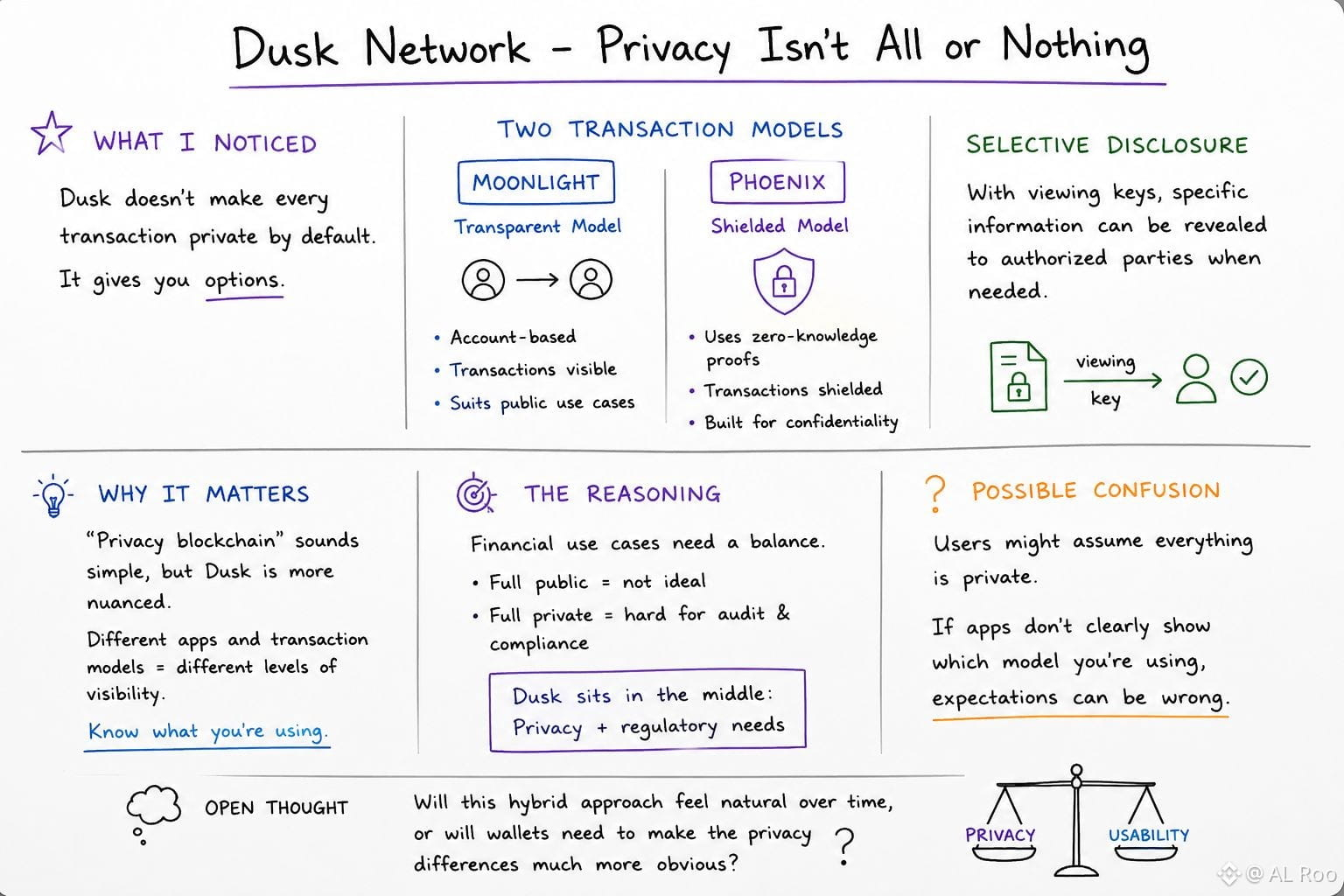
Dusk has two different transaction models. Moonlight is transparent, while Phoenix is built for shielded transactions using zero-knowledge proofs. So simply using the network doesn’t automatically mean everything you do is private.
I actually think that makes sense when you look at what Dusk is trying to build for. Financial applications don’t always need complete secrecy. Sometimes information needs to be visible for auditing or compliance, while other details probably shouldn’t be sitting publicly on-chain for anyone to inspect.
What I find interesting is the user experience this creates.
Most people probably won’t care about the technical difference between Moonlight and Phoenix. They’ll just want to know one thing: is this transaction private or not?
That puts a lot of responsibility on wallets and apps built on Dusk. If they clearly show what is public and what is confidential before someone signs a transaction, the two-model approach could feel pretty natural.
If they don’t, I can see people assuming they have more privacy than they actually do.
Maybe the harder problem for privacy-focused chains isn’t only building the cryptography. It’s making privacy obvious enough that regular users understand what they’re getting.
Curious how Dusk apps will handle that as more people actually use them.
$DUSK #dusk @Dusk
I went in thinking the privacy side would be pretty straightforward: use Dusk, get private transactions. But that’s not exactly how it works.
Dusk has two different transaction models. Moonlight is transparent, while Phoenix is built for shielded transactions using zero-knowledge proofs. So simply using the network doesn’t automatically mean everything you do is private.
I actually think that makes sense when you look at what Dusk is trying to build for. Financial applications don’t always need complete secrecy. Sometimes information needs to be visible for auditing or compliance, while other details probably shouldn’t be sitting publicly on-chain for anyone to inspect.
What I find interesting is the user experience this creates.
Most people probably won’t care about the technical difference between Moonlight and Phoenix. They’ll just want to know one thing: is this transaction private or not?
That puts a lot of responsibility on wallets and apps built on Dusk. If they clearly show what is public and what is confidential before someone signs a transaction, the two-model approach could feel pretty natural.
If they don’t, I can see people assuming they have more privacy than they actually do.
Maybe the harder problem for privacy-focused chains isn’t only building the cryptography. It’s making privacy obvious enough that regular users understand what they’re getting.
Curious how Dusk apps will handle that as more people actually use them.
$DUSK #dusk @Dusk