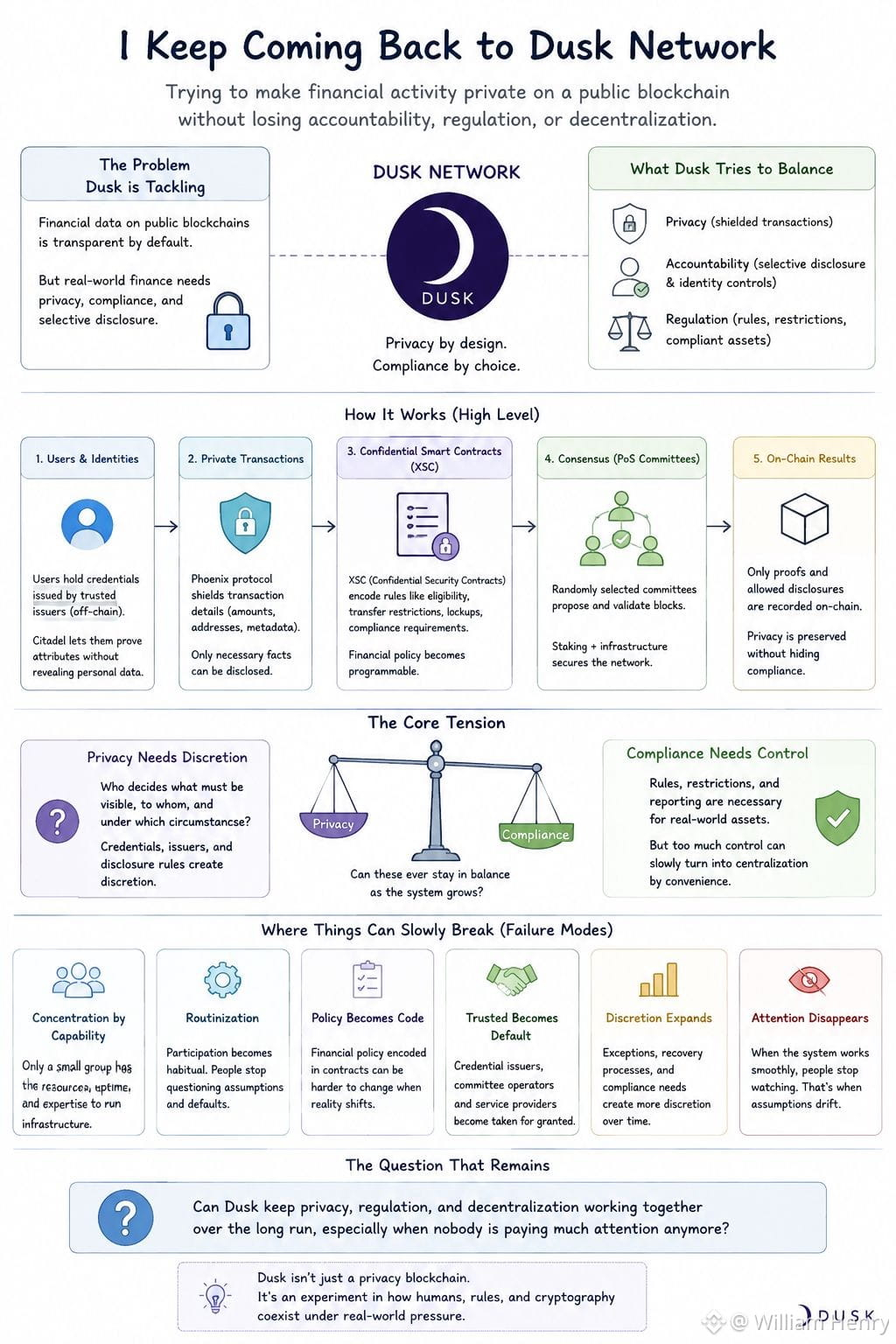

I keep coming back to @Dusk Network because it seems to be wrestling with a problem that blockchains usually avoid: how do you make financial activity private without simply recreating the closed systems that blockchains were supposed to challenge? Dusk is built around that tension. Its architecture combines confidential transactions, selective disclosure, identity controls and smart contracts designed for regulated financial assets, including its Confidential Security Contract standard.
What interests me is that Dusk does not treat privacy as disappearing completely. Its Phoenix model can shield transaction details, while Citadel allows users to prove that they possess valid credentials without putting the underlying personal information on-chain. That feels useful, but it also creates an uncomfortable question: who decides what should be proven, what should remain hidden, and who is trusted to issue the credentials in the first place?
I suspect this is where Dusk becomes less about cryptography and more about human behavior. The technology can enforce rules, but someone still has to design those rules. XSC contracts can encode things such as eligibility and transfer restrictions, which may make regulated assets easier to coordinate, but it also means financial policy can gradually become software policy.
And then there is decentralization. Dusk uses randomly selected committees for consensus, but participation still requires infrastructure, reliability and a minimum stake. Over time, I wonder whether the people with the most technical knowledge simply become the people everyone depends on.
Maybe that is what keeps pulling me back. Dusk is trying to make privacy, regulation and decentralization coexist, but those things do not naturally point in the same direction. Perhaps the real test is not whether Dusk can make them work today, but whether they still work together when nobody is paying much attention anymore.
@Dusk #dusk $DUSK
What interests me is that Dusk does not treat privacy as disappearing completely. Its Phoenix model can shield transaction details, while Citadel allows users to prove that they possess valid credentials without putting the underlying personal information on-chain. That feels useful, but it also creates an uncomfortable question: who decides what should be proven, what should remain hidden, and who is trusted to issue the credentials in the first place?
I suspect this is where Dusk becomes less about cryptography and more about human behavior. The technology can enforce rules, but someone still has to design those rules. XSC contracts can encode things such as eligibility and transfer restrictions, which may make regulated assets easier to coordinate, but it also means financial policy can gradually become software policy.
And then there is decentralization. Dusk uses randomly selected committees for consensus, but participation still requires infrastructure, reliability and a minimum stake. Over time, I wonder whether the people with the most technical knowledge simply become the people everyone depends on.
Maybe that is what keeps pulling me back. Dusk is trying to make privacy, regulation and decentralization coexist, but those things do not naturally point in the same direction. Perhaps the real test is not whether Dusk can make them work today, but whether they still work together when nobody is paying much attention anymore.
@Dusk #dusk $DUSK