I used to think one token was as good as any other. Same asset, same value, done. Then I watched how "tainted" coins get treated in crypto, and realised fungibility is a quiet assumption real markets can't live without.
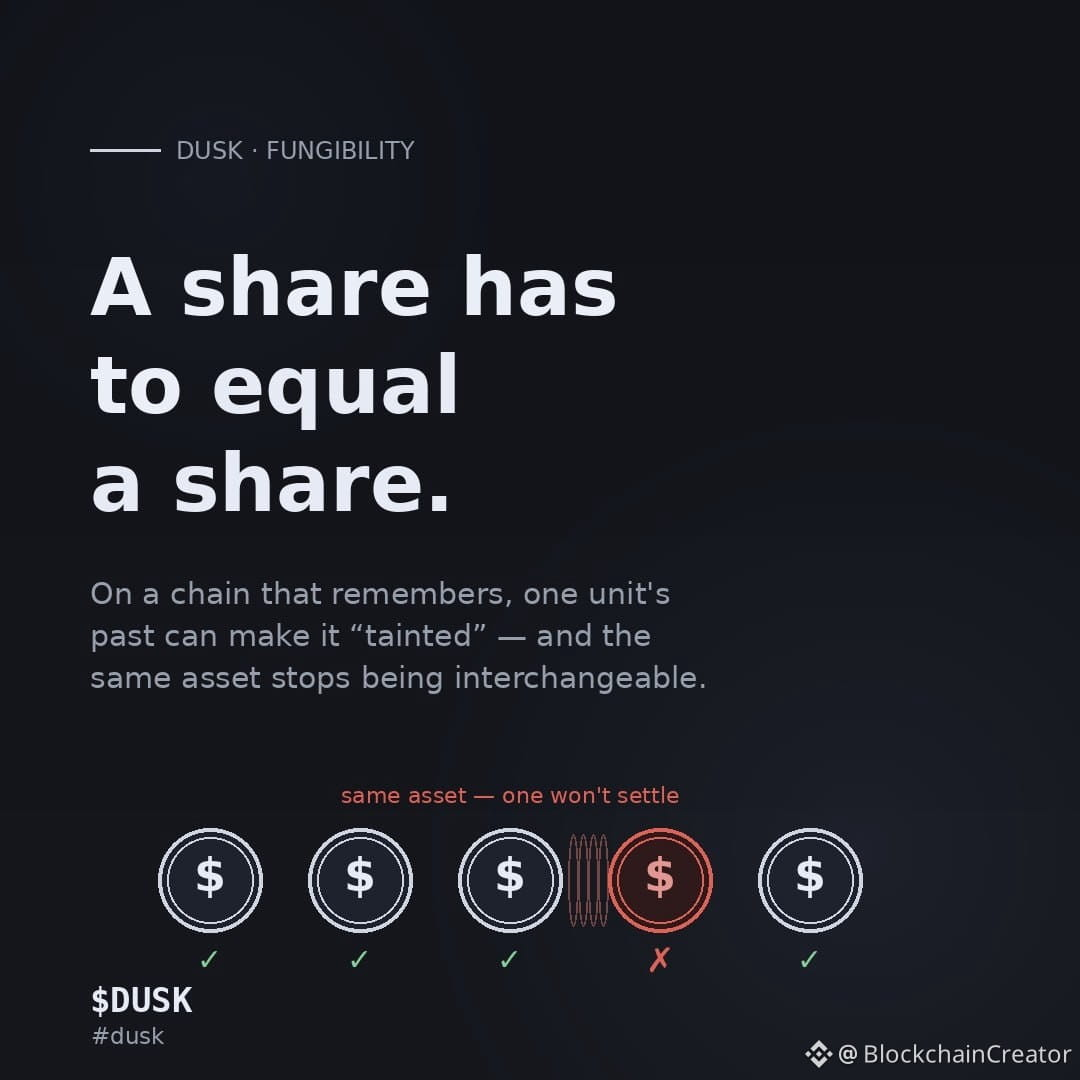
A security works only because its units are interchangeable — one share equals every other share, one unit of a bond is the same as the next. Prices, settlement and law all assume you never have to ask which specific unit you're holding. Public chains break that without meaning to. Every unit carries its history, and a coin that once touched a hacked or sanctioned address gets flagged — some venues freeze it or refuse it. Quietly, one unit is no longer equal to another. That's non-fungibility by surveillance.
For a regulated security it's a real mess: "clean" and "dirty" units of the same instrument, pricing and settling differently, is a nightmare no market wants. And you're squeezed — full transparency lets everyone taint-check but discriminates units by history; full opacity keeps them interchangeable but blinds the sanctions screening regulators require.
This is one of the few places a chain like Dusk's confidentiality helps fungibility, not just privacy: if a unit's past isn't public, it can't be casually discriminated, so a share stays a share — provided screening happens at the gate (only eligible, checked holders ever hold it) instead of the market re-litigating each unit's history after the fact.
The catch: you're then trusting the enforced rules rather than checking, and a genuinely tainted unit still needs a lawful, bounded way to be handled. What makes it fail: letting history leak until people price clean units above dirty ones of the same asset.
Worth watching, not yet worth certainty.
@Dusk
$DUSK
#dusk
A security works only because its units are interchangeable — one share equals every other share, one unit of a bond is the same as the next. Prices, settlement and law all assume you never have to ask which specific unit you're holding. Public chains break that without meaning to. Every unit carries its history, and a coin that once touched a hacked or sanctioned address gets flagged — some venues freeze it or refuse it. Quietly, one unit is no longer equal to another. That's non-fungibility by surveillance.
For a regulated security it's a real mess: "clean" and "dirty" units of the same instrument, pricing and settling differently, is a nightmare no market wants. And you're squeezed — full transparency lets everyone taint-check but discriminates units by history; full opacity keeps them interchangeable but blinds the sanctions screening regulators require.
This is one of the few places a chain like Dusk's confidentiality helps fungibility, not just privacy: if a unit's past isn't public, it can't be casually discriminated, so a share stays a share — provided screening happens at the gate (only eligible, checked holders ever hold it) instead of the market re-litigating each unit's history after the fact.
The catch: you're then trusting the enforced rules rather than checking, and a genuinely tainted unit still needs a lawful, bounded way to be handled. What makes it fail: letting history leak until people price clean units above dirty ones of the same asset.
Worth watching, not yet worth certainty.
@Dusk
$DUSK
#dusk