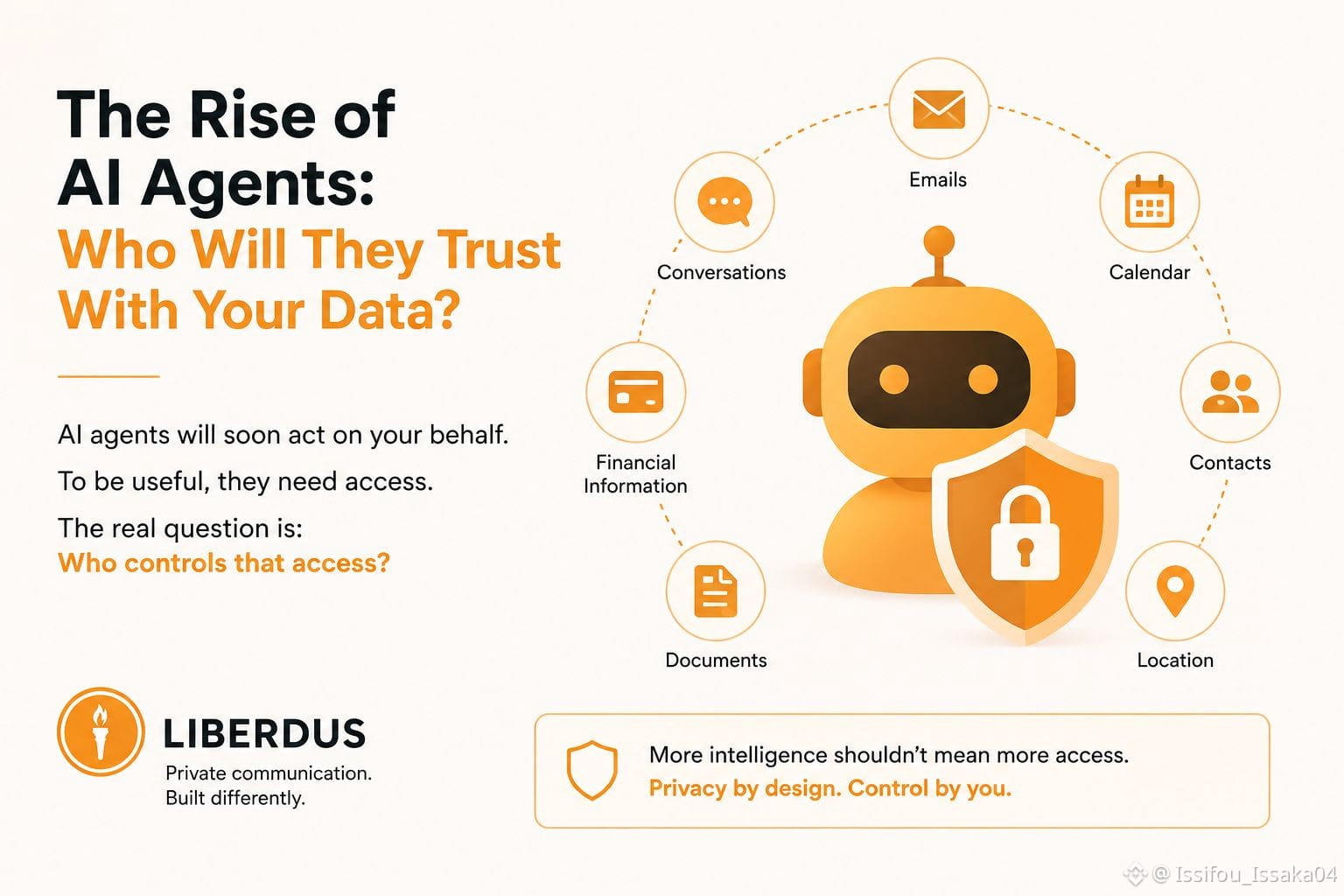
🤖 AI will get smarter. But will it become more trustworthy?
AI assistants already answer questions.
The next generation of AI agents will do much more:
📧 Manage emails
✈️ Book flights
🛒 Make purchases
📅 Schedule meetings
💰 Move money
But there's a bigger question:
Who will AI trust with your data?
For an AI agent to truly understand you, it may need access to your emails, calendar, contacts, location, documents, finances and conversations.
More context makes AI more powerful.
But it also makes a breach far more dangerous.
The biggest shift is agency.
AI won't just know things about you.
It could act on your behalf.
Send the message.
Buy the product.
Book the hotel.
Move the money.
So what happens when that agent is compromised?
The answer shouldn't be:
"Give AI access to everything and hope for the best."
Access should be:
🔐 Limited
🔑 Permission-based
👤 User-controlled
🌐 Privacy-first
And this is where the next decade of technology could get interesting.
For years, tech companies competed on users, engagement, personalization and data.
But as AI becomes more powerful, trust could become the real competitive advantage.
Users will ask:
Who has my data?
Where is it stored?
Who can access it?
Can I control it?
Can I delete it?
Ultimately:
Can I trust this technology with my digital life?
That's part of why decentralized, privacy-first projects like #Liberdus deserve attention.
Private communication.
Decentralized infrastructure.
Greater user control.
The future shouldn't be:
AI everywhere. Privacy nowhere.
It should be:
AI everywhere. Privacy by design. 🔐
#Liberdus #AI #Privacy #Web3
AI assistants already answer questions.
The next generation of AI agents will do much more:
📧 Manage emails
✈️ Book flights
🛒 Make purchases
📅 Schedule meetings
💰 Move money
But there's a bigger question:
Who will AI trust with your data?
For an AI agent to truly understand you, it may need access to your emails, calendar, contacts, location, documents, finances and conversations.
More context makes AI more powerful.
But it also makes a breach far more dangerous.
The biggest shift is agency.
AI won't just know things about you.
It could act on your behalf.
Send the message.
Buy the product.
Book the hotel.
Move the money.
So what happens when that agent is compromised?
The answer shouldn't be:
"Give AI access to everything and hope for the best."
Access should be:
🔐 Limited
🔑 Permission-based
👤 User-controlled
🌐 Privacy-first
And this is where the next decade of technology could get interesting.
For years, tech companies competed on users, engagement, personalization and data.
But as AI becomes more powerful, trust could become the real competitive advantage.
Users will ask:
Who has my data?
Where is it stored?
Who can access it?
Can I control it?
Can I delete it?
Ultimately:
Can I trust this technology with my digital life?
That's part of why decentralized, privacy-first projects like #Liberdus deserve attention.
Private communication.
Decentralized infrastructure.
Greater user control.
The future shouldn't be:
AI everywhere. Privacy nowhere.
It should be:
AI everywhere. Privacy by design. 🔐
#Liberdus #AI #Privacy #Web3