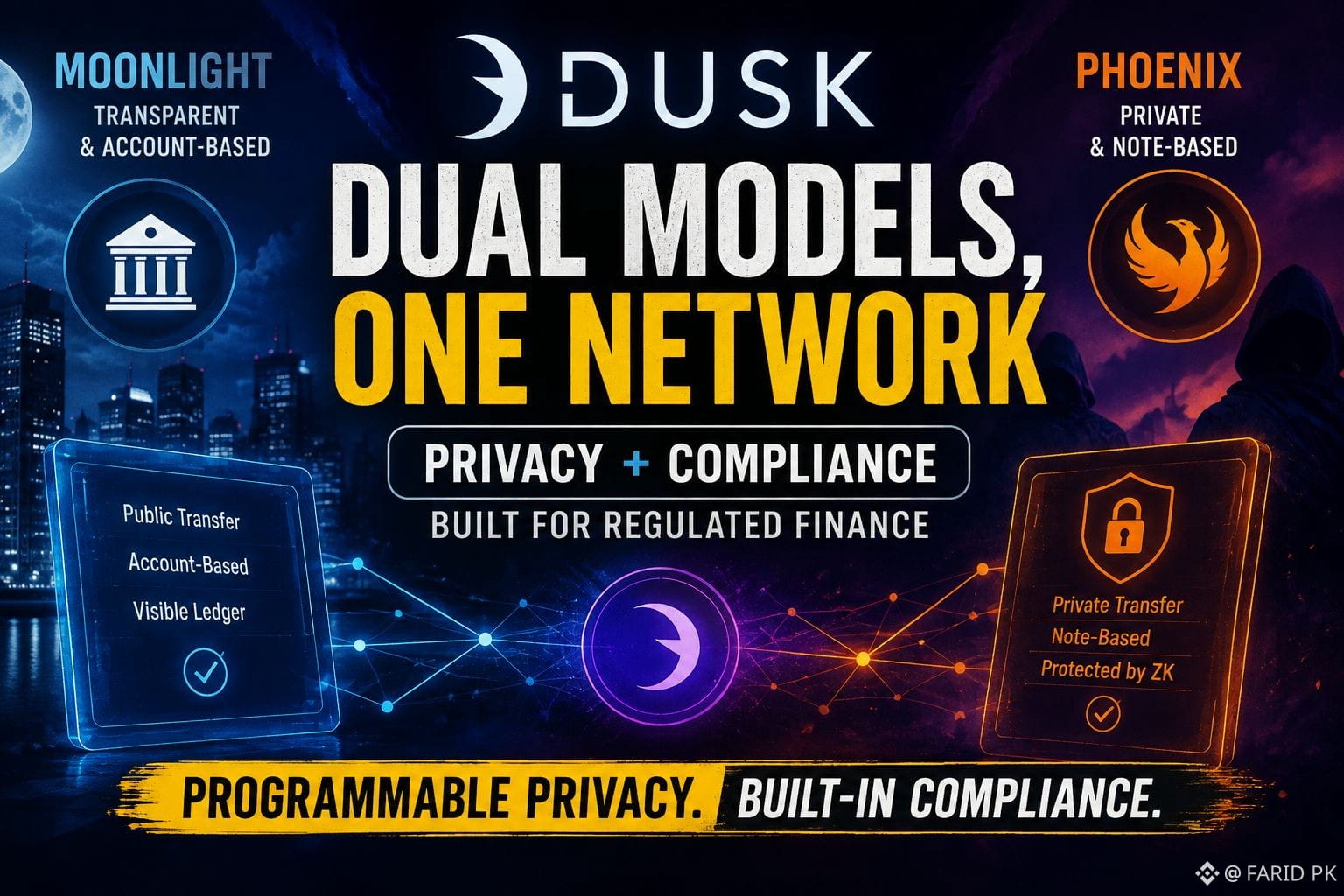
One detail about DUSK that deserves more attention is how privacy is treated as a transaction choice, not a separate privacy layer.
Dusk’s dual model design pairs Moonlight’s public, account-based transfers with Phoenix’s shielded, note-based transfers. Both are built into the DuskDS settlement layer, so an application can reason about transparent and confidential value movement within the same network architecture.
That matters for regulated finance because “private” and “visible” are not always permanent categories. A treasury flow may need public accounting, while an investor transfer may need confidentiality. Phoenix uses zero-knowledge proofs to hide transaction details, while selective disclosure can provide relevant evidence to authorized parties.
The interesting part is the programmable angle: privacy can become part of the financial workflow itself, alongside eligibility, transfer rules, and settlement, rather than being an afterthought.
One current caveat is important: Dusk’s June 2026 Boreas upgrade disabled Phoenix on mainnet. So the dual-model architecture is best understood as a design and protocol capability, not a claim that both models are currently active on mainnet.@Dusk $TUT $TAC #dusk $DUSK
Dusk’s dual model design pairs Moonlight’s public, account-based transfers with Phoenix’s shielded, note-based transfers. Both are built into the DuskDS settlement layer, so an application can reason about transparent and confidential value movement within the same network architecture.
That matters for regulated finance because “private” and “visible” are not always permanent categories. A treasury flow may need public accounting, while an investor transfer may need confidentiality. Phoenix uses zero-knowledge proofs to hide transaction details, while selective disclosure can provide relevant evidence to authorized parties.
The interesting part is the programmable angle: privacy can become part of the financial workflow itself, alongside eligibility, transfer rules, and settlement, rather than being an afterthought.
One current caveat is important: Dusk’s June 2026 Boreas upgrade disabled Phoenix on mainnet. So the dual-model architecture is best understood as a design and protocol capability, not a claim that both models are currently active on mainnet.@Dusk $TUT $TAC #dusk $DUSK