How One-Sided Liquidity Works Inside STON.fi V2
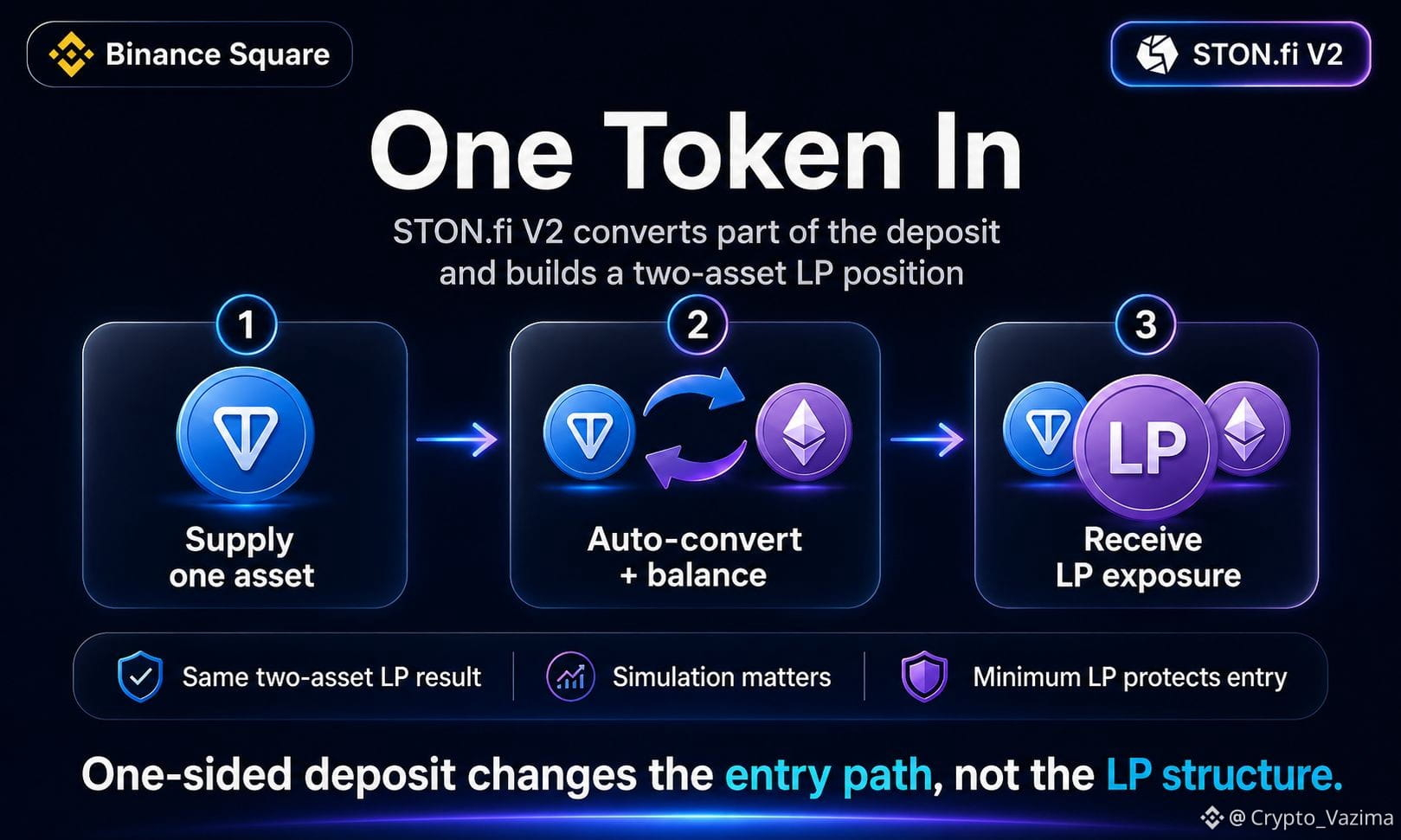
STON.fi V2 one-sided liquidity lets you add to an existing pool with only one token. The contracts handle the internal conversion so your LP tokens still represent a full two-sided position.
🔥 What “one-sided” really delivers
- Start with a single pool asset.
- Protocol swaps part of it for the paired token.
- Both resulting amounts mint LP tokens.
- Final position is always a share of both reserves.
🚀 The exact flow from deposit to LP
You select a live pool, simulate an Arbitrary provision with the second amount set to zero, review the expected LP units and minimum, then submit only the funded token. The V2 contracts perform the swap and mint when conditions are met.
This is not the same as a Balanced simulation that calculates a matching second amount. Single-sided is the zero-amount case of Arbitrary provision.
🧠 Why the internal swap still matters
- Pool depth changes execution quality.
- Larger deposits relative to liquidity create more price impact.
- Current per-pool fees affect the economics.
- Simulation is required because a fixed 50/50 split is not guaranteed.
💬 Practical takeaway for users
One-sided entry compresses a manual swap-plus-deposit into one workflow. It does not keep you economically exposed to only the original token. When you later withdraw, both assets come back according to the pool’s then-current ratio. Impermanent loss remains part of the picture once the LP position exists.
Would you check the simulated LP output before every one-sided deposit? 👇
Tell me the first thing you would verify in the simulation.
Not investment advice - research on your own! 🚀
$GRAM @STONfi DEX
STON.fi V2 one-sided liquidity lets you add to an existing pool with only one token. The contracts handle the internal conversion so your LP tokens still represent a full two-sided position.
🔥 What “one-sided” really delivers
- Start with a single pool asset.
- Protocol swaps part of it for the paired token.
- Both resulting amounts mint LP tokens.
- Final position is always a share of both reserves.
🚀 The exact flow from deposit to LP
You select a live pool, simulate an Arbitrary provision with the second amount set to zero, review the expected LP units and minimum, then submit only the funded token. The V2 contracts perform the swap and mint when conditions are met.
This is not the same as a Balanced simulation that calculates a matching second amount. Single-sided is the zero-amount case of Arbitrary provision.
🧠 Why the internal swap still matters
- Pool depth changes execution quality.
- Larger deposits relative to liquidity create more price impact.
- Current per-pool fees affect the economics.
- Simulation is required because a fixed 50/50 split is not guaranteed.
💬 Practical takeaway for users
One-sided entry compresses a manual swap-plus-deposit into one workflow. It does not keep you economically exposed to only the original token. When you later withdraw, both assets come back according to the pool’s then-current ratio. Impermanent loss remains part of the picture once the LP position exists.
Would you check the simulated LP output before every one-sided deposit? 👇
Tell me the first thing you would verify in the simulation.
Not investment advice - research on your own! 🚀
$GRAM @STONfi DEX