78

نشر

--هابط

ZOXO 78
·
--
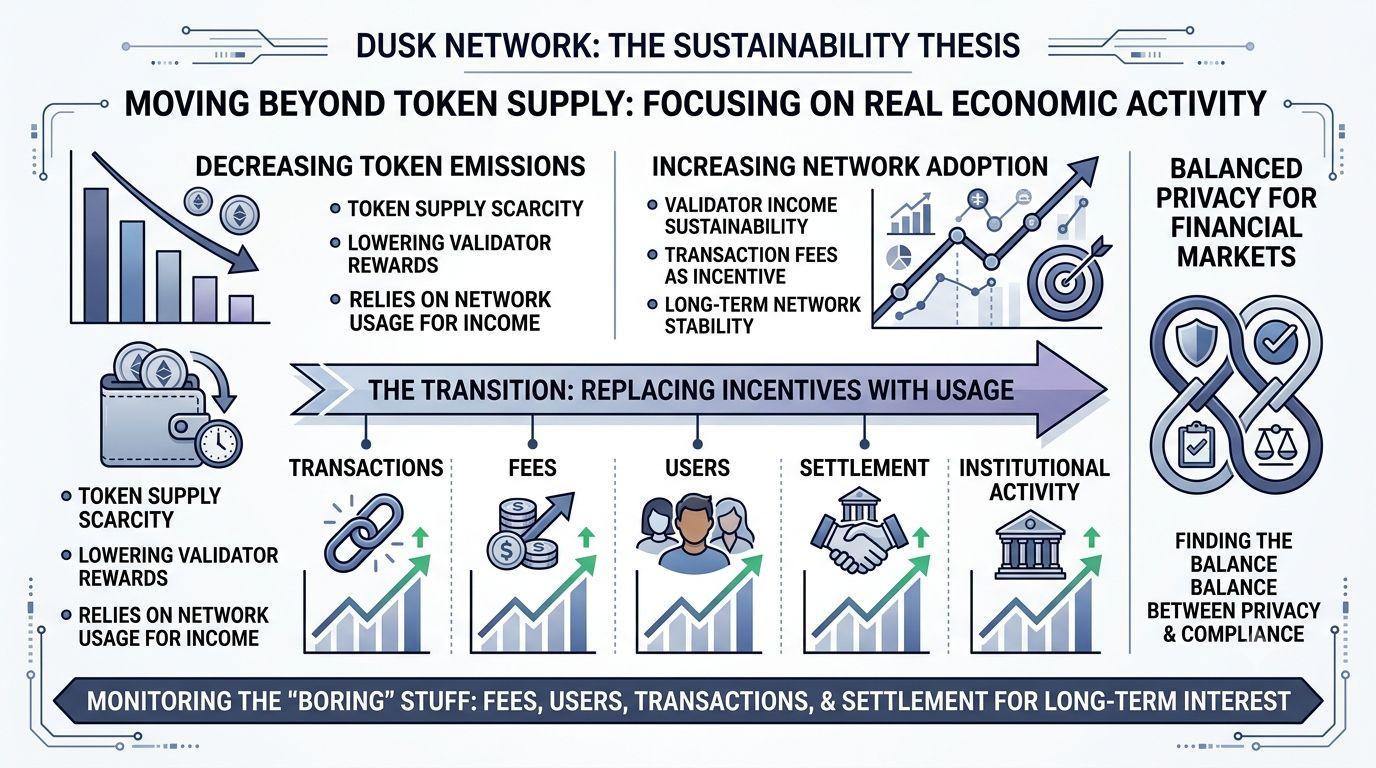
صاعدI’ve stopped looking at Dusk purely from the token-supply angle. What matters more to me now is whether the network can actually generate enough real activity to support itself over time.
Yes, lower emissions can help create scarcity. But scarcity alone doesn’t make a network sustainable. If validator rewards keep declining while fees remain low, something has to make up the difference. That’s where real usage becomes important.
I’d rather watch what people are actually doing than get caught up in another bullish narrative. Are transactions increasing? Are fees growing? Are more users coming in? Are institutions really putting assets or financial activity on the network? Those answers matter far more to me than another big promise.
Privacy is another reason I keep Dusk on my radar. I like that the goal isn’t simply to hide everything. Financial markets need privacy, but they also need verification, compliance, and accountability. Finding a workable balance between those things could be one of the more important parts of Dusk’s long-term story.
For me, the thesis is pretty straightforward: falling emissions only matter if real economic activity can eventually replace that lost incentive.
So I’m watching the boring stuff fees, validator income, users, transactions, and settlement. If those numbers start moving in the right direction, that’s when Dusk becomes much more interesting to me.
@Dusk #dusk $DUSK
$PROM
Yes, lower emissions can help create scarcity. But scarcity alone doesn’t make a network sustainable. If validator rewards keep declining while fees remain low, something has to make up the difference. That’s where real usage becomes important.
I’d rather watch what people are actually doing than get caught up in another bullish narrative. Are transactions increasing? Are fees growing? Are more users coming in? Are institutions really putting assets or financial activity on the network? Those answers matter far more to me than another big promise.
Privacy is another reason I keep Dusk on my radar. I like that the goal isn’t simply to hide everything. Financial markets need privacy, but they also need verification, compliance, and accountability. Finding a workable balance between those things could be one of the more important parts of Dusk’s long-term story.
For me, the thesis is pretty straightforward: falling emissions only matter if real economic activity can eventually replace that lost incentive.
So I’m watching the boring stuff fees, validator income, users, transactions, and settlement. If those numbers start moving in the right direction, that’s when Dusk becomes much more interesting to me.
@Dusk #dusk $DUSK
$PROM
إخلاء مسؤولية: يتضمن آراء جهات خارجية. لا تُعدّ نصيحة. يُمكن استخدام Binance AI دون أي ضمان. اطلع على الشروط والأحكام.