#dusk $DUSK @Dusk
opened Dusk’s CreatorPad task expecting another privacy focused narrative around Hedger and auditable zero knowledge proofs. Instead, what caught my attention was how the system behaved when something actually went wrong.
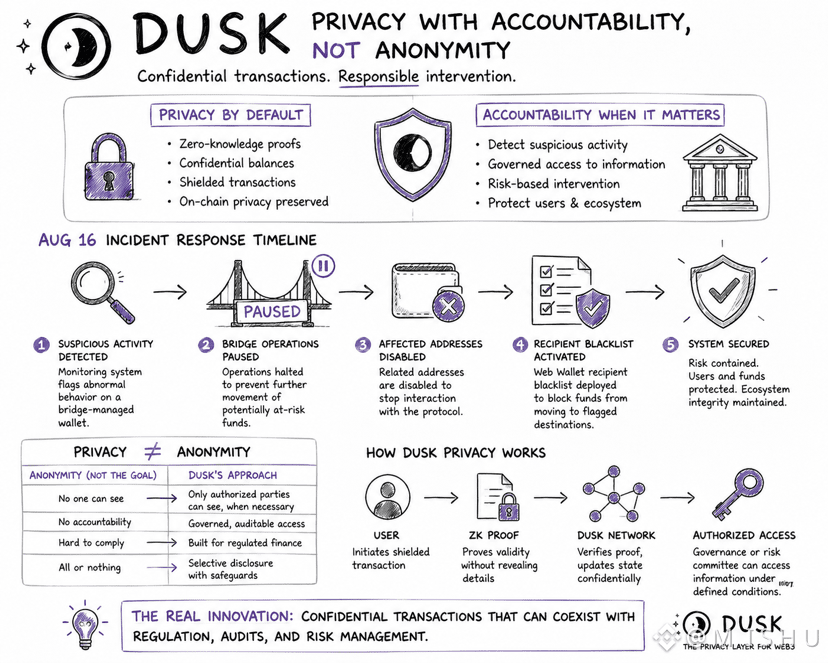
On August 16, the team detected suspicious activity involving a bridge managed wallet. Within hours, bridge operations were paused, affected addresses were disabled, and a recipient blacklist was deployed to prevent funds from reaching flagged destinations.
That response changes how I think about Dusk’s privacy model.
Many people hear “privacy by default” and assume complete anonymity. What Dusk appears to be building is something different: confidentiality with accountability. Transaction details can remain protected from public view, while the network still retains mechanisms to intervene when security, compliance, or asset protection require action.
For regulated finance, that distinction matters.
The real question may not be whether transactions are private, but who can access information under specific conditions, how that access is governed, and what safeguards exist around intervention powers.
Privacy is easy to market. Designing privacy that can coexist with regulation, audits, and risk management is the harder challenge and arguably the more important one.
opened Dusk’s CreatorPad task expecting another privacy focused narrative around Hedger and auditable zero knowledge proofs. Instead, what caught my attention was how the system behaved when something actually went wrong.
On August 16, the team detected suspicious activity involving a bridge managed wallet. Within hours, bridge operations were paused, affected addresses were disabled, and a recipient blacklist was deployed to prevent funds from reaching flagged destinations.
That response changes how I think about Dusk’s privacy model.
Many people hear “privacy by default” and assume complete anonymity. What Dusk appears to be building is something different: confidentiality with accountability. Transaction details can remain protected from public view, while the network still retains mechanisms to intervene when security, compliance, or asset protection require action.
For regulated finance, that distinction matters.
The real question may not be whether transactions are private, but who can access information under specific conditions, how that access is governed, and what safeguards exist around intervention powers.
Privacy is easy to market. Designing privacy that can coexist with regulation, audits, and risk management is the harder challenge and arguably the more important one.