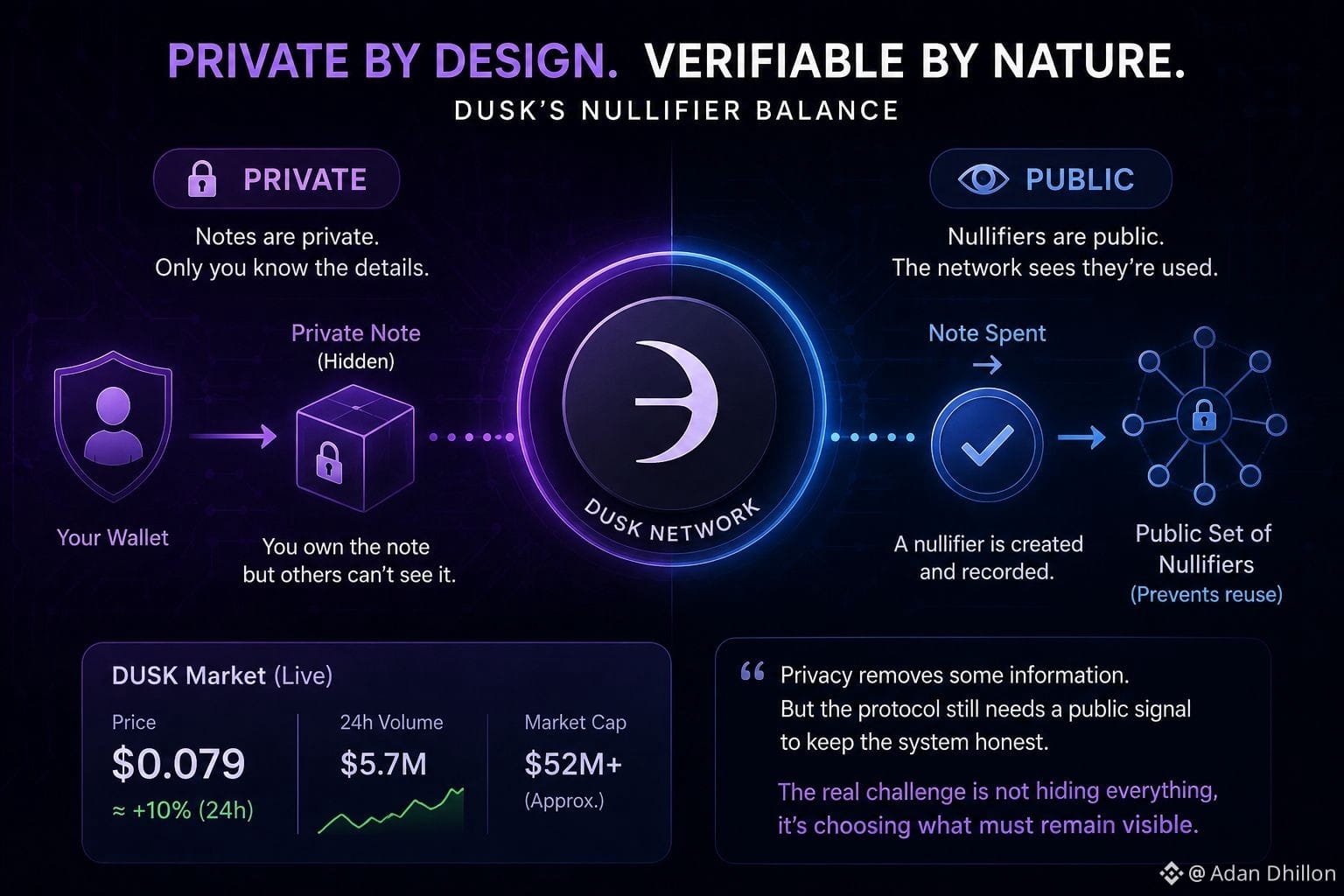
At first I assumed Dusk’s privacy model was mainly about making individual transactions harder to inspect. But the more I looked at Phoenix, the more the nullifier design made me think about a different boundary. A spent note can remain private while its nullifier is kept in a public set so the same output cannot be spent again. What caught my attention is the separation between the private thing being spent and the small piece of information needed to prove it has already been consumed. The network does not need to expose the note itself just to enforce that rule. That creates an interesting contrast: privacy removes some transaction information, but the protocol still needs a persistent public signal to prevent reuse. Maybe that is simply where private transaction systems have to draw the line. You can hide the asset history, but you still need something the network can recognize as already used. So the quieter question is whether financial privacy is really about hiding activity, or about carefully deciding which parts of activity must remain observable?
$DUSK @Dusk #dusk
$DUSK @Dusk #dusk