
TermMax: The Metrics That Matter After the Headline Numbers
The more I study TermMax, the less interested I become in headline figures and the more attention I pay to what happens underneath them.
A registered wallet count of 1.5 million sounds impressive, but that number becomes much less meaningful when compared with roughly $90 million in reported TVL. The resulting average is only about $60 per wallet. That does not automatically suggest weak user acquisition. Instead, it raises a more important question: how effectively are those wallets being activated?
The real signal is not how many addresses exist, but how many users actually deploy capital, complete a fixed-term position, return after maturity, and allocate funds again. Repeat behavior would tell us far more about product-market fit than a large wallet headline.
The same principle applies to TMX tokenomics. A maximum supply of 1 billion TMX is straightforward, and a fixed supply removes one layer of uncertainty around future inflation. But scarcity alone does not create sustainable value. The harder variable is demand. The important question is whether users, liquidity providers, governance participants, or other ecosystem participants have enough reasons to consistently want and use TMX.
Multichain expansion deserves the same scrutiny. TermMax reportedly spans ten EVM-compatible networks, which creates broader access and potentially opens new liquidity channels. Yet distribution across chains can also dilute liquidity. If $90 million of TVL were divided evenly, that would represent only around $9 million per chain. Real markets will never distribute capital perfectly evenly, but the comparison highlights an important distinction: being available everywhere is not the same as being liquid everywhere.
For fixed-rate markets, depth matters. Borrowers need reliable execution, lenders need confidence that capital can be deployed efficiently, and rates need enough participation to remain competitive. Expansion is valuable when it strengthens these conditions, not merely when it increases the number of supported networks.
Another metric I would watch closely is idle capital. If a meaningful portion of vault assets is continuously routed into external protocols such as Aave, Morpho, or Venus rather than TermMax fixed-term markets, there are two possible interpretations. It could demonstrate intelligent capital management by curators. But it could also indicate that native fixed-term borrowing demand is not yet deep enough to absorb available liquidity.
Ultimately, I think the strongest test is performance over time. Over a 90-day period, how often does a locked TermMax rate outperform the floating-rate alternative that users could have chosen instead?
That comparison connects everything: activation, retention, liquidity, borrower demand, vault efficiency, and real user value.
TMX supply is easy to count.
The harder numbers are the ones that reveal whether the market is actually working.
If those metrics improve together, the story becomes stronger. More active wallets would mean participation; repeat usage would suggest retention; fixed-term volumes would support market depth; and consistent rate performance would show that users have something they cannot replicate elsewhere. That is the evidence I would prioritize.


مقالة
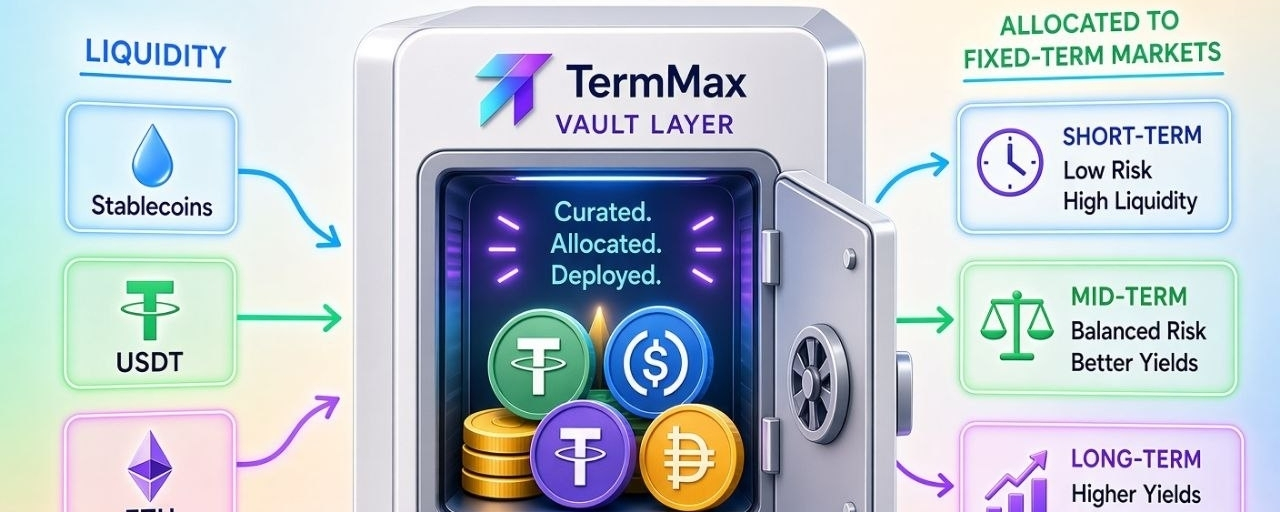
Mind share regarding TermMax Vault Layer.
إخلاء مسؤولية: يتضمن آراء جهات خارجية. لا تُعدّ نصيحة. يُمكن استخدام Binance AI دون أي ضمان. اطلع على الشروط والأحكام.