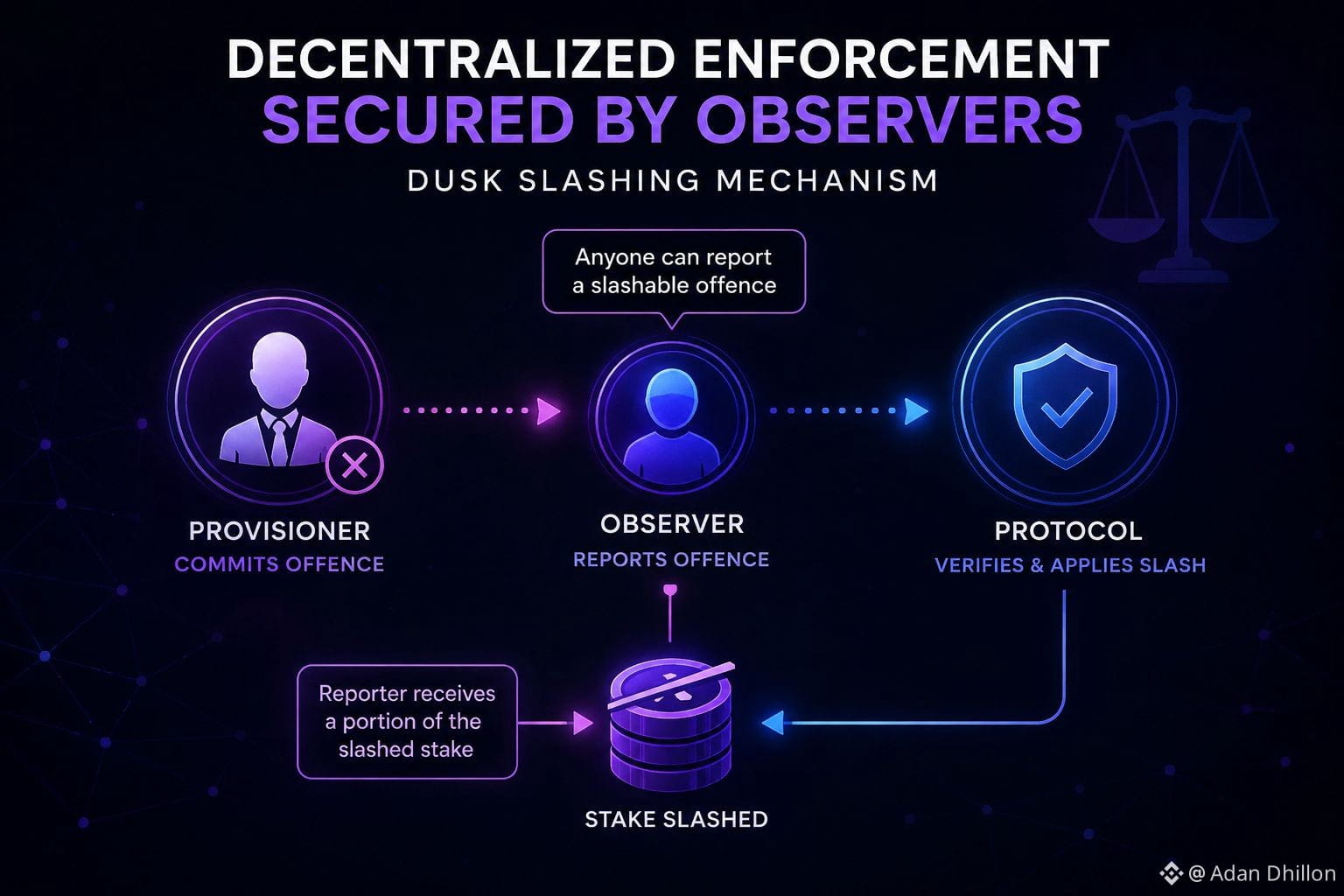
At first I assumed Dusk’s slashing mechanism was mainly about punishing Provisioners who violate the rules. But the more I looked, the more the reporting side stood out. A slashable offence can be reported by another protocol participant, and the reporter can receive part of the stake that gets revoked. What caught my attention is that enforcement therefore depends on more than the penalty itself. Someone still has to notice the behaviour and bring the offence into the protocol’s enforcement process. The reward gives that observer a reason to do so, but it also creates a quiet dependency on participants paying attention to what others are doing. I had not really thought about slashing from the observer’s side before. Maybe that is simply the trade-off of making misconduct discoverable beyond the committee itself. It makes the enforcement process feel less like a single rule and more like a relationship between the actor being monitored and the participants doing the monitoring. So the quieter question is whether decentralized enforcement depends as much on the incentives of observers as on the penalty facing validators?
#dusk $DUSK @Dusk
#dusk $DUSK @Dusk