#termmax
Think about putting in your money and letting the system take care of everything else.
Your money flows through different markets, looks for good chances, works with other available funds, and follows the rules set in the protocol.
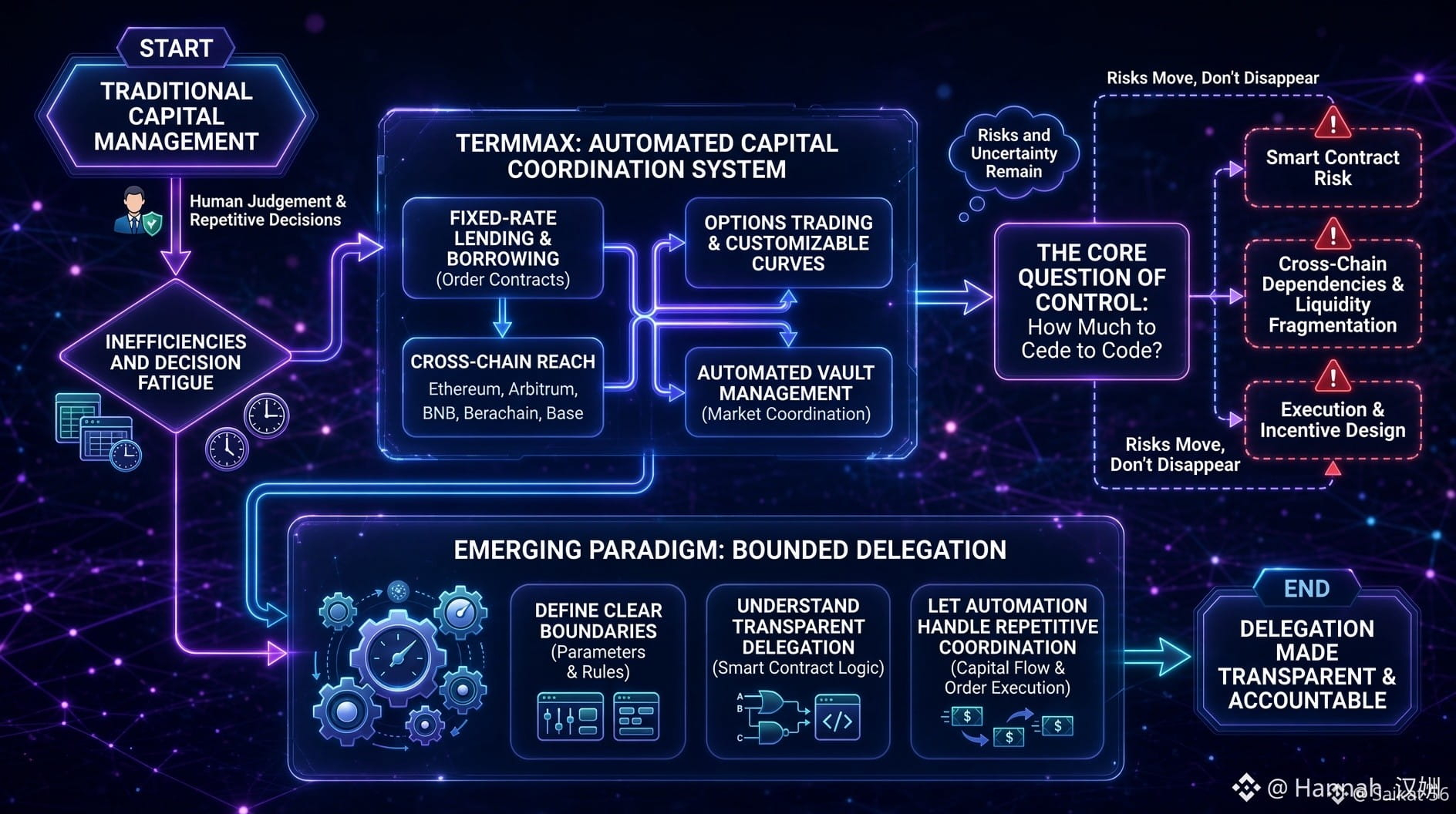
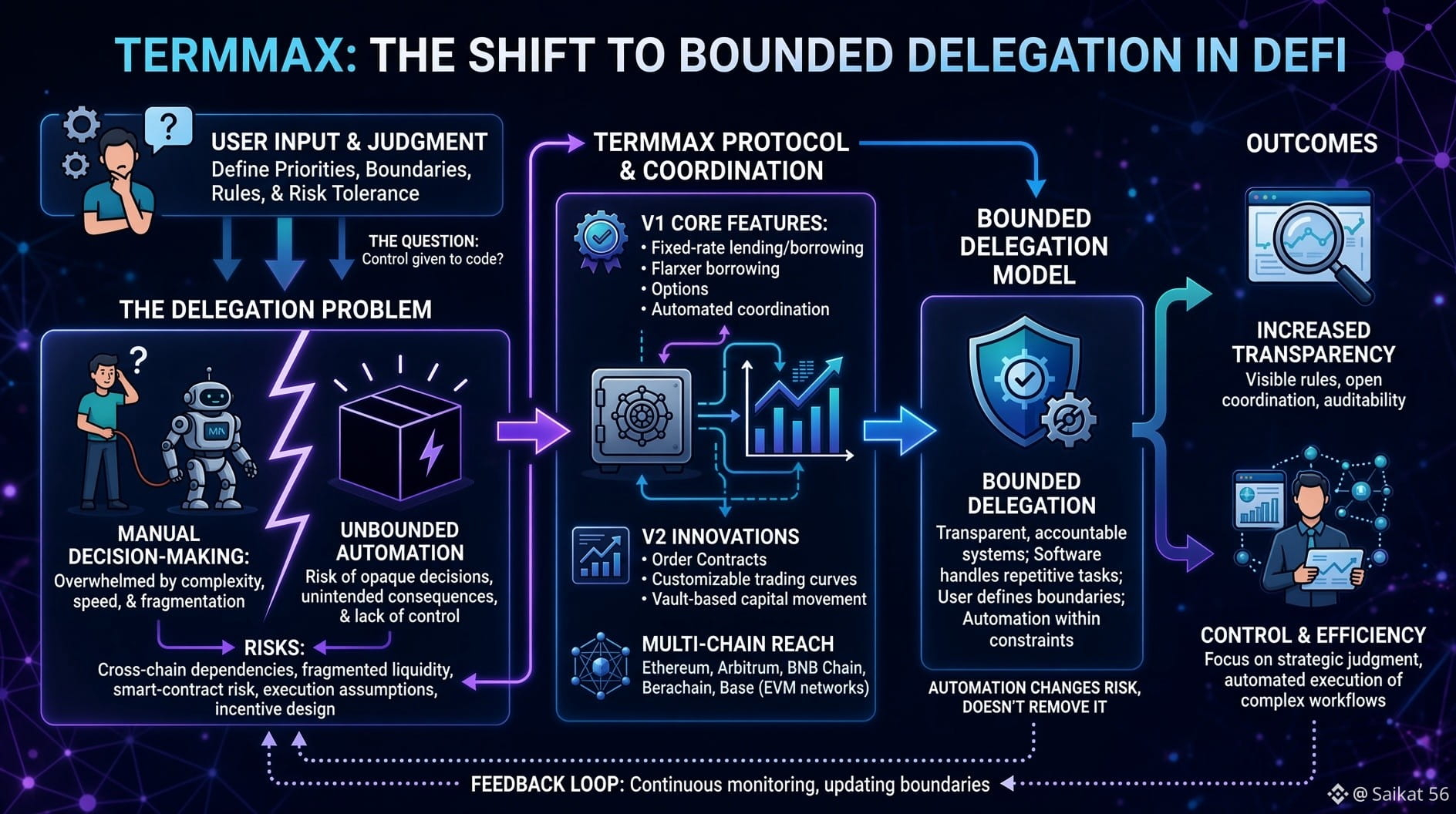
That's the kind of direction @TermMax is looking into by offering fixed-rate lending and borrowing, options, automated capital coordination, and its updated version of order contracts along with customizable trading curves.
Its vault model builds on that concept by introducing capital that can work together across various markets rather than staying separate.
Then there’s the multi-chain side.
Ethereum, Arbitrum, BNB Chain, Berachain, Base, and other compatible EVM networks can help increase access and options.
But the more convenient automation becomes, the more one question stays with me:
Where does the risk go?
Automation can take over repetitive tasks, but it doesn't remove the unknown factors.
Cross-chain dependencies still exist.
Liquidity can still fragment. Smart contracts can still fail. Execution relies on certain assumptions, and the incentives in place can lead people to act in ways that weren't originally intended.
The risk doesn’t disappear.
It simply moves through a different system.
That’s why the concept I find most intriguing is bounded delegation.
I don’t necessarily want software deciding everything for me.
I want to set the boundaries.
I want to understand the rules.
Once the boundaries are set, let automation take care of the repetitive coordination within those limits.
The question is not about whether code can take the place of human judgment, but whether it can help make the process of delegating tasks clearer, more transparent, and more accountable.
$BTC $ETH
Think about putting in your money and letting the system take care of everything else.
Your money flows through different markets, looks for good chances, works with other available funds, and follows the rules set in the protocol.
That's the kind of direction @TermMax is looking into by offering fixed-rate lending and borrowing, options, automated capital coordination, and its updated version of order contracts along with customizable trading curves.
Its vault model builds on that concept by introducing capital that can work together across various markets rather than staying separate.
Then there’s the multi-chain side.
Ethereum, Arbitrum, BNB Chain, Berachain, Base, and other compatible EVM networks can help increase access and options.
But the more convenient automation becomes, the more one question stays with me:
Where does the risk go?
Automation can take over repetitive tasks, but it doesn't remove the unknown factors.
Cross-chain dependencies still exist.
Liquidity can still fragment. Smart contracts can still fail. Execution relies on certain assumptions, and the incentives in place can lead people to act in ways that weren't originally intended.
The risk doesn’t disappear.
It simply moves through a different system.
That’s why the concept I find most intriguing is bounded delegation.
I don’t necessarily want software deciding everything for me.
I want to set the boundaries.
I want to understand the rules.
Once the boundaries are set, let automation take care of the repetitive coordination within those limits.
The question is not about whether code can take the place of human judgment, but whether it can help make the process of delegating tasks clearer, more transparent, and more accountable.
$BTC $ETH