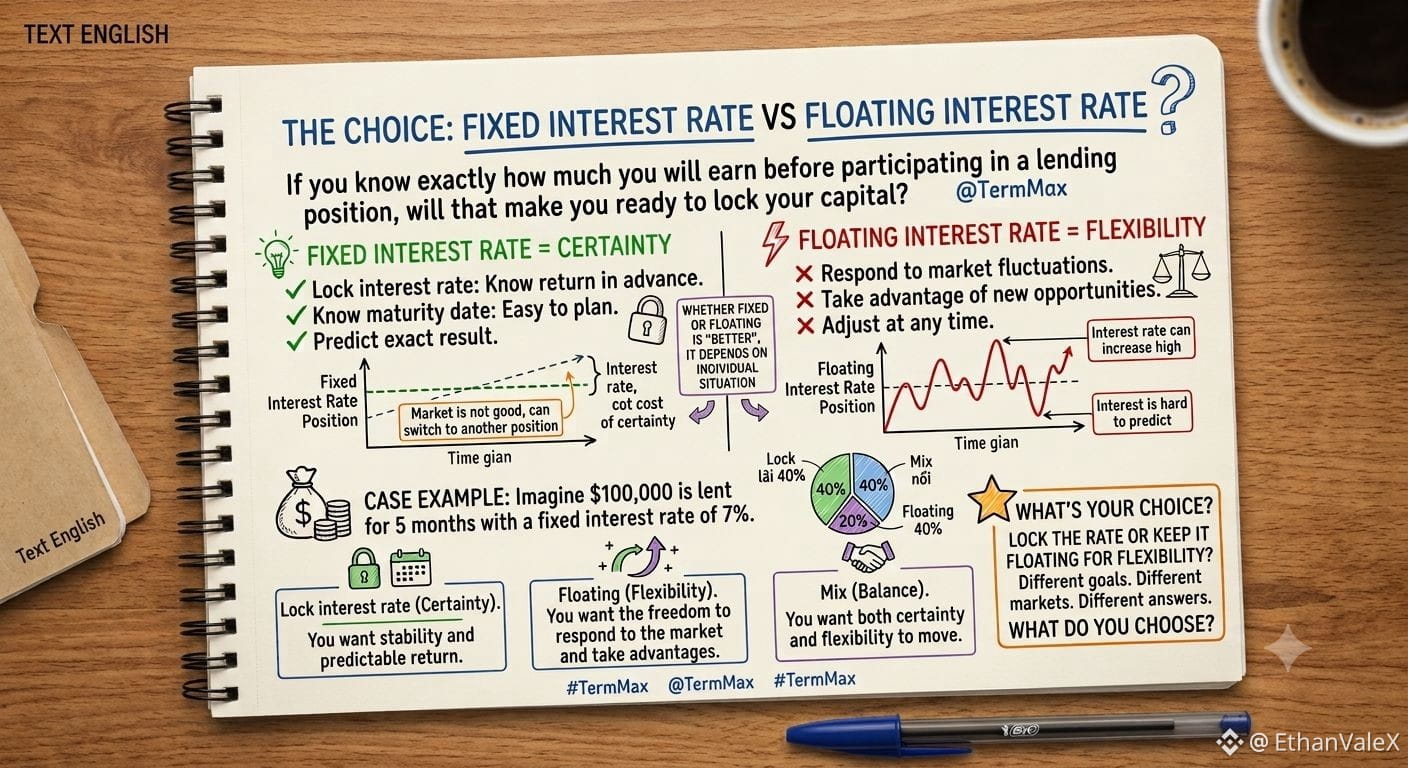
If you knew exactly what you'd earn before entering a lending position, would that make you more willing to lock your capital?
This question kept coming back to me while I was looking at @TermMax .
Fixed-rate lending gives you something valuable: certainty. You know the rate, you know the maturity, and you can plan around the position.
But certainty has a cost.
Rates can move higher after you enter. A better opportunity might appear elsewhere. Your fixed position won't move with them.
That's what makes the choice interesting. You get a more predictable outcome, but you give up some flexibility when the market changes.
Floating rates work the other way. You can react to new opportunities, but your future return is harder to predict.
Fixed rate gives you certainty.
Floating rate gives you flexibility.
Now imagine $8,000 lent for 5 months at a 7% fixed rate.
Would you lock it in or stay floating for the upside?
#TermMax
This question kept coming back to me while I was looking at @TermMax .
Fixed-rate lending gives you something valuable: certainty. You know the rate, you know the maturity, and you can plan around the position.
But certainty has a cost.
Rates can move higher after you enter. A better opportunity might appear elsewhere. Your fixed position won't move with them.
That's what makes the choice interesting. You get a more predictable outcome, but you give up some flexibility when the market changes.
Floating rates work the other way. You can react to new opportunities, but your future return is harder to predict.
Fixed rate gives you certainty.
Floating rate gives you flexibility.
Now imagine $8,000 lent for 5 months at a 7% fixed rate.
Would you lock it in or stay floating for the upside?
#TermMax