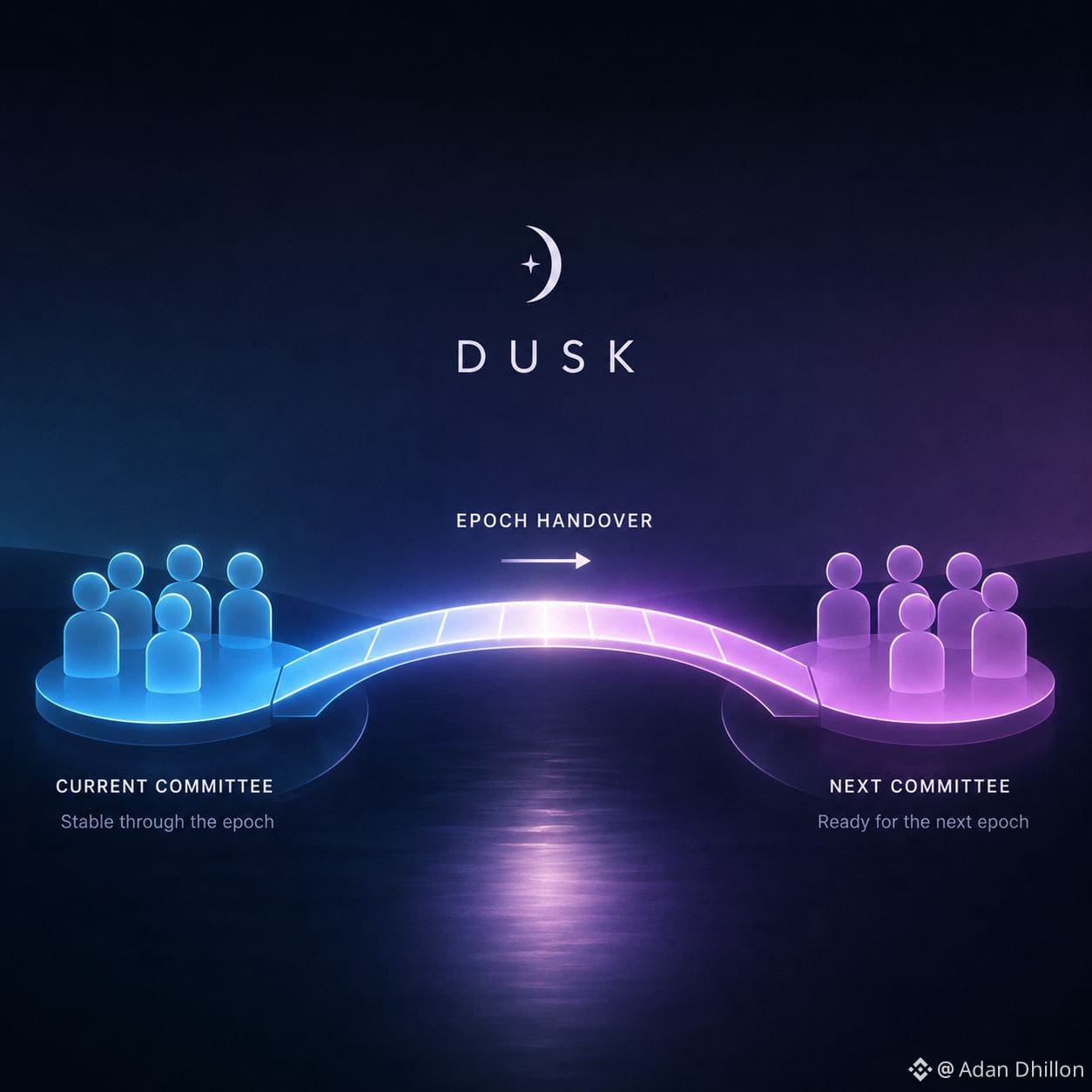
At first I assumed Dusk’s consensus committees were effectively changing from one block to the next. But the more I looked, the more the epoch boundary stood out. Dusk keeps the Generator and Provisioner sets unchanged across an epoch, while the same epoch seed is used during that period. What caught my attention is that committee selection is therefore not a fresh coordination task for every round. There is a period where the network deliberately keeps its consensus context stable. That seems to reduce churn, but it also means the transition between epochs becomes its own small coordination point. Eventually the old participant set has to give way to a new one without making that change itself become a source of uncertainty. Maybe that is simply the trade-off of keeping committees stable for multiple rounds. It made me look at committee rotation less as a selection problem and more as a handover problem. So maybe the question isn’t how Dusk chooses the next committee, but how cleanly a decentralized network can move from one trusted context to another?
#dusk $DUSK @Dusk
#dusk $DUSK @Dusk