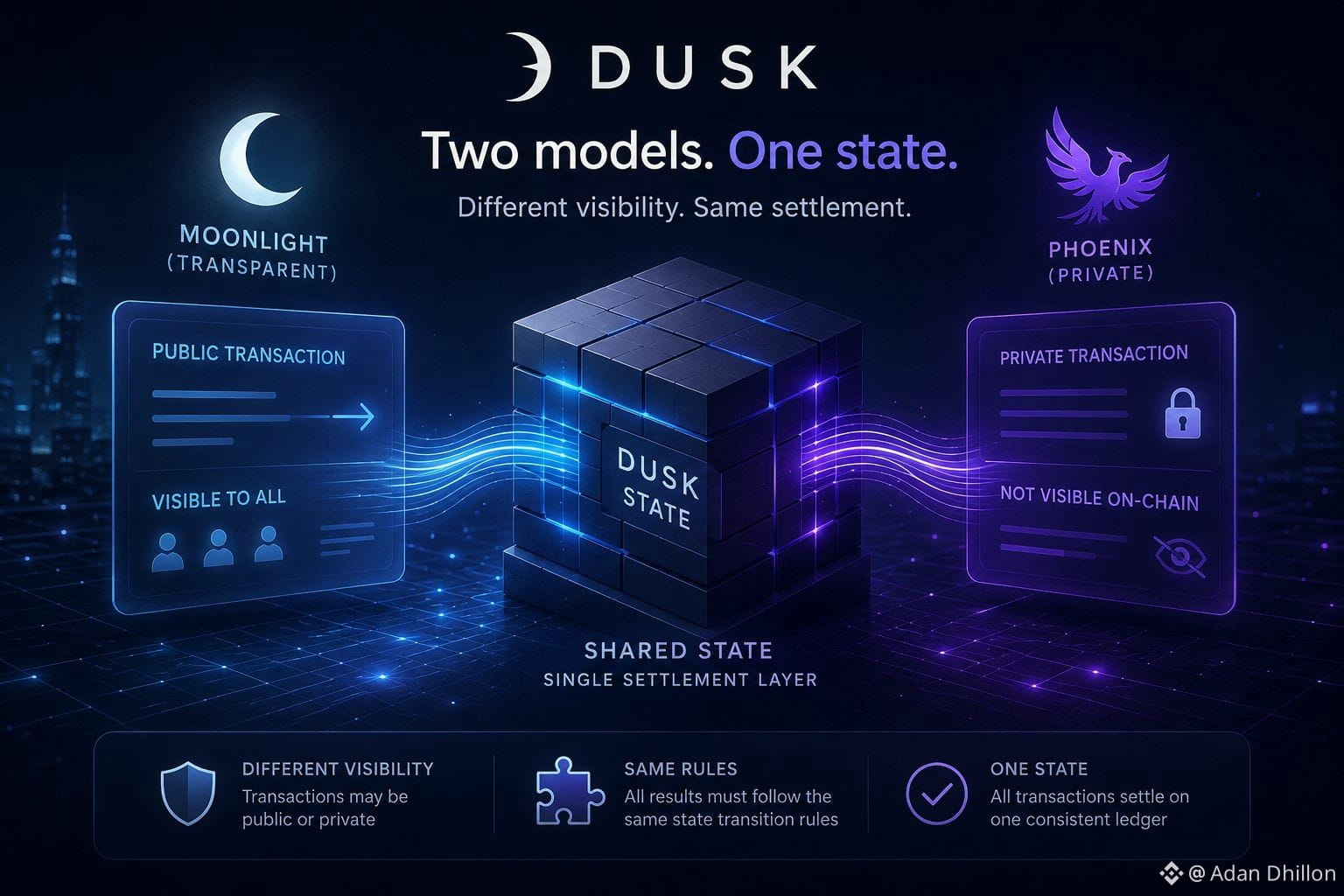
At first I assumed Dusk’s different transaction models were mostly a choice between public and private transfers. But the more I looked, the more the shared state underneath them caught my attention. Dusk can process transactions with different visibility properties, yet their effects still have to settle against one consistent state. The interesting part is that privacy does not create a second accounting system. It changes what can be observed around a transaction while leaving the underlying state transition subject to the same network rules. That creates a quiet dependency: different verification paths still have to agree on the same result, even when the information available to observers is not the same. I’m not sure this is a problem, but it does move some of the complexity into keeping those paths aligned. That feels less like a privacy question and more like a coordination problem between different views of the same ledger. So maybe the quieter question is how much information participants need to share when they still have to agree on one state?
$DUSK @Dusk #dusk
$DUSK @Dusk #dusk