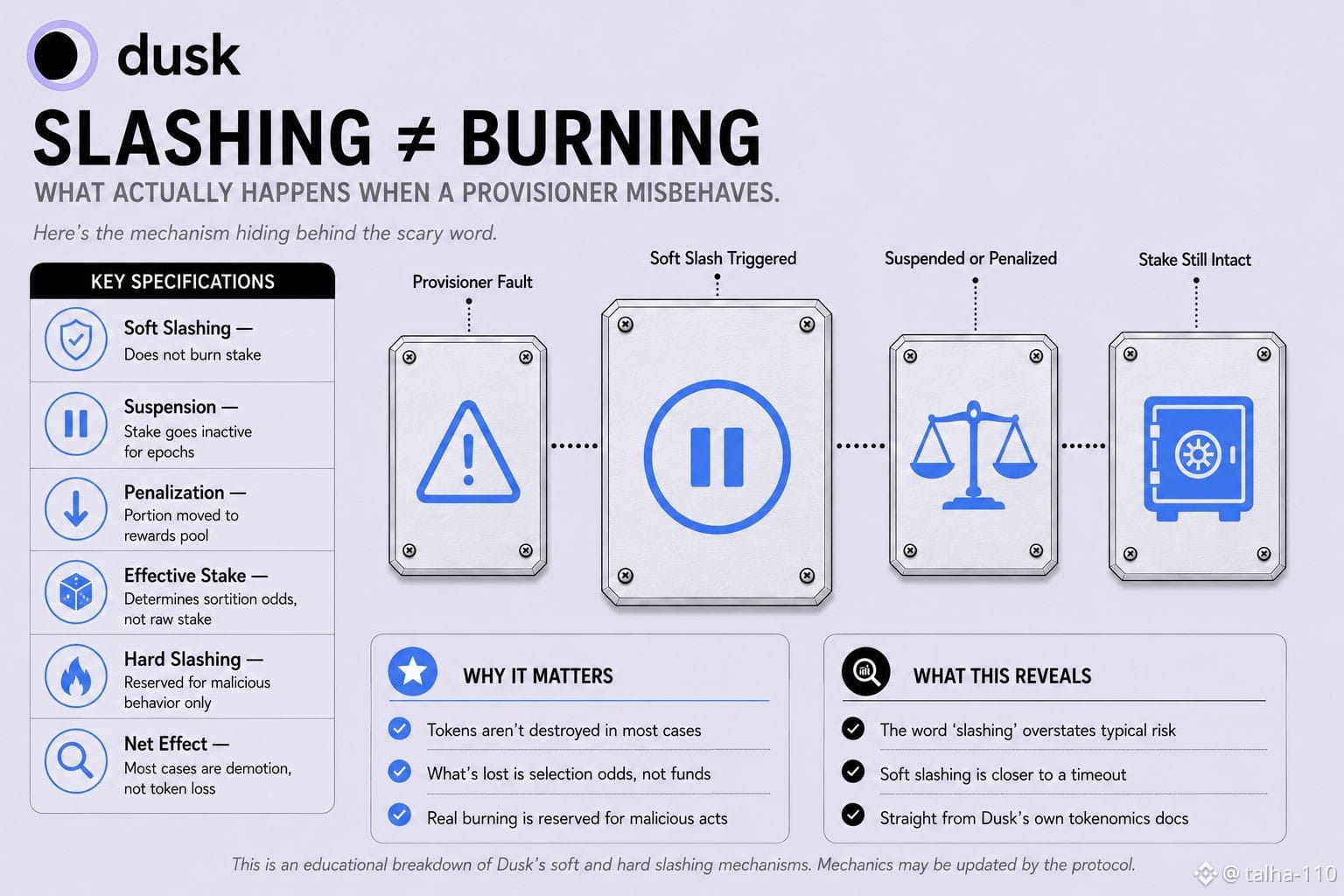
At first I assumed "slashing" on Dusk worked the way it does almost everywhere else, misbehave and a chunk of your staked DUSK gets destroyed, gone permanently, that's the whole deterrent. Reading Dusk's own tokenomics documentation, that assumption is wrong for the vast majority of real cases. Dusk runs soft slashing as its primary mechanism, and soft slashing explicitly does not burn stake at all. Instead it works two ways, suspension, where a misbehaving provisioner's entire stake goes inactive for one or more epochs, not eligible for selection, earning nothing, or penalization, where a portion of stake gets moved into the claimable rewards pool, which reduces effective stake used in sortition without actually destroying any tokens. So the DUSK never disappears. What disappears is influence, the ability to get selected as a voter or block generator, because sortition odds scale with effective stake, not raw stake. A provisioner who misses producing a block when selected doesn't lose money in the sense most people picture slashing working, they lose standing, their chances of getting picked again shrink for a set number of epochs. Hard slashing, the kind that actually burns stake, exists too, but it's reserved for genuinely malicious behavior, not the everyday downtime and missed duties that soft slashing is built to handle. That distinction matters for how you think about the risk of running or delegating to a provisioner. The scary word is "slashing." The actual mechanism, most of the time, is closer to a temporary demotion than a penalty that costs you tokens.
$DUSK #dusk @Dusk
$DUSK #dusk @Dusk