
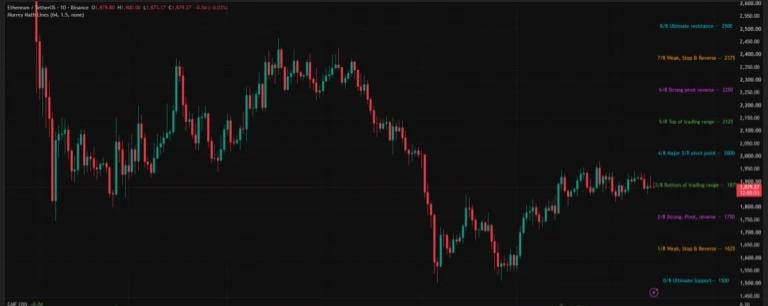
Ethereum price fell 2.4% from $1,918 to an intraday low of $1,872 as traders sold the initial U.S. inflation reaction, leaving ETH below $1,900 and testing a key daily support zone.
Ethereum price action today
According to data, Ethereum ( $ETH ) price traded near $1,879 at the time of writing after falling from an intraday high around $1,918 to $1,872. The decline erased the token’s initial response to the latest U.S. Consumer Price Index report and returned ETH below the psychological $1,900 level.
The U.S. Bureau of Labor Statistics reported that headline inflation rose 0.1% month over month and 3.4% from a year earlier in July. Core inflation increased by 0.2% in the month and 2.5% annually. All four readings matched market forecasts.
An expected result removed the risk of an inflation surprise but offered traders no new reason to extend the advance. Ethereum had already climbed into the report, reaching about $1,918 before profit-taking took control.
The sell-off accelerated after ETH slipped through the short-term $1,887 area. Thin liquidity below that level allowed the price to fall quickly toward $1,872 before buyers attempted to stabilize the market.
Ethereum’s failure to retain its CPI-related gains also mirrored weakness in the broader crypto market. Bitcoin remained near $64,000 after the inflation data, indicating that the report did little to change demand for risk across major digital assets.
What is driving the ETH decline?
The immediate pressure came from traders unwinding positions accumulated before the CPI release. With inflation matching expectations, speculative buyers had no positive surprise to support a sustained move through the $1,920–$1,950 supply zone.
Ethereum has repeatedly encountered sellers in this area since late July. The daily chart shows several failed attempts to establish a close above $1,925, while rallies toward $1,950 have produced long upper wicks or quick reversals.
Structural concerns surrounding Ethereum’s fee economy remain another source of pressure. Layer 2 networks have lowered transaction costs and expanded the ecosystem’s capacity, but cheaper activity also reduces the fees paid to the main network.
Ethereum burns the base fee charged for transactions, meaning lower fees can slow the rate at which ETH is removed from circulation. An academic study covering data through March 2026 found that Ethereum mainnet median fees had fallen from more than $2 to below $0.02, while Layer 2 median fees declined by more than 95%.
Lower transaction costs benefit users, but the weaker burn rate has made ETH’s supply narrative less compelling during periods of muted demand. However, Layer 2 networks still pay Ethereum for data availability and settlement, so their long-term effect on ETH’s valuation remains contested.
Ethereum technicals favor caution below $1,920
The daily chart places Ethereum directly around the $1,875 Murrey Math level, identified as the bottom of its current trading range. Holding this area would preserve the consolidation that has developed since late July.
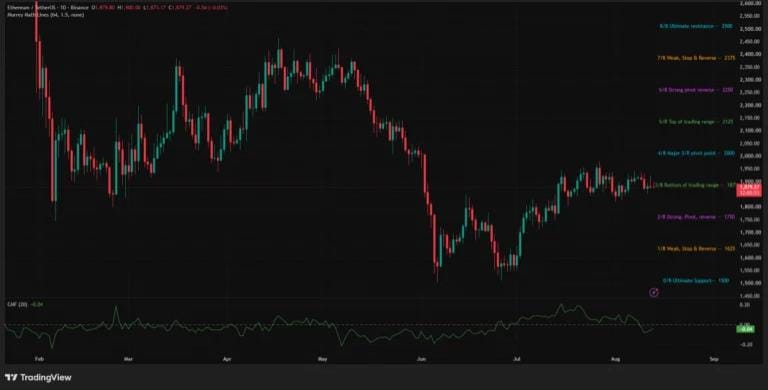
Daily Chaikin Money Flow stood at -0.04, showing that capital flows had moved slightly in favor of sellers. The reading is not deeply negative, but it provides little evidence of strong accumulation near the current price.
The 4-hour chart offers a similarly cautious signal. ETH traded below the Bollinger Band midpoint at $1,888, while the upper and lower bands stood near $1,919 and $1,857, respectively.
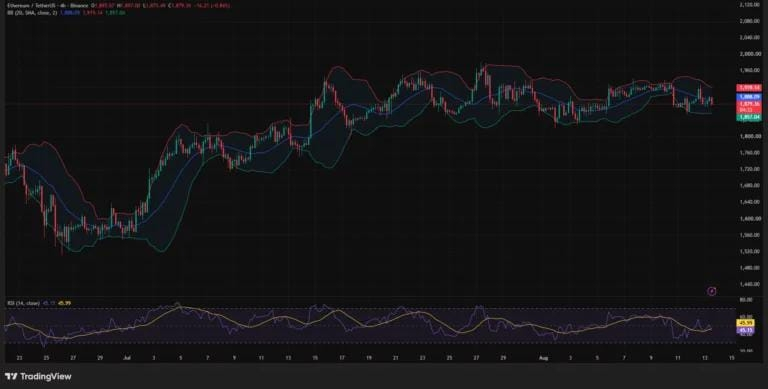
The 4-hour Relative Strength Index was 45.15, below its signal line at 45.99 and the neutral level of 50. The reading indicates weak momentum without placing Ethereum in oversold territory, leaving room for another decline if $1,875 fails.
A recovery above $1,888 would be the first sign that buyers are regaining short-term control. ETH would then need to close above $1,919–$1,925 to challenge $1,950. Reclaiming that supply zone could open a path toward the major $2,000 pivot.
Failure to defend the current range would bring the lower Bollinger Band at $1,857 into view. The daily chart identifies $1,750 as the next major pivot below that area, although intermediate demand could emerge around $1,835–$1,850.