
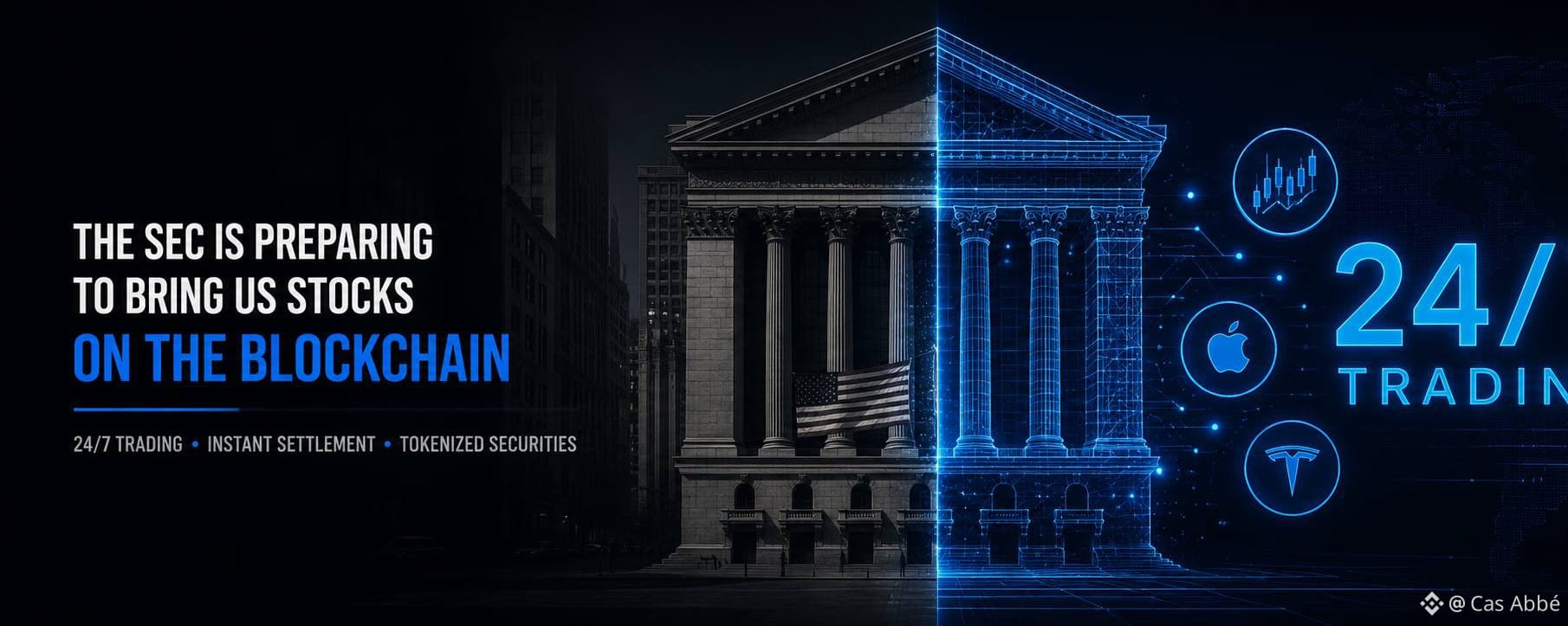

I think we are getting very close to something that could completely change how people trade traditional markets. The SEC is preparing a framework that could allow tokenized U.S. stocks and ETFs to trade around the clock on blockchain rails. Nothing is final yet, and I want to make that very clear, but this is no longer some crypto Twitter fantasy.
The SEC is actively working on it, major exchanges are building for it, and the pieces are starting to come together.
The basic idea is actually pretty simple. Instead of owning a traditional share sitting inside the existing market infrastructure, a stock can be represented as a digital token on a blockchain. That token can potentially move and trade using blockchain infrastructure that doesn’t close at 4 PM on Friday. Bitcoin already showed the world what a market that operates 24/7 looks like. Now traditional finance seems increasingly interested in taking that same infrastructure and putting stocks on it.
And this is where I think people are underestimating the story.
If tokenized stocks are eventually allowed to trade continuously, the stock market doesn’t have to operate around the old Monday-to-Friday, fixed-hours model in the same way. Imagine seeing a major earnings announcement on Saturday and being able to react to it immediately instead of waiting for Monday’s opening bell. Imagine global investors accessing U.S. equities during their own local trading hours instead of waiting for Wall Street to wake up.
That’s a pretty massive change.
The SEC has already been moving toward a more crypto-friendly regulatory framework under Chair Paul Atkins. Earlier this year, Atkins discussed an “innovation exemption,” and the SEC has been working on rules around crypto investment contracts and tokenized securities. The important distinction, though, is that the SEC has not officially approved 24/7 tokenized stock trading yet. The framework is still developing, and the exact rules matter enormously.
That uncertainty is probably the biggest thing I would watch.
For example, regulators have been looking at whether third-party platforms should be able to tokenize a company’s shares without the company’s permission. There are also questions around what exactly investors receive when they buy a tokenized stock. Does it come with voting rights? Dividends? The same legal ownership rights as a traditional share? These aren’t small details. They determine whether tokenized equities become a genuine evolution of the stock market or simply another wrapper around existing financial products.
Then there is the ugly but necessary part: regulation, security and anti-money-laundering controls.
A blockchain might never sleep, but regulators still have to know who is trading, where the assets are coming from and who ultimately owns them. That’s why any serious U.S. framework will likely come with strict compliance requirements. The whole point isn’t to throw Wall Street onto a blockchain and hope everything works out. It’s to bring blockchain efficiency into regulated finance without throwing investor protection out of the window.
And Wall Street isn’t waiting around.
The NYSE has already partnered with Securitize to develop a digital trading platform aimed at 24/7 tokenized stock and ETF trading, subject to regulatory approval. Nasdaq is also working toward expanded trading hours and blockchain-based market infrastructure. This tells me something important: traditional finance isn’t asking whether blockchain is useful anymore. The conversation is increasingly becoming how quickly can we integrate it?
The market is already moving in that direction. Tokenized real-world assets and securities have grown into a multi-billion-dollar sector, while crypto exchanges and financial platforms are experimenting with tokenized versions of traditional assets. Binance, for example, has introduced its own tokenized-stock initiative through BNB Chain.
But here’s my bigger takeaway.
This isn’t really about buying Apple or Tesla on a blockchain.
It’s about financial infrastructure.
If stocks, bonds, funds, treasuries and other real-world assets increasingly become blockchain-based, settlement can become faster, markets can become more accessible globally, and financial assets can potentially become composable in ways that simply aren’t possible inside today’s fragmented systems.
Bitcoin started with the idea that money could operate without a bank deciding when the network opens and closes.
Now we’re watching traditional markets experiment with the same underlying concept.
That’s the irony I find most interesting.
Crypto spent years being told that blockchain was a solution looking for a problem. Now one of the world’s most important financial regulators and some of America’s biggest exchanges are seriously exploring blockchain as part of the next generation of market infrastructure.
I don’t think that means every stock is suddenly going to become a crypto token tomorrow. It won’t. Regulation still has to be finalized, investor protections have to be defined, and the industry has to prove that tokenization actually improves markets rather than simply adding another layer of complexity.
But if the SEC gets this framework right, I think the impact could go far beyond crypto.
The bigger story isn’t that stocks might trade 24/7.
It’s that Wall Street is slowly moving toward a financial system that looks a lot more like crypto.
And honestly, that is a pretty wild full-circle moment.