

❓ The Question Most Storage Systems Avoid
Most decentralized storage discussions revolve around:
Cost per gigabyte
Number of nodes
Upload and download speed
Those questions are comfortable.
Walrus begins with a question that is deeply uncomfortable:
What if the network is slow, dishonest, partially offline, and never fully synchronized — forever?
That is not a stress test.
That is the default state of open, permissionless systems.
This is why Walrus Protocol cannot be understood as “just another storage layer.”
It is better understood as a data survival protocol.
All core guarantees described here are derived from the Walrus whitepaper
🌪️ Why “Asynchronous” Is the Most Ignored Word in Web3
In classical distributed systems, networks are often assumed to be:
Mostly synchronous
Fairly reliable
Reasonably ordered
Open networks are none of these.
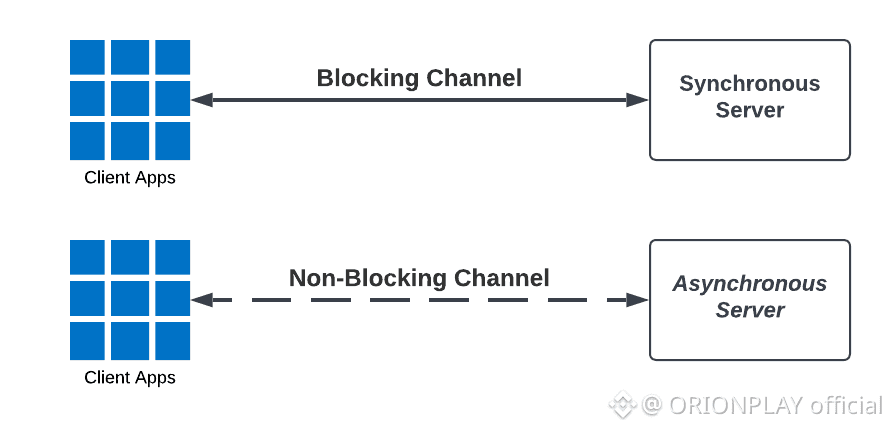
Asynchronous means:
No global clock
No upper bound on message delay
No guarantee of delivery order
This is not a minor inconvenience.
It fundamentally changes what can be guaranteed.
📚 The FLP Reality (Why Waiting Fails)
The Fischer–Lynch–Paterson (FLP) result shows that:
In asynchronous systems
With even one faulty participant
Certain guarantees cannot rely on timing
Implication:
Waiting longer does not make a protocol safer.
Many storage systems implicitly violate this reality by:
Waiting for “most nodes”
Assuming recovery eventually completes
Treating delays as rare
Walrus does not.
🧩 ACDS: Formalizing Data Survival, Not Optimism
One of Walrus’s most important contributions is formal rather than flashy:
Asynchronous Complete Data Storage (ACDS)
ACDS defines what it actually means to survive in hostile networks.
It guarantees three properties simultaneously:
• Write Completeness
• Read Consistency
• Validity
Most systems guarantee one or two.
Walrus guarantees all three — even under Byzantine behavior
🧠 Why Traditional Storage Guarantees Collapse Under Asynchrony
Let’s be precise.
In asynchronous environments:
Some nodes never respond
Others respond too late
Some respond incorrectly
Some respond maliciously
If a protocol assumes:
“Eventually, enough honest nodes will reply”
It is already broken.
Walrus avoids this assumption entirely.
🟥 Red Stuff Revisited — Through a Survival Lens
Red Stuff was explained as an efficiency breakthrough.
Here is the deeper reason it exists:
Red Stuff allows progress without global agreement.
🔁 Local Recovery Beats Global Coordination
Red Stuff’s 2D encoding enables:
Recovery using local intersections
Assistance from partial node sets
Reconstruction without full dissemination
This aligns with a core principle of fault-tolerant systems:
Local repair is always safer than global repair.
Because:
Failures stay contained
Bandwidth remains bounded
Progress continues even when some nodes disappear
This is survival-first design.
🧯 Writers Cannot Block the System
In many storage protocols:
Writers must ensure full dissemination
Failure to do so stalls the system
Asynchrony turns into deadlock
Walrus avoids this by:
Allowing writers to stop after quorum
Certifying availability cryptographically
Delegating completeness to recovery
This ensures:
Writers never wait forever
Storage does not depend on perfect conditions
The network remains live
🔍 Readers Don’t Trust — They Verify (Always)
Walrus assumes readers are skeptical.
Every read involves:
Collecting sufficient slivers
Verifying commitments
Reconstructing the blob
Re-encoding and re-checking
If any step fails:
👉 The read fails safely.
This guarantees read consistency even when:
Different readers contact different nodes
Writers behave maliciously
The network is partitioned
Consistency without coordination is rare — and powerful.
🧠 Handling Malicious Writers (A Common Blind Spot)
Most systems focus on malicious storage nodes.
Walrus also handles malicious writers.
If a writer uploads inconsistent encodings:
Nodes cannot recover valid slivers
Generate verifiable fraud proofs
Publish attestations on-chain
After quorum:
The blob is globally rejected
Nodes stop serving it
The system moves on
No ambiguity.
No endless retries.
No silent corruption
🔄 Epochs: Controlled Change in an Uncontrolled World
Change is inevitable:
Nodes churn
Stake shifts
Capacity evolves
Uncontrolled change destroys correctness.
Walrus introduces epoch-based committees:
Fixed participants per epoch
Clear fault assumptions
Predictable handovers
Reads continue.
Writes continue.
Recovery continues.
Epochs are not a convenience —
they are a safety boundary.
🧠 Why Walrus Doesn’t Fear Reconfiguration
Most systems fear reconfiguration because:
State is huge
Migration is expensive
Failures cascade
Walrus survives reconfiguration because:
Slivers are independently recoverable
Recovery cost is proportional
No global rewrite is required
Reconfiguration becomes:
A managed transition, not a systemic shock
😄 Analogy (Because This One Clarifies Everything)
Most storage systems:
“Everyone must agree before moving on.”
Walrus:
“Enough agreement is enough — the rest can catch up later.”
That difference is the line between fragility and resilience.@Walrus 🦭/acc