I'd been reading about Babylon's Trustless Bitcoin Vaults for an hour when something started to feel... off.
Not with the tech.
With the way people were talking about it.
Every other post seemed to frame TBV as a new lending product.
The more I looked the less that made sense to me.
Lending markets come and go.
Better rates show up liquidity moves users follow.
Infrastructure doesn't work like that.
If TBV does what it's supposed to do the important part isn't borrowing against BTC.
It's making native Bitcoin usable as collateral without wrapping it or handing it to a custodian.
That's a much deeper change.
So I stopped reading threads and opened the data instead.
One thing immediately stood out.
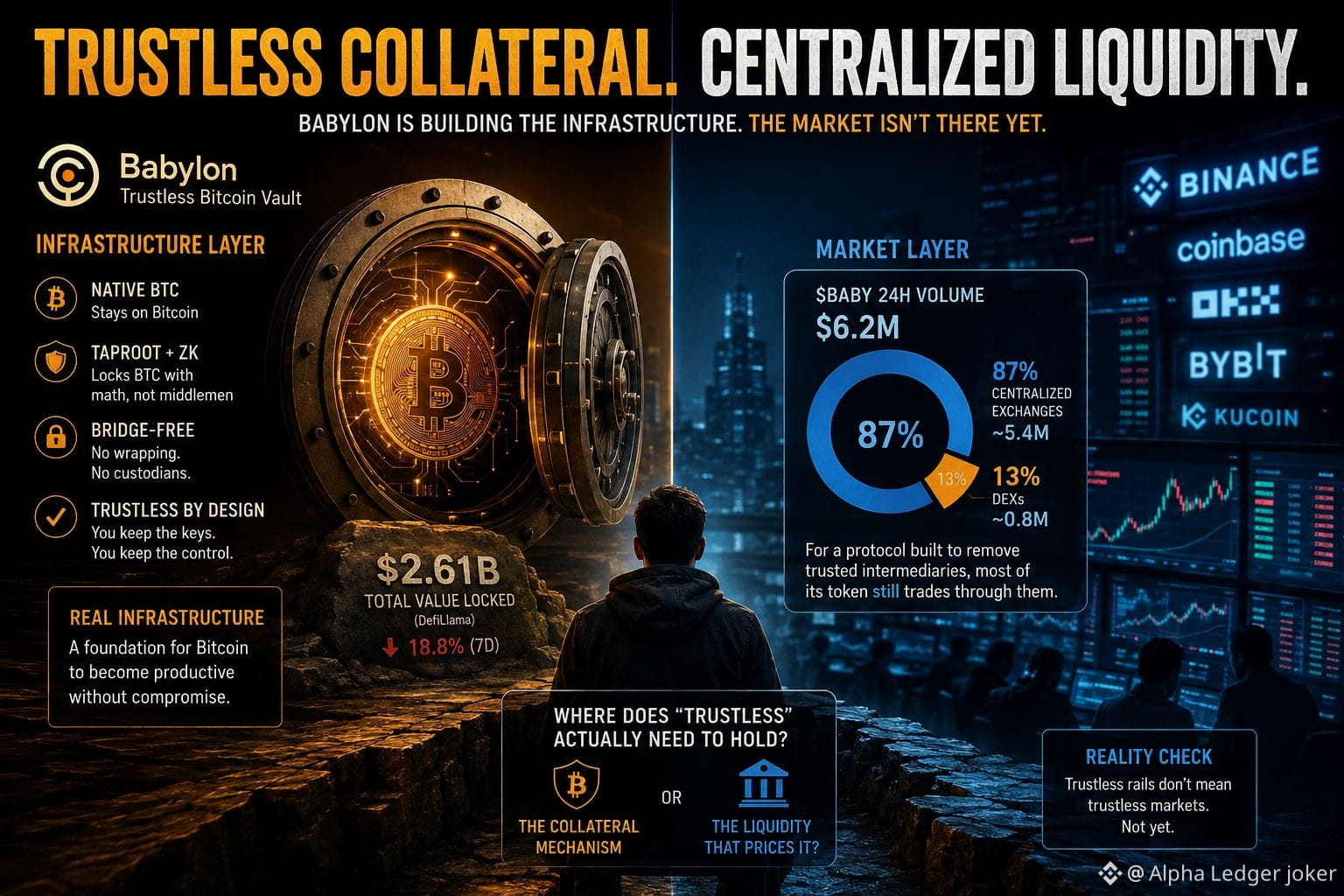
Most of the trading around $BABY still happens on centralized exchanges.
I actually smiled when I noticed it.
The protocol is trying to remove trust from Bitcoin itself...
while the token representing that ecosystem is still mostly priced through trusted venues.
At first it looked contradictory.
Then I realized it probably isn't.
Those are two completely different layers.
One secures collateral.
The other discovers price.
Maybe they don't need to become trustless at the same time.
We've seen this before.
People don't change habits overnight just because better infrastructure exists underneath them.
The rails usually change first.
Everything built on top catches up later.
That's the part I think gets overlooked.
Everyone is debating whether Trustless Bitcoin Vaults can compete with existing BTC lending.
I'm starting to think that's the wrong comparison.
The bigger question is whether TBV becomes the foundation that future Bitcoin apps quietly assume is already there.
Sometimes the most important infrastructure isn't the thing people use.
It's the thing they eventually stop noticing.#Babylon #BABY #BTCFi #DeFi
#baby $BABY
Not with the tech.
With the way people were talking about it.
Every other post seemed to frame TBV as a new lending product.
The more I looked the less that made sense to me.
Lending markets come and go.
Better rates show up liquidity moves users follow.
Infrastructure doesn't work like that.
If TBV does what it's supposed to do the important part isn't borrowing against BTC.
It's making native Bitcoin usable as collateral without wrapping it or handing it to a custodian.
That's a much deeper change.
So I stopped reading threads and opened the data instead.
One thing immediately stood out.
Most of the trading around $BABY still happens on centralized exchanges.
I actually smiled when I noticed it.
The protocol is trying to remove trust from Bitcoin itself...
while the token representing that ecosystem is still mostly priced through trusted venues.
At first it looked contradictory.
Then I realized it probably isn't.
Those are two completely different layers.
One secures collateral.
The other discovers price.
Maybe they don't need to become trustless at the same time.
We've seen this before.
People don't change habits overnight just because better infrastructure exists underneath them.
The rails usually change first.
Everything built on top catches up later.
That's the part I think gets overlooked.
Everyone is debating whether Trustless Bitcoin Vaults can compete with existing BTC lending.
I'm starting to think that's the wrong comparison.
The bigger question is whether TBV becomes the foundation that future Bitcoin apps quietly assume is already there.
Sometimes the most important infrastructure isn't the thing people use.
It's the thing they eventually stop noticing.#Babylon #BABY #BTCFi #DeFi
#baby $BABY