A woodworker I know built an incredible custom workshop in his garage, every tool mounted exactly where a serious craftsman would want it, dust collection routed to every station, jigs labeled and organized on the wall. He built it hoping other people in his neighborhood would rent time on it instead of buying their own tools. Three years later it's mostly just him in there. The workshop being genuinely excellent never automatically translated into other people showing up to use it, because building a great tool and getting strangers to trust it with their own projects turned out to be two completely separate problems requiring completely different kinds of work.
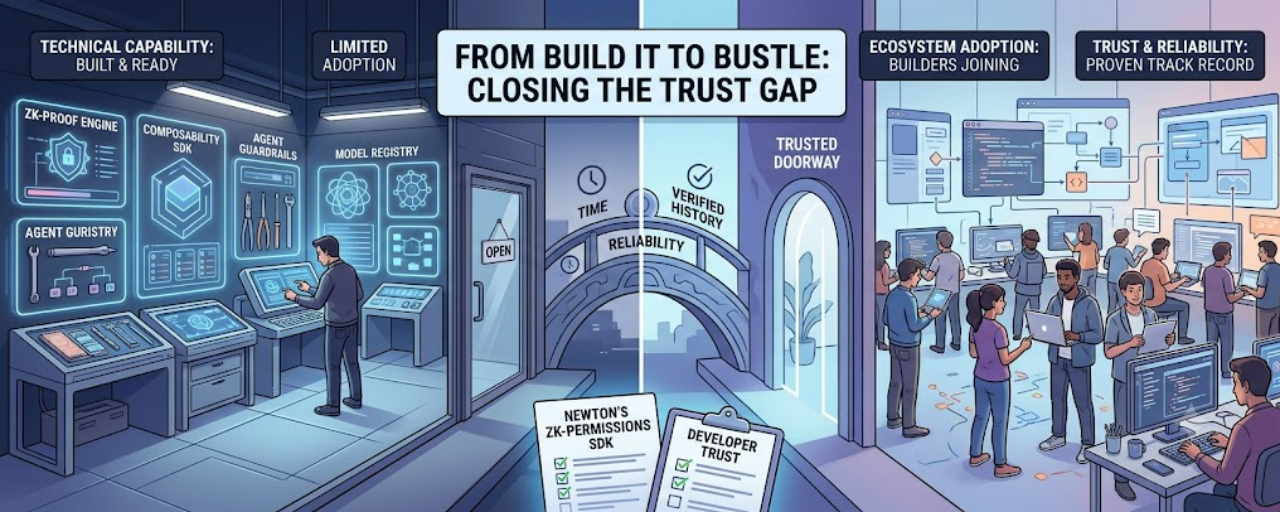
That separation is what I keep thinking about when I look at Newton's zkPermissions SDK and the broader composability pitch built around it. The technical claim is specific and, from what's documented, genuinely accurate: because Newton is designed to be composable, any dapp, stablecoin project, or AI wallet can integrate its verification client to plug automated, verifiable agent behavior into their own product rather than building that infrastructure from scratch. The SDK exists specifically to simplify wiring programmable guardrails, rules like only trade if volatility exceeds a threshold, into any agent a developer wants to build. That's a real, working door. Whether outside developers are actually walking through it yet is a separate question the SDK's existence doesn't answer on its own.
Here's what the mechanics actually look like when you follow the details closely. First, developers can define programmable guardrails through the SDK using conditions like volatility thresholds or technical indicators crossing specific levels, meaning the flexibility to build custom agent logic is already there rather than locked behind a future release. Second, that guardrail logic gets enforced through zkPermissions specifically, so a third-party developer integrating Newton isn't just calling an API, they're inheriting the cryptographic verification model, TEE execution plus zero-knowledge proofs, as the backbone of whatever they build on top. Third, the Newton Model Registry gives external strategy developers a path to list their work and earn a share of the fees generated when others use it, an incentive structure aimed specifically at attracting outside builders rather than keeping all agent development in-house. Fourth, integration requires a developer to trust Newton's Keystore rollup for permission scoping and cross-chain state, meaning any team building on top is taking on a dependency on infrastructure that's itself still maturing through its own phased decentralization rollout. Fifth, the roadmap frames onboarding third-party validators and improving scalability as prerequisites for the kind of high-frequency, verifiable automation that would make building a serious product on Newton economically viable at real volume, not just technically possible in a demo.
This is the workshop-with-no-visitors problem in a different outfit. A composable SDK is necessary but not sufficient for an ecosystem of outside builders to actually form around it. Developers choosing infrastructure to build on are making a multi-year bet, not a weekend experiment, and that bet requires confidence that the underlying rollup will keep working, keep decentralizing on schedule, and keep the economics of the Model Registry attractive enough that publishing a strategy there beats keeping it proprietary. None of that confidence gets built by the SDK documentation alone, it gets built by a track record, and a track record is exactly the thing a still-maturing protocol hasn't had time to accumulate yet.
The upside case is real too and shouldn't get lost in the caution. Composability built in from the start, rather than retrofitted after a protocol locks into its own closed ecosystem, is genuinely harder to execute well and easier to point developers toward later once trust does accumulate. Newton isn't in the position of trying to bolt external developer access onto a system that was never designed for it, the door was built into the architecture from day one, which matters even if nobody's walked through it in volume yet.
Newton isn't short on the technical capability for outside developers to build on it, the SDK, the guardrail framework, and the registry incentives are all real and documented. What it doesn't yet have, and can't manufacture through documentation alone, is the accumulated trust and track record that actually gets a builder to choose Newton's rollup over rolling their own automation logic from scratch, and that gap closes with time and reliability, not with a better developer portal or a longer feature list on a landing page.
@NewtonProtocol $NEWT #Newt $BSB