

When I first saw that Newton Protocol relies on EigenLayer operators, I treated it like another infrastructure choice. A lot of newer protocols connect themselves to Ethereum's security in one way or another. It has almost become expected.
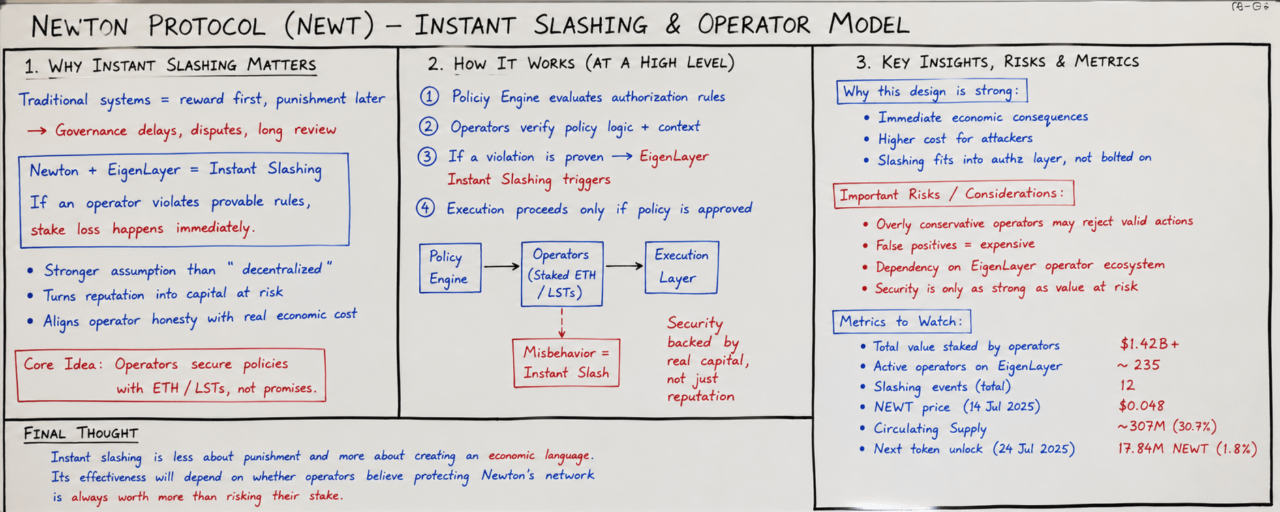
After spending more time with the design, the interesting part stopped being Ethereum itself. It became the fact that operators can lose a percentage of their staked ETH or liquid staking tokens through EigenLayer's instant slashing mechanism.
That changes the conversation.
Most blockchain systems try to convince participants to behave correctly by rewarding them. Punishment usually exists, but it often feels distant. Governance discussions happen. Validators argue. Evidence gets reviewed. Everything takes time.
Instant slashing moves in the opposite direction.
The protocol assumes that if an operator violates the rules in a way that can be proven, financial consequences should happen immediately instead of waiting for long governance processes. That is a much stronger assumption than simply saying the network is decentralized.
For Newton, this matters because its policy engine is expected to become part of real transaction authorization rather than just another monitoring tool.
If operators are helping verify whether a policy should allow or reject an action, then those operators become part of the trust model. They cannot simply disappear from the design.
The obvious question is whether they have enough to lose.
Connecting operator behavior directly to staked ETH and LSTs makes that cost very visible. It turns operator honesty into something backed by capital instead of reputation alone.
I think that is one of the cleaner design choices inside Newton.
At the same time, it also creates a different dependency.
Newton is no longer relying only on its own software behaving correctly. It also inherits assumptions from EigenLayer's operator ecosystem. If operator participation changes over time, or if economic incentives stop matching the network's security needs, Newton feels those changes too.
That dependency is easy to ignore because it sits underneath the application layer.
Another thing I keep thinking about is how instant slashing changes operator behavior.
Traditional validator networks sometimes tolerate a little uncertainty because disputes can be resolved later. Instant penalties leave much less room for hesitation.
An operator now has a reason to reject anything that looks even slightly unsafe if the alternative could threaten their stake.
That sounds positive until edge cases appear.
Authorization systems are rarely black and white forever.
Policies evolve.
Compliance rules change.
Institutional requirements shift.
If an operator faces immediate financial punishment for making the wrong decision, conservative behavior becomes economically rational.
The network needs enough flexibility that operators are not constantly choosing between participating honestly and protecting their capital.
That balance is harder than people sometimes admit.
Newton also separates authorization from execution.
I think this makes the slashing model more meaningful.
If operators were simply validating ordinary transactions, the security story would feel familiar.
Instead, they are helping enforce programmable policies before execution moves forward.
That makes incorrect validation potentially more valuable to an attacker than simply producing another block.
It also explains why stronger economic guarantees matter here.
Something else stands out.
Newton does not appear to be treating slashing as a marketing feature. It fits into a broader architecture where policy evaluation, operator accountability, and execution are connected pieces instead of isolated modules.
That feels more coherent than projects that bolt security mechanisms onto the side after the main protocol has already been designed.
Still, there are unknowns.
Economic security is only as strong as the value protecting it.
If the amount at risk is smaller than the value attackers hope to extract, slashing loses much of its deterrent effect.
That calculation changes over time as protocol usage grows.
Early-stage networks often look secure because attack opportunities remain relatively small.
The real test comes later, when higher-value assets begin depending on the authorization layer every day.
There is also an operational side that receives less attention.
Instant slashing requires confidence that faults can be identified accurately.
False positives become expensive.
Poor monitoring becomes expensive.
Software bugs become expensive.
Every automation system eventually encounters situations that developers never expected.
Newton's policy engine may become increasingly sophisticated as institutions write more complex authorization rules, and that naturally increases the importance of accurate operator behavior.
The challenge is making sure complexity inside policies does not create uncertainty outside them.
One detail I appreciate is that Newton is not trying to replace Ethereum's economic security from scratch.
Instead, it borrows an existing security market while focusing its own engineering effort on programmable authorization.
That is an efficient division of responsibility.
But borrowed security is still borrowed.
Newton's future is tied not only to its own adoption but also to the health, incentives, and discipline of the operator ecosystem standing underneath it.
Looking at it this way, instant slashing feels less like a punishment mechanism and more like an economic language between Newton and the people responsible for enforcing its rules. Whether that language remains effective will probably depend less on the slashing itself and more on whether the protocol continues attracting operators who believe protecting the network is consistently worth more than risking their stake.
