
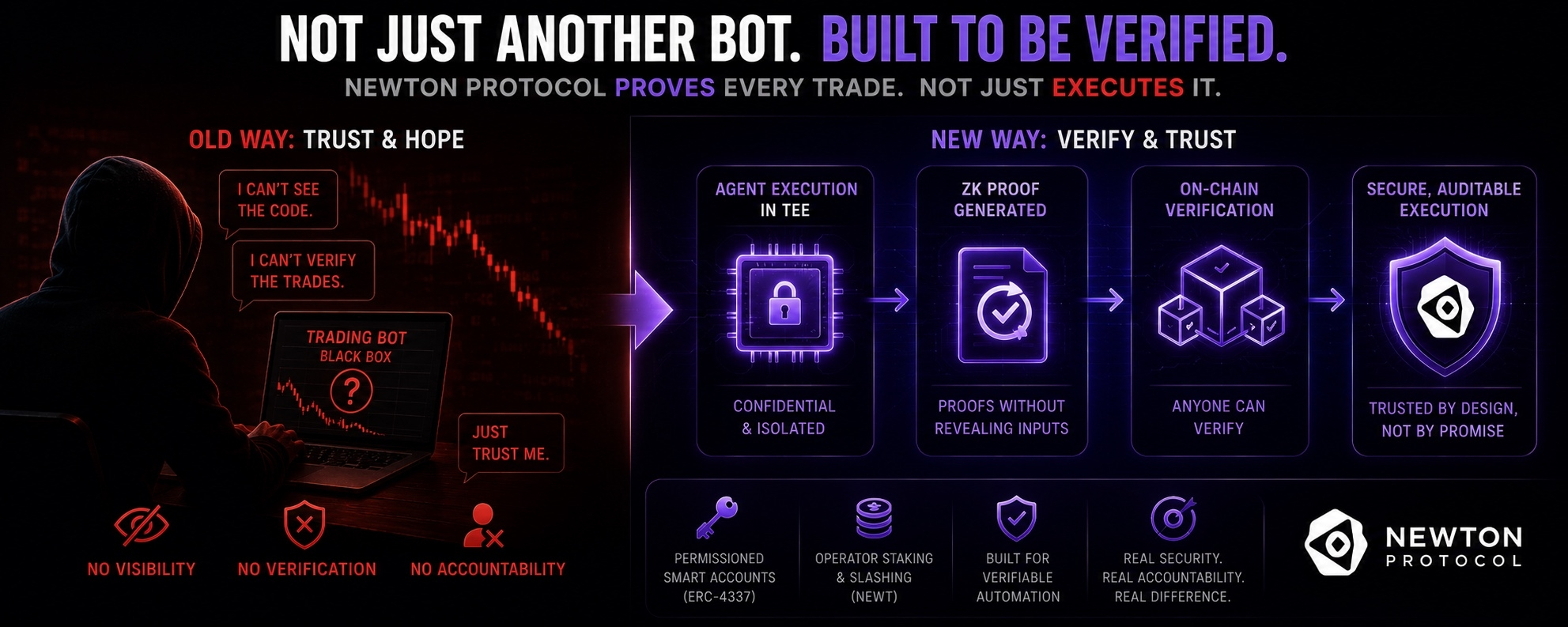
Years ago I let a friend manage a small chunk of my savings through a trading bot he'd built himself. He swore it was solid, showed me a backtest, and I wired the funds without ever seeing the actual logic that would touch my money while I slept. It worked, until one week it didn't, and by the time I noticed the strange trades it was already too late to do anything but watch the balance drop. I never got a real explanation, just a shrug and a promise to fix the code. What stuck with me wasn't the loss, it was realizing I had no way to verify anything before or after the fact. I was trusting a person, not a system, and I had mistaken that trust for security the whole time.
That memory is exactly what surfaces every time I see automated trading protocols get lumped together as one undifferentiated category of risk. The crypto automation space is full of bots, keepers, and scripts that watch a condition and fire a transaction, and the general public reasonably treats all of them with the same skepticism I should have had with my friend's code. Newton Protocol keeps getting swept into that same bucket, described casually as just another automation layer, another set of bots executing trades so you don't have to. That framing isn't wrong about the surface behavior, agents do watch conditions and execute transactions. It is wrong about what actually determines whether the automation can be trusted, and that gap is worth spelling out with specifics instead of taking either side's word for it.
Established keeper networks like Gelato and Keep3r operate on a model where a keeper watches for a defined condition and submits a transaction when it triggers, with the correctness of that execution generally assumed rather than independently proven after the fact. That worked reasonably well for years because the tasks were often simple and the stakes per transaction were usually low, a price update here, a liquidation trigger there. Newton takes a structurally different approach to the same category of problem. Agent execution happens inside trusted execution environments, sealed hardware enclaves where computation runs isolated from outside observation, including from the operator running the machine itself. That handles the confidentiality half of the problem, letting an agent work with private strategy parameters without exposing them. The verification half comes from zero-knowledge proofs generated afterward, cryptographic evidence that the execution actually followed the rules it was supposed to follow, checkable by anyone without needing to trust the hardware or the operator's word for it.
Five specific facts make this concrete rather than abstract. First, the Newton Keystore rollup is the component responsible for managing permissions and finalizing cross-chain state transitions tied to agent actions, meaning the verification isn't a side feature bolted onto a simpler automation engine, it's structurally load-bearing. Second, the protocol integrates with zk-VM frameworks including Succinct and Risc Zero specifically to generate the proofs that confirm an agent's offchain computation matched its onchain claims. Third, TEE providers such as Phala handle the confidential execution layer, meaning the enclave technology is sourced from infrastructure with its own track record rather than built in-house from scratch. Fourth, ERC-4337 smart accounts let users delegate narrow, scoped permissions to an agent instead of handing over a wallet's full signing authority, which is a fundamentally different exposure model than a bot holding your private key directly. Fifth, agent operators stake NEWT as collateral to run models, with misbehavior triggering slashing and redistribution to affected users, adding an economic layer on top of the cryptographic one rather than replacing it. None of these five pieces alone would separate Newton from a keeper network. Together they describe a system built around proving correctness, not just claiming reliability.
The honest counterpoint deserves airtime too. Verification doesn't mean invincible. TEEs have had documented side-channel vulnerabilities across the industry over the years, and zk-VM tooling, while improving fast, is still maturing, with the roadmap itself acknowledging that some milestones depend on external technology reaching performance levels outside Newton's direct control. A verifiable system can still have a bad week. But there's a real difference between a system that can fail and gets caught, versus one that can fail and nobody would ever know until the balance is already wrong. My friend's bot belonged to the second category. Whatever Newton's failure modes turn out to be, they're designed to be the kind that produce evidence.
Newton Protocol isn't a keeper network wearing better marketing, and it isn't a magic guarantee against loss either. It is a system built specifically so that when something goes wrong, there's a cryptographic trail explaining what happened instead of a shrug from whoever was running the code. That trail is what my friend's bot never had, and it's what separates a protocol you can eventually audit from one you can only ever take someone's word about. The "just another bot" comparison undersells exactly that distinction, and it's the distinction that decides whether losing money comes with an explanation or just silence.
@NewtonProtocol $NEWT #Newt $LAB $VELVET
