
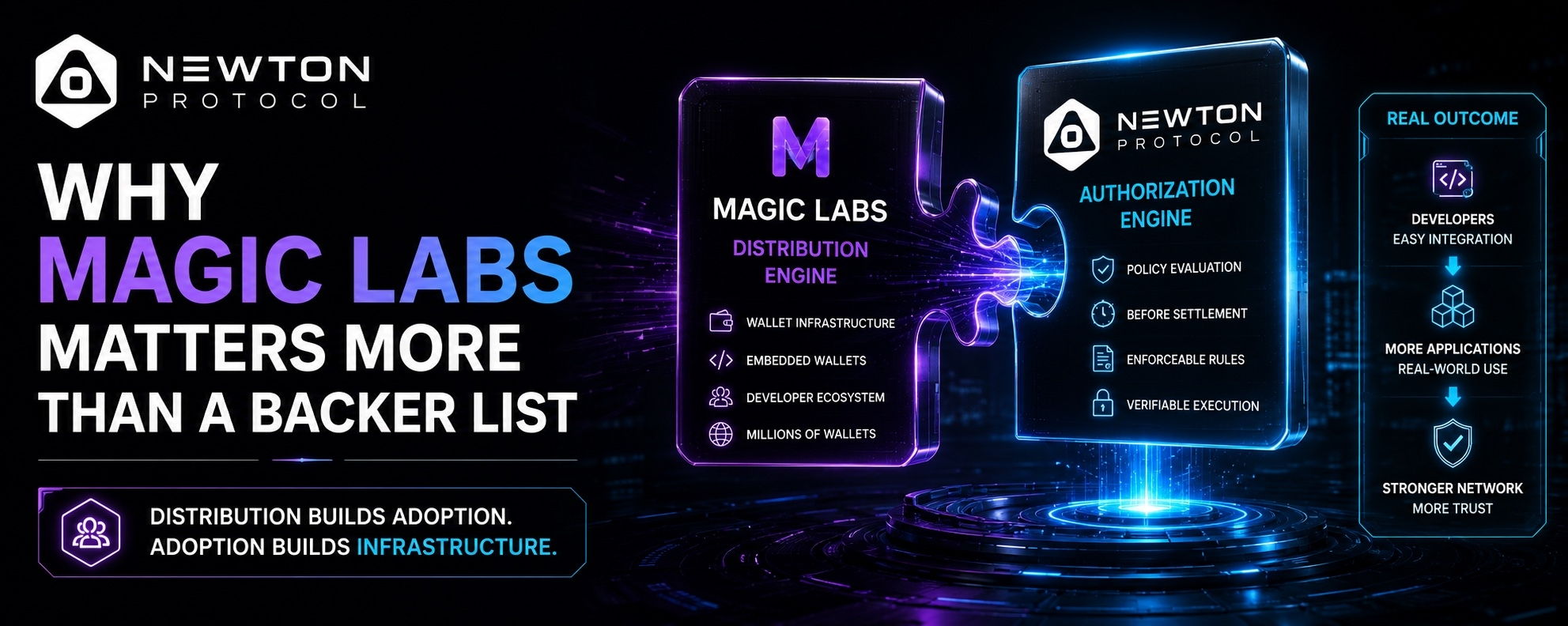

When people evaluate infrastructure projects, they often start with the wrong slide.
The investors.
The funding round.
The logos.
Those details may tell you who believed the project early.
They tell you much less about whether the technology can actually reach developers.
That is why I think the story behind @NewtonProtocol begins somewhere else.
Magic Labs.
Most people know Magic Labs for embedded wallet infrastructure.
Millions of wallets.
A large developer ecosystem.
Years spent reducing the friction between users and blockchain applications.
That background is more interesting to me than a list of venture firms.
Because infrastructure adoption is rarely decided by architecture alone.
It is decided by distribution.
◆ Crypto has a habit of treating technical superiority as if it automatically creates network effects.
History suggests otherwise.
There have been countless protocols with elegant whitepapers that struggled because developers had little reason to integrate another dependency into already complex systems.
Developers usually ask practical questions.
How difficult is integration?
How stable are the APIs?
Does this reduce operational work?
Can existing applications adopt it without rebuilding everything?
Those questions matter long before token economics enter the conversation.
That is one reason Magic Labs stands out.
Its experience has largely been on the developer experience side of Web3.
Wallet infrastructure is not glamorous.
Users rarely celebrate successful authentication or seamless onboarding.
But developers notice when those pieces work reliably.
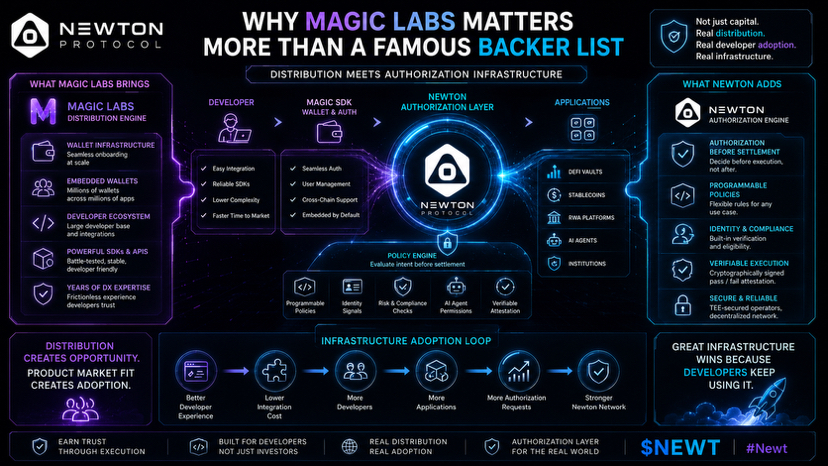
That experience becomes relevant when Newton introduces something fundamentally different:
an authorization layer that applications call before transactions settle.
🔍 Think about what that means from a builder’s perspective.
A protocol already has smart contracts.
A frontend.
Wallet connectivity.
Indexing infrastructure.
Monitoring systems.
Perhaps an oracle.
Perhaps a compliance provider.
Now another layer appears between transaction intent and execution.
That layer needs to justify its existence.
Not through marketing.
Through integration value.
If developers believe adding Newton significantly improves enforceable risk controls while remaining reasonably straightforward to integrate, adoption becomes more realistic.
If integration creates excessive friction, even strong security ideas can remain niche.
That is why developer tooling deserves more attention than it usually receives.
Infrastructure succeeds when it disappears into the workflow.
Not when every integration becomes a six-month engineering project.
👀 There is another advantage that experience can provide.
Magic Labs has spent years watching how real applications behave after launch.
Not only how they look inside technical documentation.
Wallet providers see onboarding failures.
Authentication edge cases.
Unexpected user behavior.
Cross-chain complexity.
Support tickets.
Product teams.
Enterprise requirements.
That operational perspective is different from designing a protocol entirely inside a research environment.
Newton benefits if those lessons translate into better APIs, better SDKs, clearer documentation, and lower integration costs.
But this is also where I think people should be careful.
A strong developer background is not the same thing as guaranteed protocol adoption.
Embedded wallets solve one category of problem.
Authorization infrastructure solves another.
The customer is different.
The buying decision is different.
The operational risks are different.
A team can have an outstanding track record in one infrastructure category while still needing to prove itself in another.
⚠️ Distribution creates opportunity.
It does not replace product-market fit.
Institutional vault managers will still evaluate security.
Stablecoin issuers will still evaluate compliance.
RWA platforms will still evaluate policy flexibility.
AI applications will still evaluate latency.
Developers will still ask whether Newton introduces unacceptable operational complexity.
Those questions cannot be answered by reputation alone.
They have to be answered by production usage.
Another point that often gets overlooked is credibility.
Financial authorization infrastructure sits closer to critical execution than many developer tools.
If a wallet onboarding flow fails, the user can often try again.
If an authorization layer behaves unexpectedly, legitimate transactions may fail or invalid ones may pass.
The tolerance for operational mistakes becomes much lower.
That means trust is earned differently.
Not through TVL.
Not through social media engagement.
Through uptime.
Predictable behavior.
Clear auditability.
Reliable documentation.
Transparent policy logic.
Responsive support.
Those are not exciting metrics.
But they are exactly the metrics institutions tend to care about.
◆ I also think Magic Labs gives Newton something less obvious.
Perspective on abstraction.
The best infrastructure often hides complexity instead of exposing it.
Wallet SDKs removed friction without asking every application developer to become a cryptography expert.
Authorization infrastructure may need to achieve something similar.
Developers should understand the security model.
They should not have to become distributed-systems researchers before calling a policy engine.
That balance is difficult.
Too much abstraction creates blind trust.
Too much complexity prevents adoption.
Newton will need to sit somewhere between those extremes.
And that is probably where Magic’s product history becomes relevant.
Not because it guarantees success.
Because it suggests the team has experience translating difficult infrastructure into something developers are willing to use.
There is still a long road ahead.
The authorization layer has to prove itself under production traffic.
Operators need to remain reliable.
Policy composition has to stay understandable.
External data providers have to behave consistently.
Latency must remain acceptable.
Economic incentives need to hold as network value increases.
Those challenges are independent of who built the protocol.
But they determine whether the infrastructure becomes essential or optional.
That is why I think focusing only on Newton’s backers misses the bigger picture.
Capital helps build technology.
Developer adoption determines whether that technology becomes infrastructure.
Magic Labs’ real contribution may not be the credibility of its fundraising history.
It may be years spent understanding how developers decide which pieces of infrastructure deserve a permanent place inside their applications.
And in infrastructure, that decision is often worth far more than another logo on a partnership page.