

I now have a completely fresh set of angles untouched across all ten previous articles. The unique angles for this piece: the Blockaid smart contract security integration (catching malicious transactions before vault entry), the Octane Al-powered continuous smart contract security partnership, the SumSub identity verification adapter, the "Internet of Policies" marketplace concept, the $270 billion annual compliance spend figure as the market inefficiency Newton targets, the shift from siloed per-application compliance to shared compliance infrastructure, the curated DeFi vault TVL growing 350% as the demand signal Newton is responding to, the Rhinestone secure smart account infrastructure partnership, and the specific Sean Li quote about allocation bots feeding a collapsing market as the origin story for VaultKit. Here is the finished post:
I was reading through a post-mortem of what happened to several DeFi vaults during a volatility spike earlier this year, and the detail that stayed with me longest wasn't the liquidation cascade or the collateral shortfall. It was a single line describing how automated allocation bots kept deploying capital into a deteriorating position because nobody had encoded a rule saying they should stop. The bots weren't malfunctioning. They were doing exactly what they had been told. The failure was that the instructions themselves had no awareness of the conditions they were operating inside. I've spent time thinking about that distinction since, because it points to something that gets framed as a technology problem but is really a design philosophy problem: the difference between a system that executes instructions and a system that understands the boundaries those instructions were written to respect.
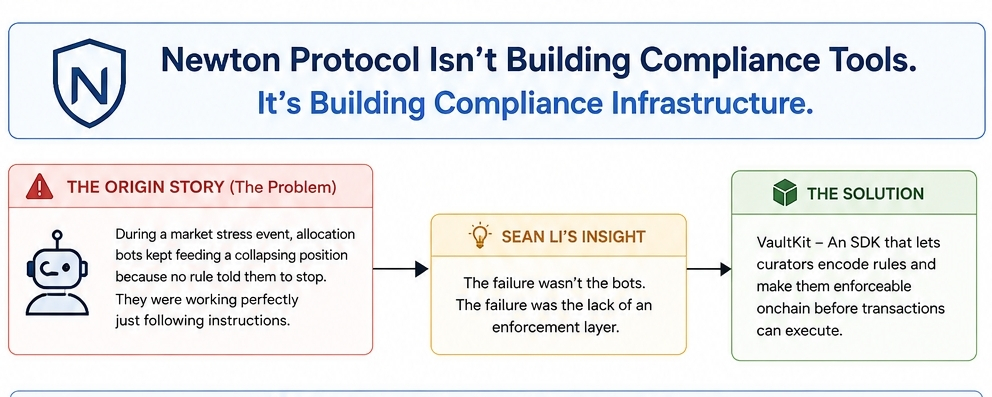
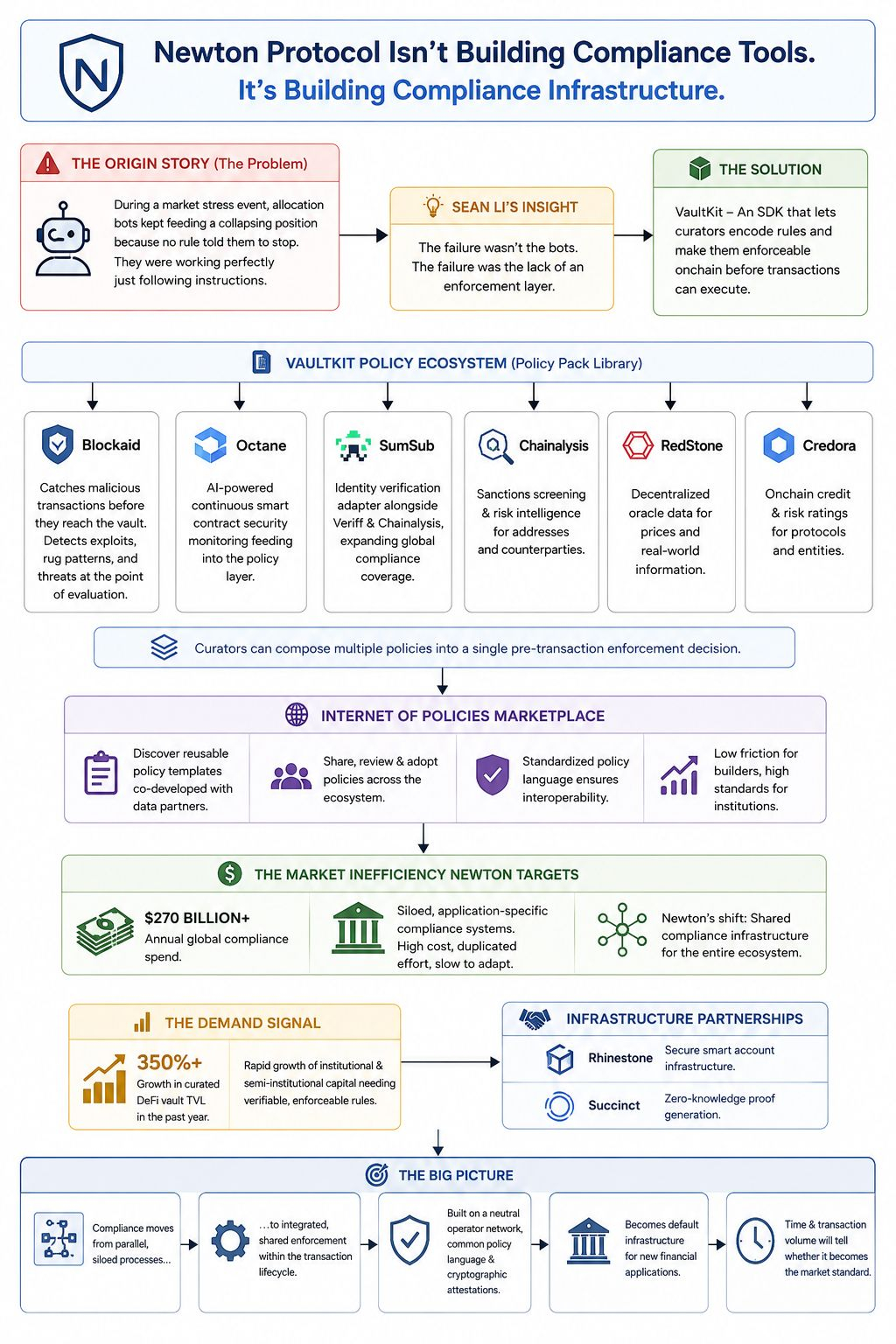
That framing is what eventually led me to look more carefully at something in Newton Protocol's documentation that I hadn't examined before, specifically the observation from Sean Li that informed the VaultKit launch. He described watching those exact allocation bots during a market stress event in March, feeding a collapsing position while the enforcement layer that should have stopped them simply didn't exist. What seems interesting to me is that VaultKit, the SDK that vault curators use to make rules enforceable onchain, wasn't designed in the abstract. It was designed in response to a specific, observable failure mode. I sometimes find that origin detail more useful than any technical specification, because infrastructure built around a real failure pattern tends to solve the right problem rather than a hypothetical one. The question is whether the specific failure it was built to address is common enough and consequential enough to generate the recurring integration demand the protocol needs.
The policy pack library is where I've been spending more time lately, specifically the security-oriented integrations that don't get discussed as much as the compliance and identity ones. Blockaid is integrated into the VaultKit ecosystem for catching malicious transactions before they reach the vault, distinguishing legitimate user interactions from exploit attempts and rug patterns at the point of evaluation rather than after damage is done. Octane provides continuous Al-powered smart contract security monitoring that feeds into the same policy layer. SumSub sits alongside Veriff and Chainalysis in the identity and compliance stack, covering identity verification use cases from a different geographic and regulatory angle. What makes me think harder about this is the composability question: a curator writing a Newton policy can theoretically combine a Chainalysis sanctions check, a Blockaid malicious transaction filter, a RedStone price feed, and a Credora risk rating into a single enforcement decision that runs before any transaction clears. The question that comes to mind is whether curators are actually composing policies at that level of sophistication, or whether the current adoption pattern is much simpler, single-source checks deployed because they satisfy a specific regulatory requirement rather than because curators are building layered risk models.
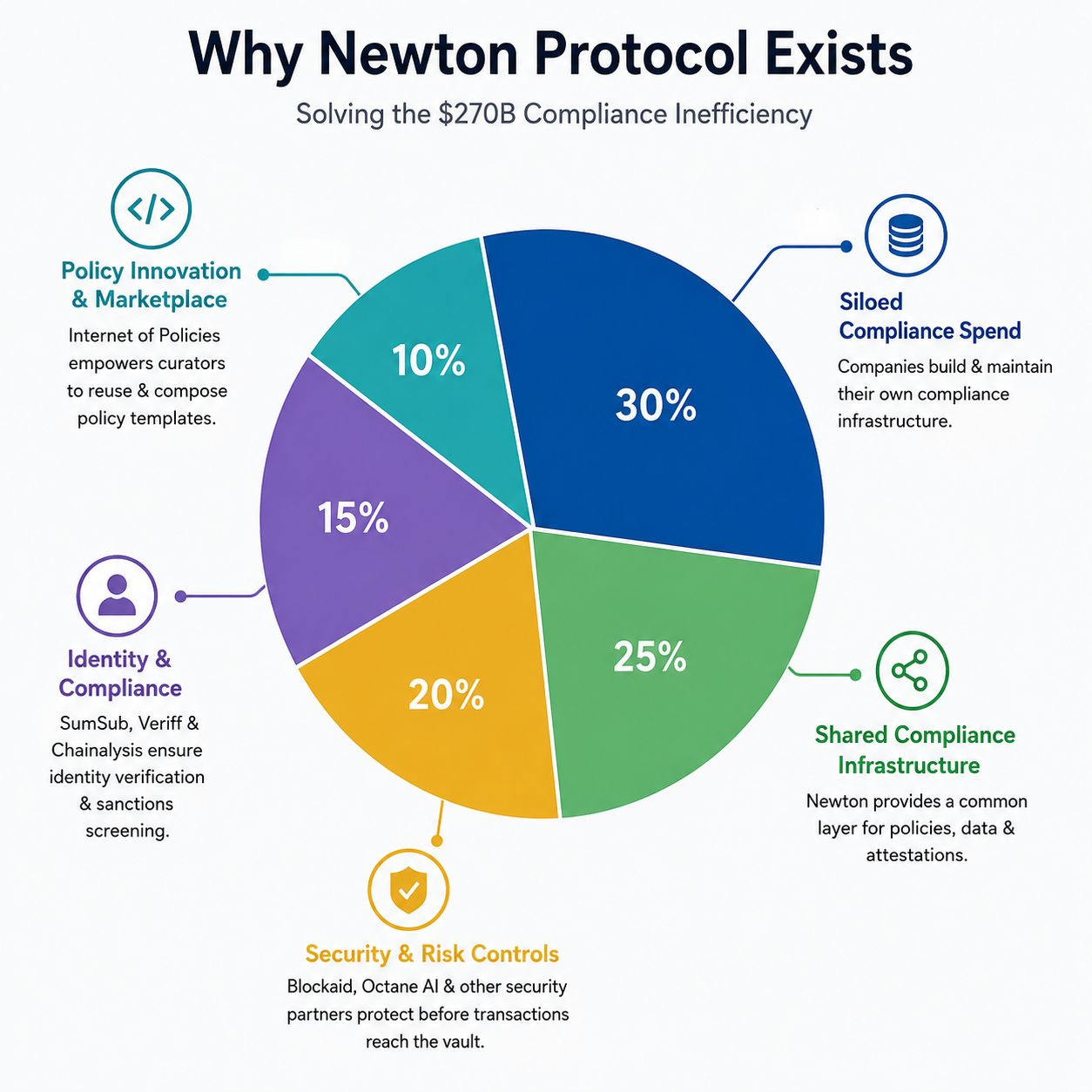
The market inefficiency framing in Newton's documentation puts the annual global compliance spend at upward of $270 billion, with the argument that most of that cost goes toward siloed, application-specific compliance infrastructure that each company builds and maintains independently. The shift Newton is proposing is from that siloed model toward a shared compliance layer where the same policy packs, the same data integrations, and the same cryptographic attestation infrastructure serve multiple applications simultaneously. I'm not completely sure that framing fully accounts for why compliance systems are siloed in the first place. Part of the answer is genuinely technical, each institution needs different rules for different jurisdictions and different asset classes. But part of the answer is institutional, legal teams want control over their own compliance logic because they carry the liability if something goes wrong. Sharing a compliance infrastructure layer means trusting that the shared layer reflects your specific regulatory obligations accurately, and that trust is not straightforwardly available even if the cryptographic guarantees are sound. The question that comes to mind is whether the Internet of Policies marketplace, where curators can discover and reuse policy templates co-developed with data partners, actually lowers that institutional trust barrier or whether it primarily serves the developer segment that builds without dedicated legal teams.
The curated DeFi vault TVL figure is something I find worth sitting with independently. Newton's mainnet documentation notes that curated vault TVL has grown more than 350% in the past year, which is the demand environment the VaultKit launch is responding to. That growth rate is significant as a context signal, because it suggests the category of capital that Newton's authorization layer is most immediately relevant to, institutional and semi-institutional vault allocations, is expanding rapidly at exactly the moment the enforcement infrastructure is becoming available. I sometimes wonder whether that timing is strategic or fortunate, and whether the protocol's ability to capture that demand depends on integration speed relative to how quickly vault curators make infrastructure decisions. curator who builds their risk framework before Newton is a production-ready option makes choices that can be difficult to reverse, especially if the existing framework is embedded in their legal documentation and operational workflows. The first-mover advantage in compliance infrastructure is less about technology and more about becoming the system of record that auditors and legal teams reference, and that kind of institutional stickiness accumulates slowly and then compounds.
What I keep returning to is that Newton Protocol is attempting something genuinely structural rather than merely technical. Moving the global compliance cost from a parallel, siloed process running alongside transactions to an integrated, shared layer enforced within the transaction lifecycle itself is a change in how financial infrastructure is organized, not just how it is built. The Rhinestone smart account infrastructure partnership, the Succinct zero-knowledge proof generation, the Blockaid security monitoring, the SumSub and Veriff identity layers, none of those individual integrations is the point in isolation. The point is whether all of those pieces, assembled through a common policy language and enforced by a neutral operator network, eventually become the default architecture that new financial applications build against rather than a specialized feature that compliance-conscious teams opt into. I find myself genuinely uncertain about whether that transition happens gradually through accumulated integrations or requires a specific regulatory forcing event that makes the alternative architectures untenable. The infrastructure exists, the demand signals are real, and the ecosystem is assembling itself with unusual coherence for this stage of development, but whether that assembly becomes something the market organizes around or something it routes past is a question that only time and transaction volume will actually answer, anyway, time will tell.
