

"Trustless automation." I've read that phrase so many times it barely registers anymore. But sit with it for a second and it actually means something. Newton Protocol is one of those projects that forces you to slow down and ask: what problem are you actually solving here? Because on paper it reads like every other AI-meets-crypto pitch from the last two years. Agents. Rollups. Marketplaces. The words blur together. I say that as someone who's read a lot of these decks, and I'll admit some fatigue creeps in around the fifth "AI-powered onchain" tagline of the week.
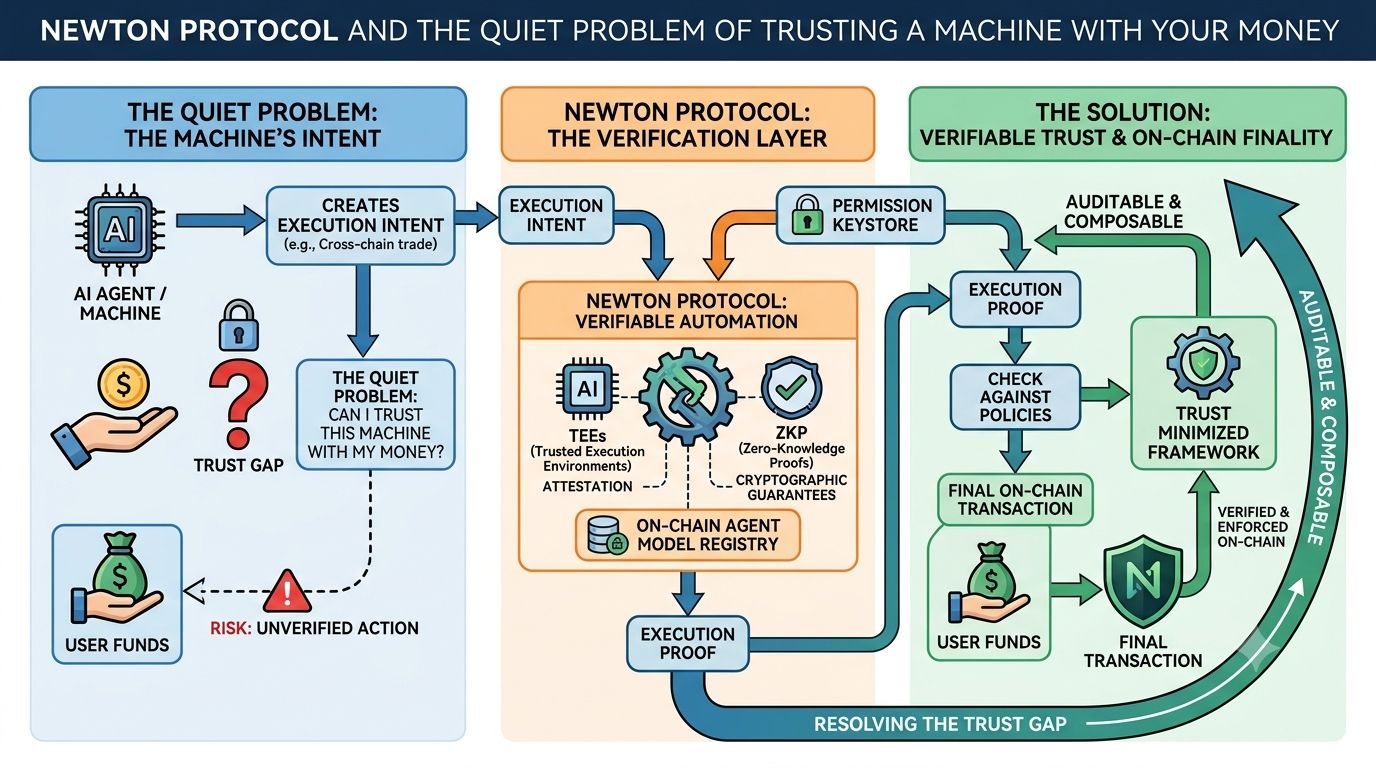
But dig past the pitch deck language and there's a specific thing going on. Newton wants you to hand off financial decisions to software without handing over custody of your money. And without trusting that the software is doing what it claims to be doing. That's the real hurdle. Anyone can build a bot that trades for you. The hard part is proving, to a total stranger, that the bot only did what you told it to do. Nothing more.
Newton's answer is a mix of trusted execution environments and zero-knowledge proofs. Sounds like jargon soup, I know. Break it down, though, and it's not that complicated. A TEE is basically a locked room. Computation happens inside it that nobody — not even the operator running the hardware — can peek into or mess with. The zk-proof is the receipt that comes out of that room. A mathematical guarantee that whatever happened inside followed the rules, without ever revealing the private details of how. Builders write policies using onchain and offchain data to decide if a transaction gets approved or blocked. A decentralized network of operators, backed by Ethereum restaking and NEWT itself, runs those checks inside the enclave and spits out a proof. Anyone can verify it later through what they call the Newton Explorer. Nobody has to take their word for it.
Here's the thing I keep coming back to, though. This isn't just an AI trading platform. It's closer to a compliance engine that happens to run AI agents on top. Once you see it that way, the rest of the design starts to click.
And honestly? That might be the more interesting story here. Not the trading angle everyone leads with. The pitch is that Newton bakes compliance directly into the transaction itself. Same way smart contracts made execution programmable. Same way oracles made outside data usable onchain. Compliance-as-code. Sounds dry until you think about who actually needs it. Stablecoin issuers. Real-world-asset platforms. Institutions that want AI touching their money but are terrified of what regulators will say about it. That's a real gap. It's been sitting there this whole time while everyone else chased faster DEXs and flashier speculative tokens. Is Newton the team that fills it? I don't know. Nobody does yet. But the shape of the problem is dead right. And builders can write these policies in a language like Rego instead of some made-up syntax nobody wants to learn — small detail, but the kind of small detail that decides whether developers actually show up.
Under the hood, three pieces matter. The Model Registry — an onchain catalog where developers publish agent strategies, the "if this drops ten percent, do this" kind of logic. The Keystore — a dedicated rollup managing permissions, letting you set spending limits and timing windows instead of handing a bot blanket access to everything you own. And smart accounts, built on the ERC-4337 standard, which let you delegate narrow slices of wallet control without ever giving up your private keys. Put it together and the idea is simple: you never hand an agent the keys to the whole house. You give it a fenced-in permission. And that fence is enforced by math, not by some company's promise buried in a terms-of-service page nobody reads.
The roadmap still has two big pieces ahead of it, not behind it. There's the Verifiable Automation Marketplace — an onchain spot where developers publish agents and users discover, mix, and activate them for things like staking or treasury management or trading. That's the piece that turns Newton from plumbing into something people actually browse and use, like an app store. And there's the expansion of the Keystore into a full multichain zkPermissions rollup, so these permissions aren't stuck on one chain. Both are still "coming soon," not shipped. And that distinction matters a lot. A rollup on a roadmap slide is a very different animal than a rollup processing real transactions at real volume.
I want to be careful not to get swept up in the architecture, because good architecture doesn't guarantee anyone shows up to use it. And adoption is the whole ballgame here. A rollup can be elegant and still sit empty. A permissions system can be airtight and still go nowhere because the SDK is annoying to integrate, or the incentives aren't there yet, or some competitor ships a scrappier version first. The way I see it, adoption speed is the real risk with this project — and that comes down to developer interest and how painless the tooling actually is. That's not a knock on Newton specifically. That's true of basically every piece of infrastructure ever built, long before crypto existed. The tech can be right and still lose. To timing. To a rival with better onboarding. Or just to the fact that most builders will go wherever the friction is lowest, every single time.
Now, the token. NEWT does the usual multi-job that these layer-two tokens tend to do. It's the gas paid to issue, update, or revoke permissions and session keys. It's the staking collateral securing the Keystore rollup, running on a delegated proof-of-stake model with a fourteen-day unstaking window. It carries governance weight once that layer goes fully live. And it's the collateral operators post when running agents — so if a strategy misbehaves, there's something real on the line to slash. Total supply is capped at one billion tokens. Sixty percent goes toward community allocations — staking rewards, grants, that kind of thing. The rest is split between core contributors and early backers, vesting out over three to four years depending on the bucket. Nothing radical there. But the unlock calendar is worth watching closely if you're the type who tracks this stuff, because there's a meaningful unlock event analysts have flagged, and if demand doesn't keep pace with the fresh supply hitting the market, that's real sell pressure. I'm not giving investment advice here — I can't, and this isn't the place for it — but that detail matters more than most of the roadmap talk, because unlock schedules are usually what actually moves price in the short term, regardless of how the tech is progressing underneath.
What really sticks with me, though, is the line the team's been using lately. Crypto built a glass house — everything transparent, everything sitting on a public ledger for anyone to see — but nobody built the locks to go with all that glass. Newton's positioning itself as the team building those locks. Long-term narrative, security and compliance as the missing layer for AI and real-world assets onchain. It's a good line. The kind that sticks with you after you close the tab. But look — a good narrative and a good product are two completely different animals. And this industry's graveyard is full of projects with great narratives that never closed the gap to something people actually used at scale.
Then there's price, which I almost don't want to touch because it swallows every other conversation the second it comes up. But ignoring it would be dishonest. The mood around NEWT right now is a weird mix — quiet confidence in the tech, paired with a wary eye on some genuinely violent post-airdrop price swings. People in the community are flagging real risk after past parabolic runs and overbought conditions. That tension — belief in the roadmap next to distrust of the chart — is basically the emotional weather pattern of every serious infrastructure token in year one. People believe the story and don't trust the candles, sometimes in the same breath. And honestly, I don't think that's irrational. It's just an accurate read of where things stand. The roadmap's unproven. The chart's unforgiving. Both can be true at once.
There's a regulatory thread here too, one that gets way less attention than the technical side but might matter just as much down the line. Newton's agents currently sit under the EU's MiCA framework, classified as an "other crypto-asset." That gives it solid footing in at least one major jurisdiction. Meanwhile, proposed U.S. rules around autonomous financial tools are still up in the air, and however that shakes out could seriously shape — or restrict — how something like this operates across borders. Sounds boring next to talk of zero-knowledge proofs and AI agents, I know. But it might be one of the more consequential variables in play. A compliance-focused protocol with shaky regulatory footing of its own would be a pretty ironic outcome. Worth watching closely over the next year, not assuming it's settled.
So where does that leave things? I keep landing in the same place. Newton's tackling a real problem that's genuinely under-addressed — verifiable delegation, agents acting on your behalf without you blindly trusting either the agent or the company behind it. And the compliance angle might end up being the more durable value here, even though the trading-bot pitch is what gets the headlines and the exchange listings and the leveraged perpetual contracts. Does the execution catch up to the ambition? Genuinely don't know. I'd be lying if I said otherwise. Infrastructure plays like this live or die on adoption curves measured in years, not months, and the loudest voices in a market like this are rarely the most patient ones. Maybe that's fine. Maybe patience isn't even the right lens for any of this. But if you're trying to figure out what actually matters here, watch the developer activity on the Model Registry. Watch how fast validators actually decentralize. That'll tell you more than the token chart ever will — because one of those things tells you whether this is actually getting built, and the other just tells you how people feel about it this particular week. Those aren't the same question. Even if this industry loves pretending they are.
@NewtonProtocol #Newt $NEWT #newt
