

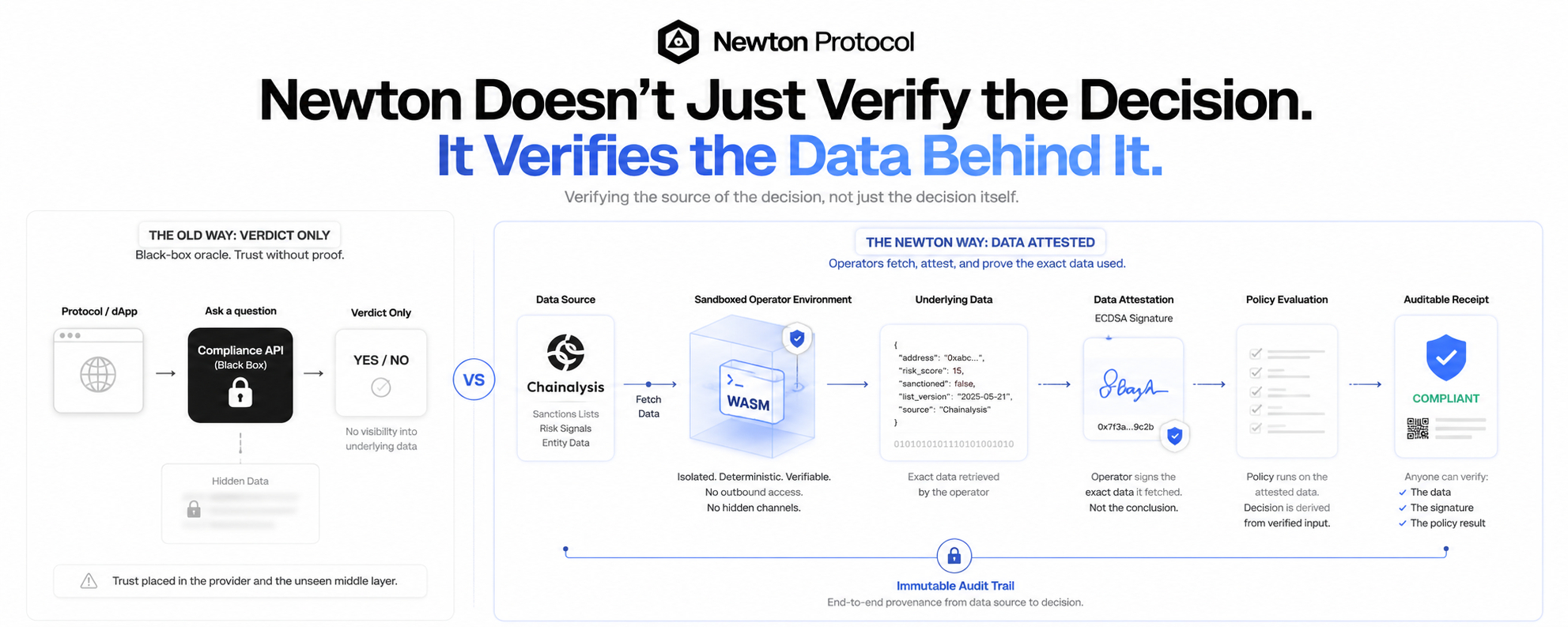


i went looking for how Newton Protocol actually uses Chainalysis, expecting a normal oracle relationship. ask a question, get an answer, treat the answer as truth.
that is how most compliance integrations in crypto work. a protocol calls an API. the API returns yes or no. the protocol accepts it and moves on. nobody downstream can check what the API actually returned, only what someone claims it returned.
Newton does not build its Chainalysis integration that way.
inside Newton, a data provider like Chainalysis runs as a sandboxed component that an operator executes directly. the operator does not just receive a verdict. it fetches the underlying data itself, then signs an attestation over that specific data. an ECDSA signature tied to what was actually pulled, not just the conclusion drawn from it.
that is a small sounding detail. it is not a small distinction.
think about what a sanctions check is normally supposed to protect against. someone worries an API might be wrong, or stale, or quietly misreported. the usual answer to that worry is "trust the provider." Chainalysis is well regarded, so the industry accepts its outputs without asking to see the basis for them.
NEWT as protocol is changes what gets recorded. it is no longer just "Chainalysis said clear." it becomes "the operator fetched this specific data from Chainalysis, signed it, and the policy evaluated that exact data."
if someone later wants to check the transaction, they are not just trusting that a check happened. they can trace back to the specific data an operator committed to, and confirm the policy result actually matches what was fetched, rather than trusting a summary someone wrote down afterward.
this is where i keep going back and forth.
Chainalysis itself is still centralized. its sanctions list is still one source. Newton attesting to the data an operator received does not mean Newton is vouching for whether Chainalysis's list was correct that day. it means Newton is vouching for whether what Chainalysis returned at that moment is exactly what the policy used. nothing added, nothing dropped, nothing quietly interpreted differently by different operators.
so the trust in Chainalysis has not gone away. what changed is the trust in everything sitting between Chainalysis and the final decision.
before, that middle layer was invisible. an operator could summarize or simplify what a data source said, and nobody downstream would know. now that middle layer produces its own signed record. if an operator's attestation does not match what Chainalysis actually returned, that mismatch becomes provable.
i think this is a narrower claim than it first sounds, and the narrowness is the point. Newton is not promising that every external source it plugs into is accurate. it is promising that whatever an operator used to reach a decision is exactly what it says it used.
for a compliance receipt regulators eventually look at, that is not cosmetic. a receipt that only proves "the check passed" tells an auditor almost nothing if someone disputes it later. a receipt that proves "this exact data was used, signed by this operator" gives them something to actually verify against the original source.
the sanctions check still depends on Chainalysis being right. Newton was never going to fix that part.
what it changed is whether anyone can catch the operator being wrong about what Chainalysis said.
