

A little while ago, I found myself asking a simple question: what is actually the best way to examine a system? Every system can be viewed from many different angles, but how do we identify the one angle that reveals the most about how it will behave under real conditions?
The more I thought about it, the more I realized that understanding a system is often less about reading its features and more about identifying the point where small assumptions can create large consequences.
That idea stayed in my mind while reading Newton Protocol's mainnet Beta architecture.When I first looked through Newton Protocol's mainnet Beta design, I didn't spend much time asking whether the authorization policy itself was strict enough.
That part is relatively easy to understand because policies can always be updated, tightened, or expanded.
The question that stayed with me was different: when a policy depends on outside information, how much confidence should we place in the path that brings that information into the system?I remember reviewing a digital asset strategy where almost everything looked technically sound. The smart contracts were well organized, the execution logic made sense, and the risk model appeared carefully designed.
Yet one detail kept bothering me. Instead of relying entirely on established data providers, part of the decision process depended on a privately maintained data connector. It wasn't obviously insecure, but I kept wondering what would happen if the connector quietly produced inaccurate information without anyone realizing it.
A system can execute every instruction perfectly while still reaching the wrong conclusion if the information entering the system is already flawed.
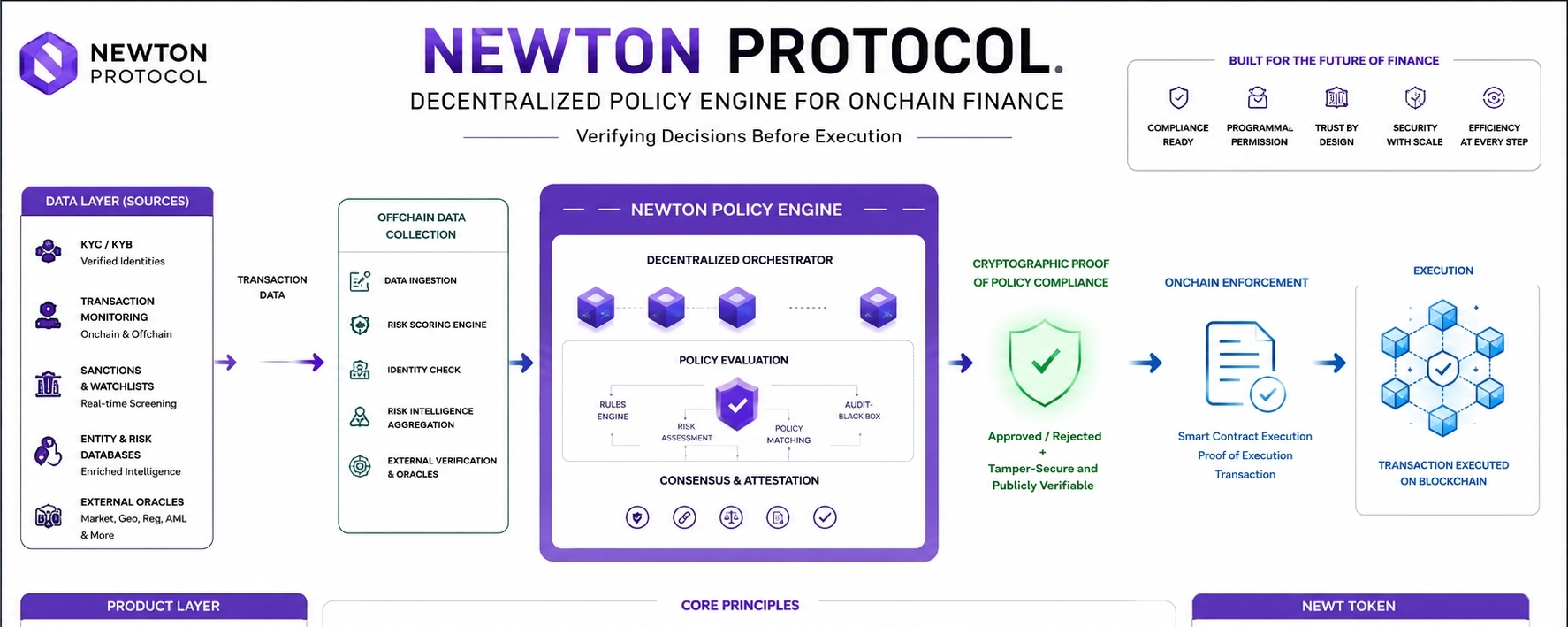
That experience shaped how I read Newton's architecture.Most discussions focus on the three major stages of the authorization flow: user intent, policy evaluation, and distributed consensus.
On paper, the separation is sensible.
One participant does not make the final decision alone.
Multiple Operators independently evaluate the same request before a signature is produced. Combined with economic staking and cryptographic verification, this creates several layers designed to reduce blind trust.
But each of those words—evaluation, consensus, verification, infrastructure—actually represents an entire ecosystem rather than a single feature.Take evaluation, for example.
Evaluation is not simply reading a price feed. It may include market prices, historical volatility, wallet reputation, sanctions screening, liquidity conditions, vault health, risk ratings, timing information, and many other external signals.
Every one of these inputs follows its own collection process, update schedule, validation rules, and failure conditions. If just one of those pieces behaves differently than expected, the final evaluation may still complete successfully while quietly drifting away from reality.The same applies to infrastructure. Infrastructure is far more than servers running software.
It includes communication between Operators, execution environments, data synchronization, monitoring systems, logging, recovery mechanisms, security boundaries, software updates, and operational procedures.
When people say an infrastructure is secure, are they referring only to code security, or are they also including the quality of operational decisions made every day?Newton's documentation explains that developers can introduce custom data connectors whenever built-in providers cannot satisfy a particular use case.
From a flexibility standpoint, that makes complete sense. Every ecosystem eventually encounters assets or datasets that existing providers do not support.
However, flexibility introduces another layer of responsibility.Sandboxing protects the execution environment by preventing custom modules from accessing resources they shouldn't.
But sandbox isolation is different from validating whether the information being collected is logically correct. If timestamps are inconsistent, fallback sources activate incorrectly, or calculation methods contain subtle assumptions, the module may execute flawlessly while still producing misleading inputs.
The authorization system would then faithfully process incorrect information without technically malfunctioning.This raises another question that I haven't found fully answered.
If every Operator executes the same custom WASM connector independently, how is deterministic behavior guaranteed across different environments?
Are runtime differences completely eliminated? If two Operators receive identical requests but slightly different outputs because of implementation details, what happens to consensus?
More importantly, who reviews these third-party connectors before institutions begin relying on them? Is the review limited to security vulnerabilities, or does it also examine data methodology, operational assumptions, maintenance practices, and accountability after deployment?I also find myself thinking beyond today's supported chains.
As Newton expands into additional ecosystems, will every chain maintain identical levels of data quality, Operator participation, and service-provider coverage? Or will authorization confidence naturally differ depending on where the transaction originates? If so, institutions may eventually evaluate not only Newton itself, but also the maturity of each individual deployment.
None of these questions suggest that the overall direction is wrong. In fact, I think Newton has built a thoughtful framework that addresses several long-standing weaknesses in on-chain authorization.
But strong frameworks are often tested at their boundaries rather than at their center. Sometimes the biggest risks are not hidden inside the architecture itself—they appear where new components, external data, and human responsibility connect to an otherwise reliable system.
That is why my attention remains on the data layer. Technology can verify execution, cryptography can verify signatures, and economic incentives can discourage malicious behavior.
Yet if uncertainty still exists around who validates custom connectors, how deeply they are reviewed, and who accepts responsibility when data quality fails, then perhaps those are the questions worth answering before the next stage of institutional adoption begins.
This is simply the angle that made the most sense to me while thinking through the system. But I'm genuinely curious whether this is the right lens to evaluate a design like this, or whether there's an even more important perspective that deserves attention.I'd really like to hear your thoughts.
Do you think this is the best way to analyze a system like Newton Protocol, or would you approach it from a completely different angle? Share your perspective in the comments.