


Was refreshing a DEX aggregator earlier just to see if slippage improved on a swap I'd been putting off, and got distracted reading a thread arguing about which "AI crypto" projects have "real utility." Everyone was throwing around usage charts like they settled the argument. Closed that tab too, honestly.
So out of curiosity I went and pulled up Newton Protocol's on-chain activity myself, just to see what "utility" actually looks like in raw numbers rather than in someone's Twitter chart.
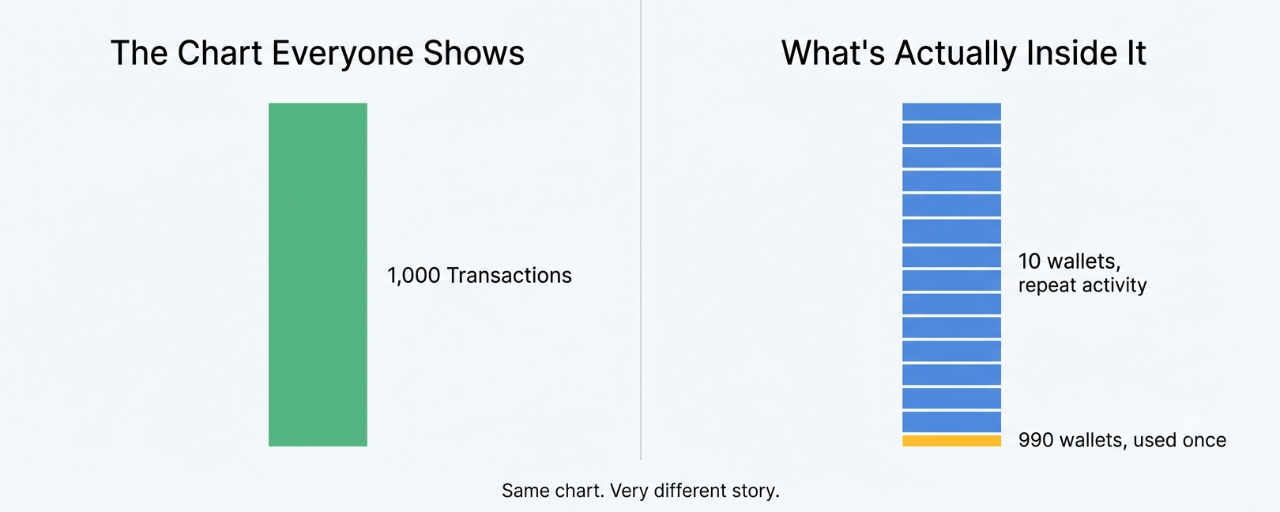
And something clicked that I didn't expect — the transaction count looks healthy, genuinely. But when I started poking at which addresses were generating that volume, it's a much smaller set of wallets than the headline number suggests. Not fake, not empty, just... concentrated. A handful of addresses doing a lot of repeat activity, and a much longer tail of addresses that touched the protocol once and never came back.
What people assume when they say "utility will decide the winner" is that utility equals transaction volume, full stop — more activity means more real-world use, means more staying power. What actually seems to be happening is that a chunk of that volume is a small group of wallets — possibly bots, possibly power users, possibly the team's own testing infrastructure, genuinely can't tell from outside — cycling transactions repeatedly, which inflates the "usage" number without necessarily reflecting broad organic adoption. Ten wallets doing a thousand transactions each looks identical in a bar chart to a thousand wallets doing ten each. But they're not the same thing at all.
I'm not fully convinced this is unique to Newton, to be clear — this is basically true of most early-stage chains and protocols right now. But here's the part that bothers me: if "utility" is the metric everyone's using to pick winners, and utility is currently indistinguishable between "broad genuine demand" and "concentrated repeat usage from a small group," then the entire framework people are using to rank these projects might be measuring the wrong thing. Or at least measuring something that looks like the right thing without actually being it.
I thought maybe unique wallet growth would clear this up — like if new addresses are climbing steadily, that's a decent proxy for broad adoption regardless of what the top wallets are doing. But actually, checking that specifically, new unique addresses are growing, just at a noticeably slower rate than raw transaction count. So the picture isn't "fake growth," it's more like growth happening on two different tracks at two different speeds, and only one of them gets shown in the headline stat.
This matters for anyone trying to actually rank "AI crypto" projects by utility rather than by narrative, because if the standard metric can't tell the difference between a protocol with real distributed demand and one with a smaller group of heavy users, then most comparisons being made right now — Newton against its peers, this generation of projects against each other — are probably less meaningful than they look. It's not that utility doesn't matter. It's that "utility" as currently measured might not be measuring utility.
Who this actually affects: anyone allocating capital based on usage-chart comparisons across AI-crypto projects, assuming those charts are apples to apples. They might not be, project to project, depending on how concentrated the underlying wallet activity is.
When would this stop mattering? Probably once someone builds a decent way to separate "unique meaningful usage" from "repeat usage by a small set of addresses" as a public, comparable metric. I haven't seen that done well yet, for Newton or really for anyone in this space. Might already exist somewhere and I just haven't found it.
@NewtonProtocol #Newt $NEWT